 XI Wiki

Ok new question popped up.
What is the maximum number of the complex solutions to x^17-573x^9+54x^8-167x+2=0?
Answer: seventeen. only time there may be fewer than 17 complex roots is if some of the roots have a multiplicity greater than one (like double roots, tripl roots, etc.).
Can someone explain this?
- Navigation
Results 21 to 40 of 40
Thread: HALP me learn pre-calculus~


-
2013-01-23 13:29 #21You wouldn't know that though because you've demonstrably never picked up a book nor educated yourself on the matter. Let me guess, overweight housewife?

- Join Date
- Mar 2006
- Posts
- 22,829
- BG Level
- 10
- FFXIV Character
- Allyra Arianos
- FFXIV Server
- Sargatanas
- WoW Realm
- Windrunner

-
2013-01-23 13:39 #22Pied Piper of the Homos
- Join Date
- Feb 2009
- Posts
- 7,303
- BG Level
- 8
- FFXI Server
- Lakshmi

Isn't your husband Asian? Or you could just ask your daughter, sure she could figure this out by now.
www.wolframalpha.com
-
2013-01-23 14:09 #23Old Merits
- Join Date
- Jun 2008
- Posts
- 1,192
- BG Level
- 6
- FFXI Server
- Odin
 Unless I'm terrible, the answer is 17 because it's the largest exponent. It could be fewer if a root is used more than once such as: x^3 - 3x + 2. Before working it out, you know there will be a max of 3 solutions. But after factoring you find it is = (x-1)(x-1)(x+2). So you have 1 and -2 as solutions because the 1 is used twice.
 Originally Posted by Ksandra

Since I am terrible - does real / complex change any of the ideas above?
-
2013-01-23 14:21 #24RIDE ARMOR
- Join Date
- Jan 2010
- Posts
- 10
- BG Level
- 1
- FFXI Server
- Ramuh

The question is asking you to remember the fundamental theorem of algebra.
You don't need to know the coefficients of the polynomial, just it's degree. Complex numbers is a/the splitting field for polynomials with real coefficients; any such polynomial factors into linear terms, like in Chirus' example, when you are allowed to use complex numbers.
-
2013-01-23 14:34 #25You wouldn't know that though because you've demonstrably never picked up a book nor educated yourself on the matter. Let me guess, overweight housewife?
- Join Date
- Mar 2006
- Posts
- 22,829
- BG Level
- 10
- FFXIV Character
- Allyra Arianos
- FFXIV Server
- Sargatanas
- WoW Realm
- Windrunner
haha ya, and he also was a math major before switching to animation. But 1. that was over ten years ago (we're both old) 2. he's on crunchtime at work for summer films and is working 12-14 hour days 6 days a week, so last thing I want to do is pester him with this stuff. Originally Posted by Milkster
@ the website link: doesn't answer the particular question but it looks like it'll be useful for others, so thanks!
Originally Posted by Chrius
makes sense, thanks for breaking it down for me! Originally Posted by Wesleydimble
-
2013-01-23 19:00 #26You wouldn't know that though because you've demonstrably never picked up a book nor educated yourself on the matter. Let me guess, overweight housewife?
- Join Date
- Mar 2006
- Posts
- 22,829
- BG Level
- 10
- FFXIV Character
- Allyra Arianos
- FFXIV Server
- Sargatanas
- WoW Realm
- Windrunner
aight next question.
learning about the multiplicative inverse of complex numbers. They ask to do so for 3-2i and solve it this way:
1/3-2i * 3+2i/3+2i = 3+2i/9-4i^2 = 3+2i/9+4=3/13+2/13i
Now I understand everything about complex numbers and the whole a+bi thing, but I'm stuck on why they cancelled out the i^2 in step 3. Can imaginary numbers not be squared or something?
-
2013-01-23 19:12 #27RIDE ARMOR
- Join Date
- Jan 2010
- Posts
- 10
- BG Level
- 1
- FFXI Server
- Ramuh
That's a little hard to read without brackets, but if it's just an i^2 thing tripping you up then it's time to take a coffee break.

-
2013-01-23 19:22 #28You wouldn't know that though because you've demonstrably never picked up a book nor educated yourself on the matter. Let me guess, overweight housewife?
- Join Date
- Mar 2006
- Posts
- 22,829
- BG Level
- 10
- FFXIV Character
- Allyra Arianos
- FFXIV Server
- Sargatanas
- WoW Realm
- Windrunner
probably, just found what I was looking for. Hadn't come across the whole i = √-1 thing -.-; /sigh
-
2013-01-23 19:26 #29Sea Torques
- Join Date
- Jul 2010
- Posts
- 544
- BG Level
- 5
- FFXI Server
- Ifrit
i^2 = -1
-
2013-02-07 20:10 #30You wouldn't know that though because you've demonstrably never picked up a book nor educated yourself on the matter. Let me guess, overweight housewife?
- Join Date
- Mar 2006
- Posts
- 22,829
- BG Level
- 10
- FFXIV Character
- Allyra Arianos
- FFXIV Server
- Sargatanas
- WoW Realm
- Windrunner
bump!
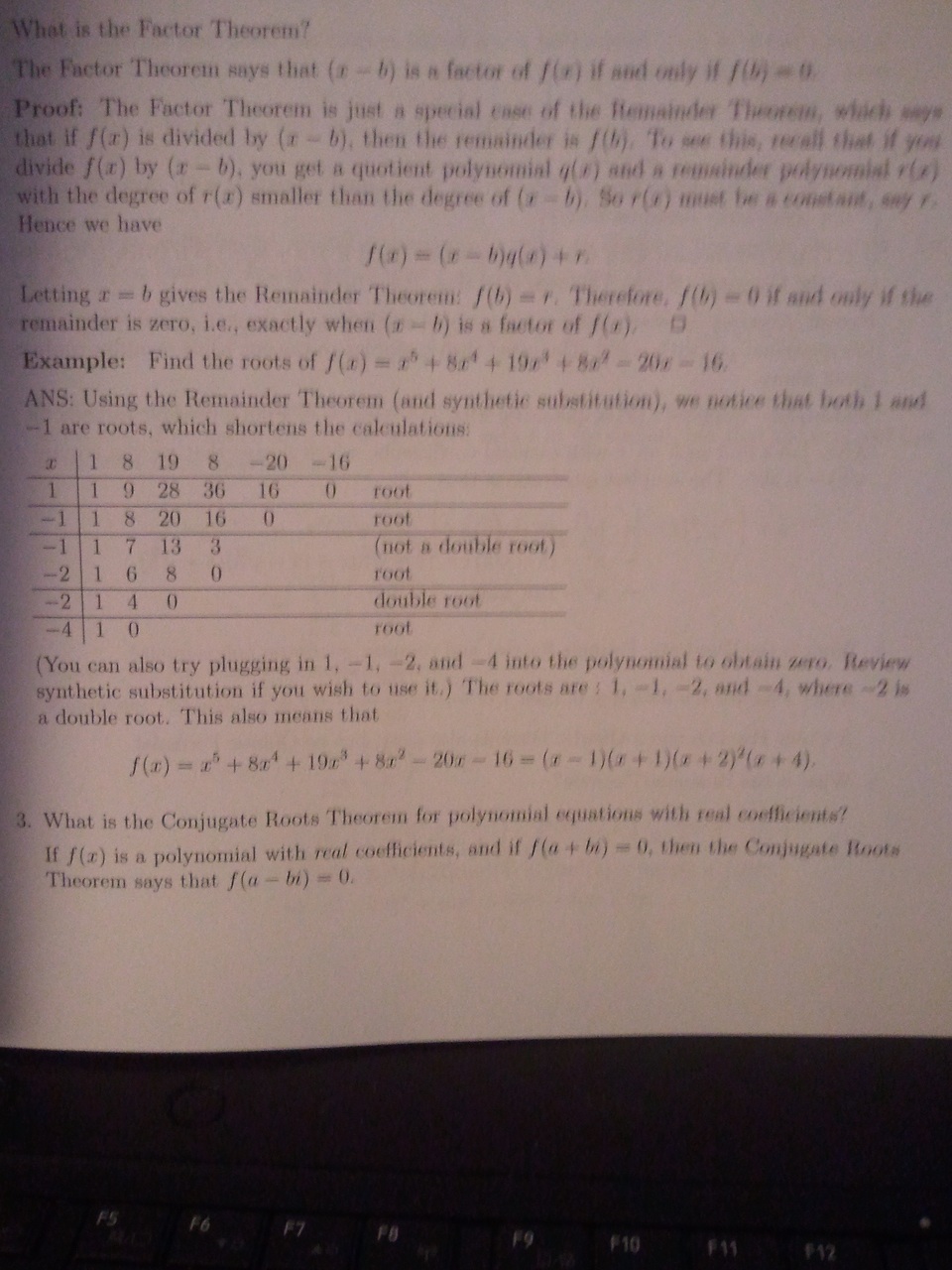
Came across this in my book and can't seem to find any guides on how it generated the chart, or make sense of the whole factor/remainder theorems. I kinda get how you want to hit zeros, because of the factor theorem but I'm at a lost on how they're getting these numbers. Also the whole "double root" thing. (sorry for fuzzy pic)
-
2013-02-07 20:28 #31Black Guy from Predator.
Uppity Negro
Secret Admin
The Immortal Bill Duke
- Join Date
- May 2008
- Posts
- 15,667
- BG Level
- 9
get a better copier/scanner/camera
-
2013-02-07 20:28 #32You wouldn't know that though because you've demonstrably never picked up a book nor educated yourself on the matter. Let me guess, overweight housewife?
- Join Date
- Mar 2006
- Posts
- 22,829
- BG Level
- 10
- FFXIV Character
- Allyra Arianos
- FFXIV Server
- Sargatanas
- WoW Realm
- Windrunner
It was my phone, I'm not home atm so don't have a printer nearby.

-
2013-02-07 20:55 #33Sea Torques
- Join Date
- Jul 2010
- Posts
- 544
- BG Level
- 5
- FFXI Server
- Ifrit
f(x)=x^5+8x^4+19x^3+8x^-20x-16
(x-b) where x is the coefficient of the largest exponent, and b is the y intercept.
So in the above equation the coefficient of the largest exponent is 1, and the y intercept (b) is -16.
To find the potential list of factors, let f be a polynomial function of a degree 1 or higher, where each coefficient is an integer. If P/Q (think of it as B/X) in the lowest terms is a rational zero of f, then p must be a factor.
Ex:2x^3 + 11x^2 - 7x - 6
P: -6 the possible factors of -6 are (+- 1, +-2, +-3, +-6)
Q: 2 the possible factors of 2 are (+- 1, +-2)
P/Q leaves you with (+- 1, +- 2, +- 3, +- 6, +- 1/2, +- 3/2) as the possible zeroes
To factor choose a # from the set of possible zeroes, i am going to choose 1.
f(1)= 2(1)^3 + 11(1)^2 -7(1) - 6
which turns into
2+11-7-6= 0
That means that (X-1) is a factor of 2x^3 + 11x^2 - 7x - 6
Since (X-1) is a factor we can use synthetic division to factor the rest of it, which would leave you with (x-1)(2x^2 +13x +6), then you factor 2x^2 + 13x + 6, which leaves you with (x-1)(2x+1)(x+6) which is 2x^3 + 11x^2 - 7x - 6 in factored form.
I wrote all of this from my iphone so it could have possibly confused you even more. In the event that it confused you more you should light the sath or woozie signal.
-
2013-02-07 21:01 #34Black Guy from Predator.
Uppity Negro
Secret Admin
The Immortal Bill Duke
- Join Date
- May 2008
- Posts
- 15,667
- BG Level
- 9
sath wont answer her, rofl, but maybe woozie. i'll check
-
2013-02-07 22:17 #35Relic Weapons
- Join Date
- Oct 2006
- Posts
- 335
- BG Level
- 4
The chart in the image is synthetic substitution. The goal, as mentioned earlier, is to test the potential roots against the coefficients to get a remainder of 0. If you get a non-zero remainder, you know the value you are testing is not a root.
For f(x) = x^5 + 8x^4 + 19x^3 + 8x^2 - 20x -16
You start off with the list of possible roots to try (1, -1, 2, -2, 4, -4) and the coefficients of the original polynomial (1, 8, 19, 8, -20, -16).
"x" is the value of the root you will be testing, and the example is testing x=1 first:
x | 1 8 19 8 -20 -16
Drop down the first coefficient:
x | 1 8 19 8 -20 -16
-------------------------
1 | 1
Then, multiply that value with the potential root (1 * 1 = 1), add it to the next coefficient (8), and write down the sum (1+8=9):
x | 1 8 19 8 -20 -16
-------------------------
1 | 1 9
Repeat until you have reached the last coefficient and you will have calculated the remainder:
x | 1 8 19 8 -20 -16
-------------------------
1 | 1 9 28 (1 * 9 + 19 = 28)
1 | 1 9 28 36 (1 * 28 + 8 = 36)
1 | 1 9 28 36 16 (1 * 36 + -20 = 16)
1 | 1 9 28 36 16 0 (1 * 16 + -16 = 0)
Because your remainder is 0, you know that 1 is a root and thus (x-1) is a factor of the original polynomial, x^5 + 8x^4 + 19x^3 + 8x^2 - 20x -16. The values on the final line actually give you the coefficients of the dividend, so you know that x^5 + 8x^4 + 19x^3 + 8x^2 - 20x -16 = (x-1)(x^4 + 9x^3 + 28x^2 + 36x + 16).
The chart in the image condenses all of this into a single line, and you continue testing potential roots against the coefficients of the dividend (NOT the coefficients of the original polynomial or the calculated coefficients of a root you determine to be a non-factor). Again, a non-zero remainder means that the potential root being tested is not a root. A potential root that you are able to test twice and results in a zero remainder means that it's a double root; in the example x=-2 factors completely (with a zero remainder) and thus (x+2) shows up twice--as (x+2)^2--in the list of factors of the original polynomial.
-
2013-02-07 22:54 #36You wouldn't know that though because you've demonstrably never picked up a book nor educated yourself on the matter. Let me guess, overweight housewife?
- Join Date
- Mar 2006
- Posts
- 22,829
- BG Level
- 10
- FFXIV Character
- Allyra Arianos
- FFXIV Server
- Sargatanas
- WoW Realm
- Windrunner
Thank you guys, you definitely have been a big help!
I'm so sorry, I know I am over my head with most of this stuff, but
why is 8 and 16 not on the list? Originally Posted by Teorem
I thought that you needed to do the Rational Root Theorem to find all possible roots which would put all the factors of 16 over 1 which = 1, -1, 2, -2, 4, -4, 8, -8, 16, -16
What am I missing? :/
(edit: on a semi-positive note, I took a random practice test online for shits n' giggles to see if I should even bother to keep trying. I only got a 11/30 which is terrible BUT I haven't gone through all the study guide material yet. Out of the questions that Ive gotten knowledge of through the study guide I only missed two. So ya, you guys really are helping. )
)
-
2013-02-08 00:01 #37Relic Weapons
- Join Date
- Oct 2006
- Posts
- 335
- BG Level
- 4
I could say that I was testing your understanding of the Rational Root Theorem to see if you'd catch the omission, but the reality is that I was wrong to omit the factors and that you're right as they (+/-8, +/-16) should have been included in the potential roots to test. You don't appear to be missing anything, though you may want to work out a few synthetic substitution exercises to make sure you've got the table notation down. Originally Posted by Ksandra
-
2013-02-08 00:19 #38You wouldn't know that though because you've demonstrably never picked up a book nor educated yourself on the matter. Let me guess, overweight housewife?
- Join Date
- Mar 2006
- Posts
- 22,829
- BG Level
- 10
- FFXIV Character
- Allyra Arianos
- FFXIV Server
- Sargatanas
- WoW Realm
- Windrunner
That makes me feel a bit better ^^; Though the book also skips those numbers. As well, it skips +2. So is there like a method you should do or should you keep trying numbers until you get X amount of roots? As well, should you always start with the smallest values and work your way up? Originally Posted by Teorem
And ya I started looking up synthetic substitution once you mentioned it. Only problem is, all the examples I've found to guide you through it already give you a value for x instead of making you try and find all the roots.
-
2013-02-08 00:24 #39Nidhogg
- Join Date
- Oct 2006
- Posts
- 3,665
- BG Level
- 7
omg where is Aurik
-
2013-02-08 04:15 #40Relic Weapons
- Join Date
- Oct 2006
- Posts
- 335
- BG Level
- 4
It's really just guess-and-test, and smaller numbers are faster to multiply initially so you tend to begin with them. The synthetic substitution method is supposed to be faster than regular substitution, the latter of which is what Dizzy's illustrated earlier (evaluating the value of the original polynomial to see whether the result was zero). Originally Posted by Ksandra
Just keep in mind that you should reevaluate a root even after it successfully divides (presuming you have degrees left in your dividend) to make sure it's not a multiple (double, triple, etc.) root.


Similar Threads
-
Halp me BG! (Finding a Poster)
By Palin in forum General DiscussionReplies: 4Last Post: 2009-10-31, 03:28 -
So BG, halp me with gov homework?
By The_OG_Nelta in forum General DiscussionReplies: 12Last Post: 2008-11-19, 01:16 -
halp me
By Remyo in forum General DiscussionReplies: 9Last Post: 2007-06-12, 19:31 -
Halp Me (PS3 problems) :(
By Chreman in forum General DiscussionReplies: 11Last Post: 2007-04-29, 14:11