

Start reading reviews of the original Spelunky and you will start to see the same word repeated: perfection. There are many who regard Spelunky, released in 2008 (and later updated to HD in 2012), as a perfect game. Players controlled Guy Spelunky (or one of a handful of unlockable characters), a cave explorer armed with a whip, a handful of bombs, and some ropes as he explored randomly generated cave systems. While players could reach the “final” level with some practice, the game held a bevy of mysteries, some which required pulling off truly obscure and daunting feats. Spelunky was a quintessential 2-D platforming rouge-like; players always started at the same point, dying would send them back to the start, and because each level was randomly generated, no two runs were the same. And while the game did not feature many upgrades or improvements that could be useful on subsequent runs, at its core, Spelunky was a game about learning and knowledge. Players needed to learn how each trap and enemy operated, and progressing deeper required learning more about new traps and enemies, and discovering how to overcome those obstacles.

Levels in Spelunky 2 follow roughly the same format, players start at the top and work their way down to the exit which leads to the next level. Along the way, there are gems and gold to collect, occasional shops to visit, hidden chambers, and a horde of dangerous adversaries and thematic traps to impede or extinguish your progress. If I had to give one description to define Spelunky 2 it would be that the game is brutally fair. The game lays out its rules clearly and then challenges players to achieve perfection (or as near as possible). Fall short, make a mistake, or choose poorly, and the game will punish you. Arrow traps will always fire if something is in front of them; cavemen will always spot you from the same distance and charge at the same speed; explosions will launch things and getting hit by an object with momentum will stun and hurt you. Mastery of Spelunky 2 comes down to learning how to anticipate and evade dangers while balancing the run-ending risks against potential rewards.
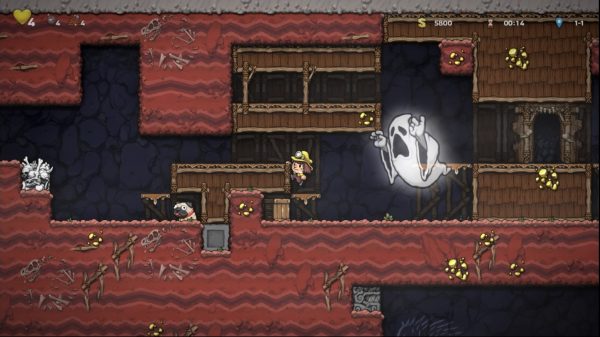
For the most part, every stage is comprised of four levels of increasing difficulty. The levels in a stage are designed around specific themes, and reaching a new stage requires learning about the latest dangers and finding ways to survive. For example, the first level is a cave system occupied by primitive cavemen with simplistic spikes and traps built into totems. The spikes in the Tide Pool are comprised of bright red coral and the ornate lion statues hide spike traps. Although there are some basic enemies that appear in nearly every stage, foes like bats and spider, most enemies also vary from stage to stage, with later levels introducing more durable and dangerous foes. The aforementioned cavemen are replaced by more challenging enemies like the impervious Pangxie or deadly Yetis the deeper into the caves your expedition progresses.
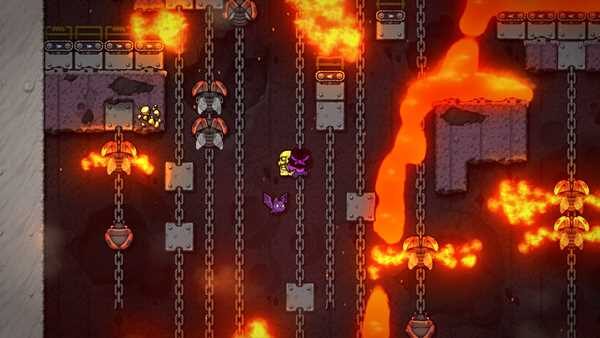
While Spelunky 2 is a great experience on its own, the game also allows players to team up with up to three friends for four player expeditions. While the original Spelunky offered couch co-op, Spelunky 2 also allows players to team up online. In co-op, only one player needs to reach the exit to pull all surviving players through to the next level. Additionally, if someone dies, they are not permanently dead for the remainder of that run, as a dead teammate can be revived on the next level by finding and cracking open a coffin. While this might make it sound like the Spelunky 2 experience is significantly easier with friends, the trade-off is that co-op expeditions cannot use shortcuts and must be completed from start to finish in a single run. Another trade-off comes with money and items. While players pool their money, making it easier to amass a surplus to spend in shops, the effects of items are not shared, and items on a player who dies are lost unless another teammate can collect them. As much fun as I have had with Spelunky 2, I have had more fun playing with friends, laughing over the untimely mistakes and the stupid ways we manage to die and end runs.
I usually try to beat a game before writing a review, and although I have seen the credits, I still have a long way to go before I can say I beat Spelunky 2. As players progress through Spelunky 2, they fill the game’s journal with entries on the enemies encountered, stages visited, and items uncovered. There are still a number of spots waiting to be filled in my journal, and like the original game, there are a wealth of mysteries to solve in Spelunky 2. These range from secret areas and chambers, to secret bosses, to rooms full of seemingly identical items with no use, to entire secret stages I have yet to uncover. I am sure I will eventually rely on the internet to discover which puzzles I am missing, but for now, I am loving the exploration and unknowns as I strive to improve. Can I say I have beaten Spelunky 2? Yes, but there is still so much more to do before I consider myself done with this game.


Digging tunnels. Day after day, that’s my job.
Comments
No comments yet.
Log in through the forum to comment.