 XI Wiki

Buy a Hershey bar sized gold brick. Take bitches out to dinner, pay by breaking a piece off.
- Navigation
Results 21 to 40 of 44
Thread: Investing and investments


-
2012-01-03 03:16 #21Ironing this Thread

Sweaty Dick Punching Enthusiast
- Join Date
- Feb 2006
- Posts
- 21,329
- BG Level
- 10
- FFXIV Character
- Boyiee Star
- FFXIV Server
- Gilgamesh
- WoW Realm
- Kel'Thuzad


-
2012-01-03 03:47 #22BG Medical's Student of Medicine
- Join Date
- Oct 2006
- Posts
- 34,661
- BG Level
- 10
Wisdom. Originally Posted by Boyiee

Looking to invest for long-term too. Anyone have any advice on how much I would need to get started? Currently building savings right now (have like, nothing).
-
2012-01-03 04:30 #23Ironing this Thread
Sweaty Dick Punching Enthusiast
- Join Date
- Feb 2006
- Posts
- 21,329
- BG Level
- 10
- FFXIV Character
- Boyiee Star
- FFXIV Server
- Gilgamesh
- WoW Realm
- Kel'Thuzad
As vague as it is, the more the better. A set number isn't realistic, but if you want real wisdom - it takes money to make money.
I had 20k to invest a couple years ago. Had no idea what to do with it, have a few friends on wall street, mainly in bonds and emerging markets. The best suggestions I got were gold and a home.
I eventually spent most of it.
-
2012-01-03 06:00 #24FOR FUCKS' SAKE !!!
FOR FUCKS' SAKE !!!
FUCK FUCK FUCK
- Join Date
- Mar 2010
- Posts
- 14,680
- BG Level
- 9
 This this this. Originally Posted by Elesirdur
I had $25k a couple years ago when I forayed into the market. I didn't do so bad, making an average $5k a year, but in the end, after all the constant reading and researching and sleepness nights worrying about it, I said fuck it.
Took everything I had, set up a tax free savings, RRSP and 5 GICs to ladder. One of my GIC is about to finish up and I'll be doubling it for it's next 5 year term (2.3% interest isn't too shabby doing nothing).
-
2012-01-03 10:39 #25Science Fiction Super Fan
- Join Date
- Jul 2006
- Posts
- 3,053
- BG Level
- 7
- FFXI Server
- Cerberus
gold and a home... although it might not be the best time to buy gold. wait till it drops back down to 700-1000 per/oz and buy it up. i own almost 50 1oz gold coins that i've been buying up over the last few years. it all started with one as a gift and i figured it was a good idea to keep it going
-
2012-01-03 18:54 #26Pens win! Pens Win!!! PENS WIN!!!!!
- Join Date
- Jun 2007
- Posts
- 454
- BG Level
- 4
- FFXI Server
- Carbuncle
Gold / Silver are the best options really. You can physically hold it in your hand and not have it be a number on a computer (Well, I suppose the worth is a number). The best thing about it is that, should you move to anywhere in the world, you can sell it. Everyone wants gold and silver, it has been the currency of the world for thousands of years.
It goes up and down like everything else does, typically because of dollar/euro strength and panic buying from stock market 'problems' (such as you saw in August of this year when gold hit $1900 /oz)
-
2012-01-03 20:27 #27Ridill
- Join Date
- May 2005
- Posts
- 13,568
- BG Level
- 9
Mass-buying gold is a terrible idea. Most sane advisers will tell you not to put more than a small portion of your portfolio (5%) in gold; since your capital amount is so small, I'd suggest not buying gold at all.
If you're looking to invest very long term (ie, 30+years so you can retire someday), the easiest way to invest smartly is to simply to buy an index-tracking fund and hold.
Edit: also, buying land not a terribly hot idea these days either. And in Canada you can't write off mortgage payments and can't simply walk away from an underwater mortgage, so yeah...not as attractive here.
-
2012-01-03 20:51 #28Banned.

- Join Date
- Jan 2009
- Posts
- 3,872
- BG Level
- 7
- FFXI Server
- Shiva
- WoW Realm
- Kil'jaeden
don't invest in anything
-
2012-01-03 21:37 #29Canada
- Join Date
- Oct 2006
- Posts
- 1,482
- BG Level
- 6
- FFXIV Character
- Mlle Skjie
- FFXIV Server
- Hyperion
- FFXI Server
- Sylph
- WoW Realm
- Madoran
TFSA since you'll use it in a few years to pay down debt. That said, keeping the Government Student loan and putting your money somewhere more long term can be a better idea in some cases.
-
2012-01-03 23:11 #30D. Ring
- Join Date
- Mar 2005
- Posts
- 4,661
- BG Level
- 7
Gold/silver is a horrible idea to invest in.
Tax Free is the way to go, try to not take out anymore debt.
I max out my RothIRA and my SimpleIRA, 401k, every year. Then have liquid funds on top of that with other savings on the side.
-
2012-01-04 07:17 #31E. Body
- Join Date
- Nov 2005
- Posts
- 2,010
- BG Level
- 7
Good timing, as i've mentioned in another post I started my new job. I work for a company now that has a software that creates a predictive forecast for the next 1-3 days and right now it's up to 86% accurate on its trend forecast. It's not cheap, but when you're talking about investing tens of thousands or more it's a very handy tool.
Hit me a PM if anyone wants to chat about it you can be my first sale
-
2012-01-04 11:42 #32Relic Horn
- Join Date
- Jul 2007
- Posts
- 3,411
- BG Level
- 7
- FFXI Server
- Asura
If you don't have 8+ hours a day to spend paying attention to markets, just do one of the following:
1) use it to cover living expenses until you get a job
2) pay off moderate-high interest rate debt
3) dump it in an index and forget about it
Whatever you do, do not take hot tips on X stock that's about to go through the roof or whatever, don't take advice from the TV or WSJ or other financial media, and don't get tied up with some broker running up commissions.
-
2012-01-09 00:05 #33Woodwork Football Fan
- Join Date
- Nov 2009
- Posts
- 140
- BG Level
- 3
- FFXI Server
- Carbuncle
I'm in a sort of similar situation to the OP, so instead of making a new thread I thought I'd use this one. I'm in need of some financial advice, as I think I know what to do, but want some input to make sure I'm making the right choice.
My situation: I graduated this spring, so I've already entered repayment on my loans (currently on forbearance, but I anticipate being able to make regular payments within a few months). I also have some money invested in mutual funds, and I'm trying to decide if I should pull the money out and put most of it towards paying my loans to cut down on the interest they'll be accruing.
Specific numbers:
Total loans: $20,181.93
*$5500.00 is at a 4.5% interest rate, meaning it accrues $247.50 interest annually
*$3500.00 is at a 5.6% interest rate, meaning it accrues $196.00 interest annually
*$11,054.19 (broken down into three loans of $6641.10, $2138.64, and $2274.45) is at a 6.8% interest rate, meaning it accrues $751.68 interest annually
Total interest: $1195.18 annually
Total money in mutual funds: $13,836.31
Profits needed to earn more than $1195.18 annually: 8.7%
It seems pretty unlikely that I'll earn nearly 9% profits annually, especially as I've actually lost money the entire time I've had them. If I pulled the money out, I could pay off the bulk of my loans at the 6.8% interest rate. However, I want to make sure there's not something I'm missing in my calculations.
Also, are there any penalties for pulling money out of a mutual fund? I tried looking it up but couldn't find anything specific, but I'd like to know as this would also factor into my decision.
Tell me what to do, BG Financial
-
2012-01-09 01:28 #34Renegade Philosopher
- Join Date
- Jul 2004
- Posts
- 4,439
- BG Level
- 7
Don't forget to take into account any taxes you would owe on your investments or deductions you could take on losses when deciding whether to keep them invested or take them out to pay your loans. Also take into account whatever fees are incurred by the mutual funds when figuring out how well the stocks would have to perform.
In general, unless you are an amazing stock guru, you're probably better off paying off the loans early. That being said, if you've had the money in the market for a while, perhaps it would be good to keep it there and pay down your loans with extra money from your income. The reason for that is that you've already taken a loss on your investment. If you pull that money out and then 6-12 months from now the market jumps up, you're going to be kicking yourself and it would be psychologically demoralizing. I would double check and make sure that the mutual funds you're invested in are worth sticking with, since lots of mutual funds actually underperform the market. If you keep your money in the market and decide you don't like sticking with your current mutual funds, an index fund with minimal fees would be a conservative bet to take.
The most important points are that you need to tailor your investments to the amount of risk you're willing to stomach, and stock investing will give you the best returns over a long enough period of time. If it's going to bother you if your current investments don't do much for a while, then you might decide it's worth it for the peace of mind to get that debt down. But if you don't *need* to take that money out, unless it's being managed poorly, taking it out would risk missing the next economic upturn.
-
2012-01-09 17:13 #35Ruke
- Join Date
- Nov 2005
- Posts
- 3,972
- BG Level
- 7
I tend to think of my student loans at an overall basis rather than year-to-year, which in the end gives a better picture of how your decision can affect you in the long-term. Originally Posted by Shakki
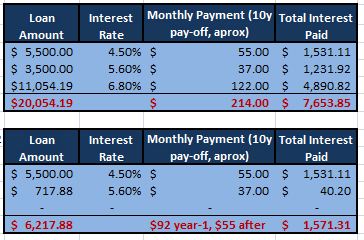
The first table being an approximation of the repayment period of your student loans without a lump-sum payment to start, and the second applying that lump sum payment in your investment towards it.
So, long-term if you were to opt to apply that lump sum payment you'd save about ~$6,100 over the life of the loans. Additionally, you'd have a much lower monthly loan payment (which can be great if you're ever in financial trouble).
Now, that's as far as the absolute numbers go, everything involving a stock-market based investment can't be exactly quantified.
So for the question of paying off loans vs investing, it really comes down to what the risk is worth to you. Are you living comfortably enough where making a $214/month payment for 10-years wouldn't cause financial stress on your budget? Do you feel confident that you will be financially secure over this period (steady job/income, good health, etc)? Is the potential extra money earned in a MM more valuable to you than the saved interest payments? Etc.
Personally, I'd opt to pay off student loans. The future is way too uncertain, and I just feel safer with guarantees and being prepared for the worst possible scenarios. So I'd rather pay off as much as I can, save the guaranteed money on interest, and be safer in the event of unexpected financial trouble. But that's me.
-
2012-01-09 17:54 #36The Optimistic Asshole
Sweaty Dick Punching Enthusiast
- Join Date
- Aug 2005
- Posts
- 29,723
- BG Level
- 10
- FFXIV Character
- Tyche Six
- FFXIV Server
- Tonberry
Was reading an article yesterday that fine art and gemstones have beaten the S&P 500 index in 6 of the last 10 years and by almost 10% last year. Go find a Warhol.
-
2012-01-09 19:05 #37Banned.

- Join Date
- Jun 2008
- Posts
- 6,514
- BG Level
- 8
- FFXI Server
- Phoenix
What program did you use to make those tables Ruk?
-
2012-01-09 19:30 #38Woodwork Football Fan
- Join Date
- Nov 2009
- Posts
- 140
- BG Level
- 3
- FFXI Server
- Carbuncle
While it's kind of discouraging that the mutual funds have lost money since the investments were originally made, the actual effect this has on me is minimal because I didn't invest the money myself, so I don't actually know how much money they had to begin with. In the time I've had them, though, they've either lost money or gained so little that it's ultimately negligible. My knowledge about investing is also extremely limited, so I have neither the ability nor the time to manage these accounts myself. The same sort of thing goes for taxes/deductions/etc relating to these accounts -- the effect on myself has been negligible, to the point where I don't even remember the financial impact it's had on me thus far (which is saying a lot, as I spent the past two years living on minimum wage...), so it's hard for me to determine what effect it would have if I just pulled the money out now.
As far as monthly payments go, my position right now is still sort of tenuous (recent move, new job, etc.), so while I could make the $200+ monthly payments if I had to, I might be cutting it pretty close if any unexpected expenses popped up. I feel like it'd be better in both the short and long run if I took out the money and paid it towards my loans now, then just worked on building my savings back up over time with extra income from my job. Based on the drastic effect it would have over a 10-year period, seems like it might be a good call. Thanks for all the help.
-
2012-01-09 20:44 #39Ruke
- Join Date
- Nov 2005
- Posts
- 3,972
- BG Level
- 7
I just threw them together in excel quick. D: Originally Posted by Mazmaz
I'm doing stupid shit like this all the time, so I have tons of different tables already made that calculate stuff like that. /dork
/dork
Yeah, especially with you not actively managing the accounts or being involved in the market, I'd definitely say paying towards the loans is the better direction. It's without a doubt the least exciting/fun choice, but if you ever do end up in a crisis you'll be happy to have a significantly lower monthly payment (as long as you don't consolidate all the loans into one before applying the lump payment, do not do that). And you're guaranteed to save at least an extra $6.1k interest that stays in your pocket. Originally Posted by Shakki
-
2012-01-12 20:54 #40Banned.
- Join Date
- Jun 2008
- Posts
- 6,514
- BG Level
- 8
- FFXI Server
- Phoenix
Solanis now that you're unbanned come read this thread!


Similar Threads
-
Coming into money, considering investing, any advice?
By Andarvi in forum General DiscussionReplies: 40Last Post: 2008-08-27, 13:35 -
/wave Peng and Ondori
By layoneil in forum General DiscussionReplies: 3Last Post: 2004-08-19, 17:09 -
A question to Yummy and Clistophy!!
By Hirronimus in forum General DiscussionReplies: 2Last Post: 2004-08-11, 00:14