 XI Wiki


The only good that came from the game was
- Navigation
Results 2581 to 2600 of 3058
-
2013-03-17 13:04 #2581I pullout to go pee.

- Join Date
- Sep 2008
- Posts
- 3,739
- BG Level
- 7
- FFXI Server
- Carbuncle
- WoW Realm
- Winterhoof

-
2013-03-17 13:05 #2582Relic Shield
- Join Date
- Mar 2009
- Posts
- 1,615
- BG Level
- 6
- FFXI Server
- Shiva
Had this happen to me a little while ago. Can anyone explain how the hell this happened??
http://i718.photobucket.com/albums/w...ps30ac2bb4.png
-
2013-03-17 13:23 #2583The Syrup To Waffles's Waffle
- Join Date
- Jun 2007
- Posts
- 5,045
- BG Level
- 8
- FFXIV Character
- Cair Bear
- FFXIV Server
- Excalibur
- FFXI Server
- Fenrir
Automaton abilities count as weaponskills, Flash is magical, there are sometimes errors.
-
2013-03-17 20:33 #2584Relic Shield
- Join Date
- Mar 2009
- Posts
- 1,615
- BG Level
- 6
- FFXI Server
- Shiva
Even though I personally landed the killshot? Damn, so I could build Amber light on PUP with extremely epic timing....wunderbar! Originally Posted by Cairthenn

-
2013-03-18 16:35 #2585So hard we fuck rocks
- Join Date
- Jan 2009
- Posts
- 3,043
- BG Level
- 7
- FFXI Server
- Sylph
lol anderson cooper...
-
2013-03-18 16:38 #2586But I don't want my title changed
- Join Date
- Nov 2008
- Posts
- 6,486
- BG Level
- 8
- FFXIV Character
- Fievel Mousekewitz
- FFXIV Server
- Excalibur
I got a pretty good chuckle out of that too. Originally Posted by shepardG
-
2013-03-18 20:02 #2587CoP Dynamis
- Join Date
- Jun 2011
- Posts
- 284
- BG Level
- 4
- FFXI Server
- Fenrir
A little late, but not selling a self-produced resource which you need or want to consume is not the same has having purchased it for consumption. This is poor economic analysis as well as poor physical analysis. It's not even using "opportunity cost" correctly, to be honest.
You can't really refer to the value of the materials to build a relic as an opportunity cost if the desired goal is to build a relic because the alternative (not building a relic) is mutually exclusive with our desired outcome. We can talk about that value as the opportunity cost of building the relic (we could have bought other things, we could have not spent the time making the money to buy the relic, etc.)
But since we are making a relic, the assumption is that we need 17700 currency (or whatever the cost is) and we have to procure that somehow. Assuming liquid capital is available, and simplifying the system to the two extremes "produce it all" or "purchase it all" - although in most cases both processes will occur - we can now talk about opportunity costs in terms of time or the risk incurred by reducing available capital, among other potential "costs."
The example where purchasing the relic now increases our efficiency at gaining capital is a good example of opportunity cost used correctly - as the difference between pre-relic farming and post-relic farming - is a cost we incur if we instead choose self-production at a slower rate. The nice thing about this sort of cost is that it is easily quantified and thus can be analyzed objectively. Another example of opportunity cost used correctly was the sacrifice of potential purchases (of course this risk diminishes to zero as the ratio of required target capital for a particular outcome (in this case, building a relic) to our initial available capital increases but for most players this risk is not diminished enough to ignore).
When we start to talk about opportunity cost in terms of time we have to consult leisure-consumption models and consider marginal rates of substitution, and our analysis stops being objective and becomes subjective. How much can we consider dynamis farming "work" versus "leisure?" If the means of production are enjoyable enough, self-produced consumables will have a "cost" less than their market value if purchased with already accrued capital (one might then argue that the the value of selling is greater because of this, but this is irrelevant because we assumed we need to consume some amount of currency and selling it therefore does not accomplish our goal except in the case where we expect a massive downward market shift).
This mistake could have been avoided by paying careful attention to the first sentence of the Wikipedia article for opportunity cost: "Opportunity cost is the cost of any activity measured in terms of the value of the next best alternative forgone (that is not chosen)." If the assumption is that we are building a relic by some means, then we cannot consider the market value of self-produced currency to be an opportunity cost because we are either going to self-produce or we are going to purchase. The correct comparison is the marginal rate of substitution between time/leisure (if any) sacrificed to produce the currency and the current market value - along with any other costs or risks associated with either self-production or capital reduction as previously mentioned.
http://sighroll.com/wp-content/uploa...oreyouknow.jpg
-
2013-03-18 20:07 #2588E. Body
- Join Date
- Oct 2004
- Posts
- 2,252
- BG Level
- 7
- FFXI Server
- Asura

So we had a Ninja to pull the adds and hold them while Uptala died, but this Mnk REALLY hated the adds and decided they needed to be the priority over Uptala.
-
2013-03-18 21:04 #2589S N K
- Join Date
- May 2006
- Posts
- 2,664
- BG Level
- 7
- FFXI Server
- Sylph
The entire post I was looking at your avatar and thinking that bug has the right image for explaining this. Originally Posted by Asymptotic
Who the fuck is this autobot? Originally Posted by Fake
-
2013-03-19 06:54 #2590Absolute Messenger of Promathia

- Join Date
- Jan 2008
- Posts
- 13,204
- BG Level
- 9
- FFXIV Character
- Blaise Destin
- FFXIV Server
- Sargatanas
- FFXI Server
- Asura
Oh Asura. Originally Posted by Falaras
Sad thing is, I know that name somewhere. I don't know where i know it, But i know it... Thats going to eat at me until i find it out.
-
2013-03-19 13:49 #2591Puppetmaster
- Join Date
- Jul 2009
- Posts
- 64
- BG Level
- 2
- FFXI Server
- Lakshmi
Spoiler: show
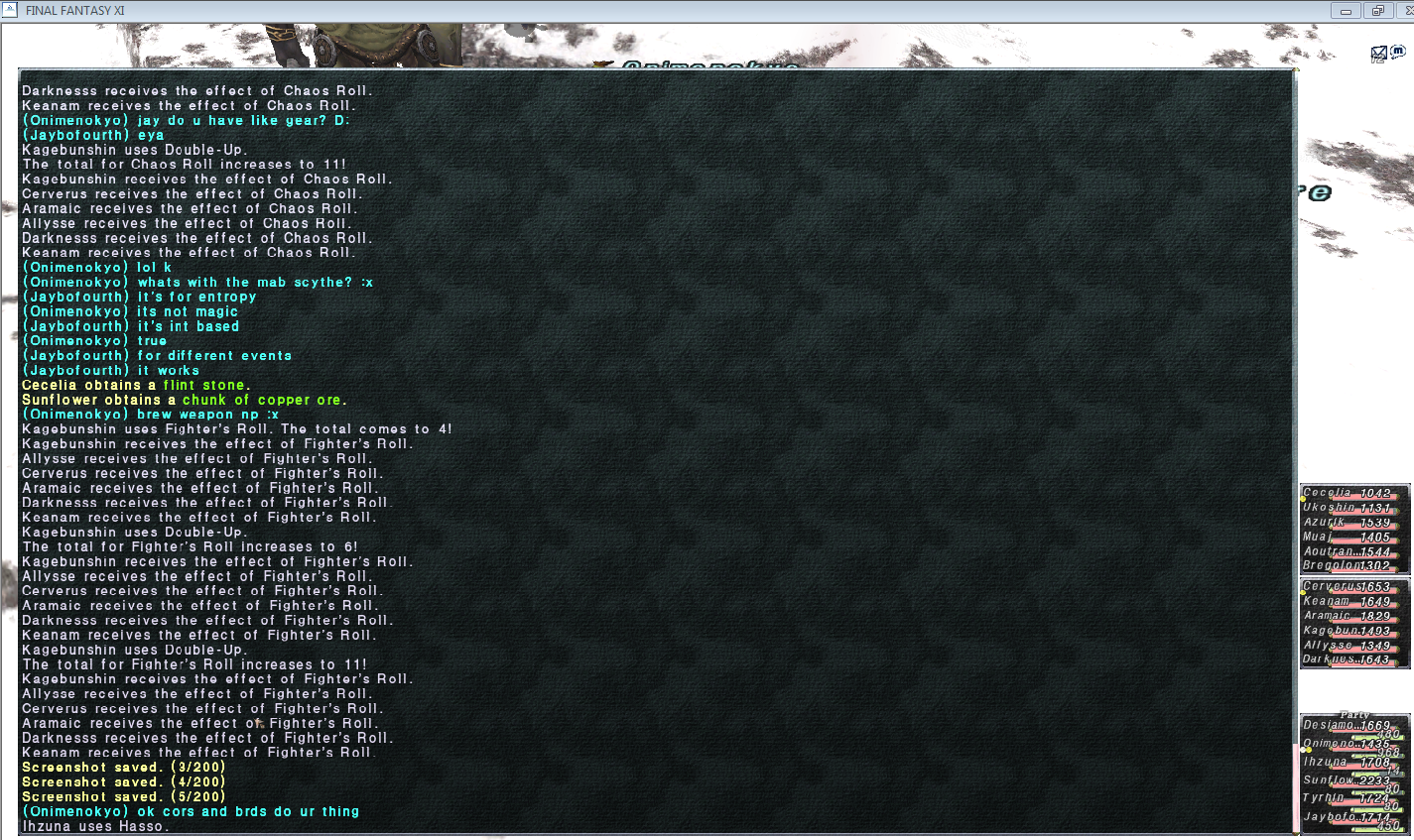
We got this gem while doing Kaggen.
Wish I screenshoted his gear before he swapped to his "Great Sword" gear. His scythe setup was Magian MATB Scythe, twightlight head/body, INT+ Rings, INT+ Neck, and a few other INT+ pieces. Though he didn't swap to anything that impressive when he did swap.
We decided not to bother to correct/inform the guy, it was going to be a lost cause.
-
2013-03-19 20:44 #2592D. Ring
- Join Date
- Dec 2010
- Posts
- 4,896
- BG Level
- 7
- FFXI Server
- Diabolos
Well had some craptastic At&t luck today, I manage to claim sisyphus (farming for bale earring) against the 5 billion there camping him for apademak pops and after 25 mins of kiting him and killing him on smn (only job I have that he won't fuck over sadly enough), right as he hits 15% with hundreds of people waiting for me to wipe, my internet connection decides to do it's twice weekly disconnect moment, come back to find a nin farming sisy pops killed it
 .
.
-
2013-03-19 20:57 #2593Old Merits
- Join Date
- Jan 2010
- Posts
- 1,230
- BG Level
- 6
does no one invite for earring type drops? I always gave away axes with dragua
-
2013-03-19 21:05 #2594Old Merits
- Join Date
- Jun 2008
- Posts
- 1,203
- BG Level
- 6
- FFXI Server
- Valefor
 twice weekly? ip lease issues? i rage pretty hard when i disconnect, i wont have it. Originally Posted by Robertfb
-
2013-03-20 00:12 #2595Nidhogg
- Join Date
- Apr 2007
- Posts
- 3,895
- BG Level
- 7
^ That. Jesus, that.
I love my connection stable. Recently I was having issues with the router/modem being in the garage, and after having enough of it over the course of a month, I said FUCK IT. Talked to the house owner and I moved that shit into my room.
Not a single problem since.
-
2013-03-20 01:23 #2596Old Merits
- Join Date
- Sep 2008
- Posts
- 1,154
- BG Level
- 6
- FFXI Server
- Valefor
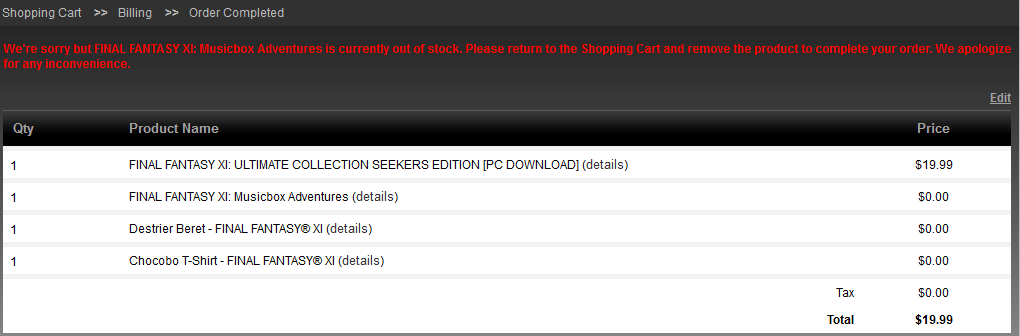
Tried to buy expansion on SE store, to be told a digital download item is out of stock. When trying to take it out of the shopping cart it won't let you remove it.
-
2013-03-20 01:25 #2597HABS SUCK!!!!!
Sepukku is my Hero
Therrien's Cum Dumpster
- Join Date
- Mar 2005
- Posts
- 37,884
- BG Level
- 10
- FFXI Server
- Gilgamesh
Hows a digital download item out of stock?
-
2013-03-20 03:58 #2598
- Join Date
- Feb 2009
- Posts
- 8,774
- BG Level
- 8
PC Load Letter.
-
2013-03-20 07:49 #2599Flowery Twats
- Join Date
- Jul 2008
- Posts
- 3,583
- BG Level
- 7
 The fail isn't your isp,its not asking to team up with people who just want red proc when you just need blue and don't need red. Gj wasting your time and theirs taking an age to try and kill it when you could have a lot faster by asking to team up with whoever claimed it. No idea why you thought camping a highly camped KI mob for a blue drop without th or proc against people who just want KI and 99% would invite you for drop, on a job that takes an age to kill it was s good idea. Originally Posted by Robertfb
-
2013-03-20 07:51 #2600Sea Torques
- Join Date
- Feb 2008
- Posts
- 580
- BG Level
- 5
- FFXI Server
- Phoenix
Square Enix? Originally Posted by NynJa


Similar Threads
-
Random fail.
By Lutia in forum FFXI: MediaReplies: 1643Last Post: 2009-01-22, 23:51