XI Wiki

Yep it's 4 liberals and 5 conservatives.
- Navigation
Results 21 to 40 of 873
Thread: Obamacare, Healthcare, etc.


-
2012-03-02 21:52 #21F5 Like A Boss.

- Join Date
- Sep 2005
- Posts
- 7,396
- BG Level
- 8
- FFXIV Character
- Kuroki Kaze
- FFXIV Server
- Sargatanas
- FFXI Server
- Quetzalcoatl
- WoW Realm
- Twisting Nether

-
2012-03-02 23:45 #22Banned.

- Join Date
- Jun 2008
- Posts
- 6,514
- BG Level
- 8
- FFXI Server
- Phoenix

I don't think transparency is ever a bad thing.
-
2012-03-02 23:50 #23Chram
- Join Date
- Jun 2006
- Posts
- 2,737
- BG Level
- 7
Judges aren't really liberal/conservative in the same way we use those terms. Should probably make that clear. Originally Posted by Kurokikaze

-
2012-03-03 01:38 #24Demosthenes11Guestya, these present judges are more liberal/republican Originally Posted by Darus Grey
-
2012-03-03 10:09 #25Ninja Ninja
- Join Date
- Dec 2008
- Posts
- 5,672
- BG Level
- 8
- FFXIV Character
- Noemi Rondain
- FFXIV Server
- Gilgamesh
- FFXI Server
- Phoenix

 Did you read the rest of my post? I never said I was going to go without insurance. The insurance offered through my contracting agency was good enough for me based on my previous medical history but wasn't enough insurance for me based on MA guidelines. I was trying to point out the flaw where my tax money was still going towards paying for Masshealth but I couldn't access it myself because I was making "too much money". Originally Posted by Weeks
The last sentence was a bit weird, yes, but my point is that it's a half assed bill because people who are below $36300/year in pay can get on Masshealth for lower cost or even free compared to single payer plans. Meanwhile if you make even a hundred more than that a year then you need to shell out $3000+/year just to meet the state minimum even if you don't want to carry that much insurance all while still paying taxes that help fund the people who are on Masshealth.
Right now MA is pretty much leading the country in health insurance covered citizens but at the same time it's making the "free market" that everyone glorifies in this country harder since it's just restricting options for people living here, increasing the cost of living the state, and making it look like we have universal coverage when it's only a half assed system in reality.
-
2012-03-03 10:54 #26BG Medical's Student of Medicine
- Join Date
- Oct 2006
- Posts
- 34,556
- BG Level
- 10
Do it right or don't do it at all, I always say.
-
2012-03-03 17:26 #27Relic Shield
- Join Date
- Jul 2006
- Posts
- 1,857
- BG Level
- 6
Point is, you need more insurance than your previous medical history warrants, because otherwise the state and the insured end up paying when you're the lucky soul with subpar insurance that develops leukemia. The state sets a minimal acceptable standard and the insurance industry (ideally) prices that taking into account the low chance of you ending up needing extensive services, which is the entire idea of universal health insurance. Originally Posted by Ragnus
You want to complain about the cost to people right above the cutoff line, go ahead. Luckily the national program is a little bit more forgiving of people in that salary range.
-
2012-03-03 18:14 #28F5 Like A Boss.
- Join Date
- Sep 2005
- Posts
- 7,396
- BG Level
- 8
- FFXIV Character
- Kuroki Kaze
- FFXIV Server
- Sargatanas
- FFXI Server
- Quetzalcoatl
- WoW Realm
- Twisting Nether
Interesting read on the price of healthcare in the US versus other nations: http://www.washingtonpost.com/blogs/...ztoR_blog.html
-
2012-03-04 16:29 #29Nidhogg
- Join Date
- Dec 2005
- Posts
- 3,815
- BG Level
- 7
- FFXI Server
- Kujata
So much idiocy in a single post. All the arguments are already recorded, just not visually. Originally Posted by Demosthenes11
-
2012-03-04 17:57 #30The Optimistic Asshole
Sweaty Dick Punching Enthusiast
- Join Date
- Aug 2005
- Posts
- 29,635
- BG Level
- 10
- FFXIV Character
- Tyche Six
- FFXIV Server
- Tonberry
I read a good article yesterday about why the U.S. will likely be moving to universal care. It isn't because we want it or that the politicians want it, but because due to the elimination of underwriting in the Affordable Care Act, health insurance as we know it today is unsustainable in the long term.
http://www.forbes.com/sites/rickunga...-are-we-ready/
Speaking at a recent conference, Mark Bertolini, CEO and Chairman of Aetna Insurance, announced that the end is near for profit driven health insurance companies. “The system doesn’t work, it’s broke today. The end of insurance companies, the way we’ve run the business in the past, is here.”
In highlighting the reasons for his bold statement, Bertolini called out the ban on medical underwriting propounded by the Affordable Care Act, which Bertolini believes has made the traditional health insurance business model untenable in the long term, while also giving an ‘honorable mention’ to the MLR requirements.
Underwriting is the process of separating out the healthy from those more likely to be ill and then offering coverage to the good risks while passing on the bad ones.
And yet Bertolini, who leads one of the nation’s largest health insurance companies and is a man known for his honesty and willingness to do the right thing, was not raging against government interference nor suggesting that the Affordable Care Act has destroyed his business as it leads America down the road to healthcare disaster. Indeed, Mark offers a considerable measure of praise for Obamacare saying, “For most of what has already been implemented, it has been a pretty good thing.”
Maybe the most interesting part of the article is the CEO of a major health insurance company thinks Obamacare is a good thing.
-
2012-03-04 18:10 #31Demosthenes11Guestit's pretty hard to play a soundbite on fox that is text or that has no picture. Nowhere near the same power Originally Posted by SwampdonkeyPLD
-
2012-03-04 18:11 #32The Shitlord
- Join Date
- Feb 2008
- Posts
- 11,560
- BG Level
- 9
- FFXIV Character
- Kharo Hadakkus
- FFXIV Server
- Hyperion
- FFXI Server
- Sylph
- WoW Realm
- Rivendare
Dateline does it.
-
2012-03-05 05:41 #33Salvage Bans
- Join Date
- Jun 2008
- Posts
- 955
- BG Level
- 5
- FFXI Server
- Odin
Originally Posted by Tyche
I know that we (a not for profit insurance company) are overjoyed with Healthcare reform. We are rolling out quite a few interesting programs in accordance with some of the sweeping changes which puts us at an advantage over our local 'for profit' competitors to be able to offer employer style discounts, and benefits to individuals and families without healthcare. A lot of reform and restructuring within HCOs as well so physician availability is abundant and not so overcrowded. I completely agree this will inevitably lead to universal healthcare as it's already blurring some of the lines and will slowly void the already outdated healthcare system we use today.
-
2012-03-05 16:39 #34Human Being
- Join Date
- Apr 2007
- Posts
- 3,169
- BG Level
- 7
From the provider side, where I am, I'm seeing several large insurance companies re-branding themselves as businesses providing health-oriented solutions, not just insurance. Some of them are buying up physician groups and hospitals in an effort to align with the buzzword concepts like "patient centered medical home" and "accountable care organization". The healthcare cold war of payor versus provider has been an arms race for the last few years, and that race is accelerating in response to the reform legislation.
Nevermind that the concept of insurance in healthcare has been twisted well beyond the true definition, mainly because of the risk-shifting from the insurance seller to employers (self-funded clients) and policy holders (by way of High Deductible Plans, Limited Benefit Plans, etc.).
I read the same Aetna article that Tyche did, and I have much the same opinion. Professionally, as much as I feel the move to a more universal system will most likely remove my entire career from the field, the concept makes a lot more sense to me than what we're doing today.
-
2012-03-05 17:50 #35D. Ring
- Join Date
- Apr 2006
- Posts
- 4,738
- BG Level
- 7
- FFXI Server
- Siren
Nationalized health care and insurance is a deadly idea that Obamacare would take a huge step toward bringing about. The only possible function of a government is to protect people's rights and retaliate in measure when specific people have their rights violated. Obamacare does the opposite by compelling the entire country to make choices they don't want to make.
It's totally wrong morally and frankly twisted to try and compel people into doing what another person believes will be good for him. In this case it's the equivalent of saying "You have to be healthy and have insurance. If you disagree and resist, the government will arrest you or kill you by force" or more simply; "Do what I say is healthy or I'll kill you". Which is the alternative given to people when the "choice" is backed by fiat government law.
Because it's wrong, it's also impractical, misguided, and can't work in practice. And when it comes to nation-wide health care, a failed theory in practice means dead people who otherwise would have lived.
Even if the goal is supposedly to help people who are less well off (which I don't accept as a good reason) then Obamacare will only make the problem worse not better. It would lead to deeper political pressure on all sides where the people who get the best health care will get privileged priority by having the best friendly connections. Are you a in a politically connected union who donated to candidate X's re-election? Time to get your back scratched, you may get an insurance waiver to avoid the penalties. Are you a regular schmuck stuck working a job at Radioshack? Too bad, time to make friends fast. Better start working 3 jobs to pay for that insurance. Don't break an arm sucker.
If Obamacare is upheld it's much worse than the concrete issue of health care. It would set precedent where federal government has the power to compel everyone to sign contracts or purchase anything it wants. That would be the logical step down the road that upholding Obamacare achieves. Are people too stupid and ignorant to understand that Macs are superior to P.C.s? There's no logical or legal reason government shouldn't declare everyone buy only Macs. After all think of how much time and money is wasted having to remove viruses from windows P.C.s. It's only doing what's good for our modern society and the health of our internet infrastructure.
-
2012-03-05 17:53 #36I'll change yer fuckin rate you derivative piece of shit
- Join Date
- Sep 2006
- Posts
- 58,681
- BG Level
- 10
Apparently you completely missed the memo that low-income people have their health-insurance premiums partially or completely subsidized. Radio shack wage-earner isn't going to break the bank to get insurance. Originally Posted by Gwynplaine
-
2012-03-05 17:57 #37D. Ring
- Join Date
- Apr 2006
- Posts
- 4,738
- BG Level
- 7
- FFXI Server
- Siren
I'm aware of that but as measures of Obamacare would be implemented the cost of insurance will skyrocket and the quality will degrade. The insurance company giants would be solidified into a sanctioned and favored establishment, while small companies are crushed by burdens. Extremely expensive and frivolous perks would be required to be covered increasing the price even more. For a while in the short range the true increasing price of coverage might be hidden by subsidies but not very long. Eventually something has to give.
-
2012-03-05 17:59 #38Demosthenes11Guestwhat in the actual fuck Originally Posted by Gwynplaine
-
2012-03-05 18:02 #39D. Ring
- Join Date
- Apr 2006
- Posts
- 4,738
- BG Level
- 7
- FFXI Server
- Siren
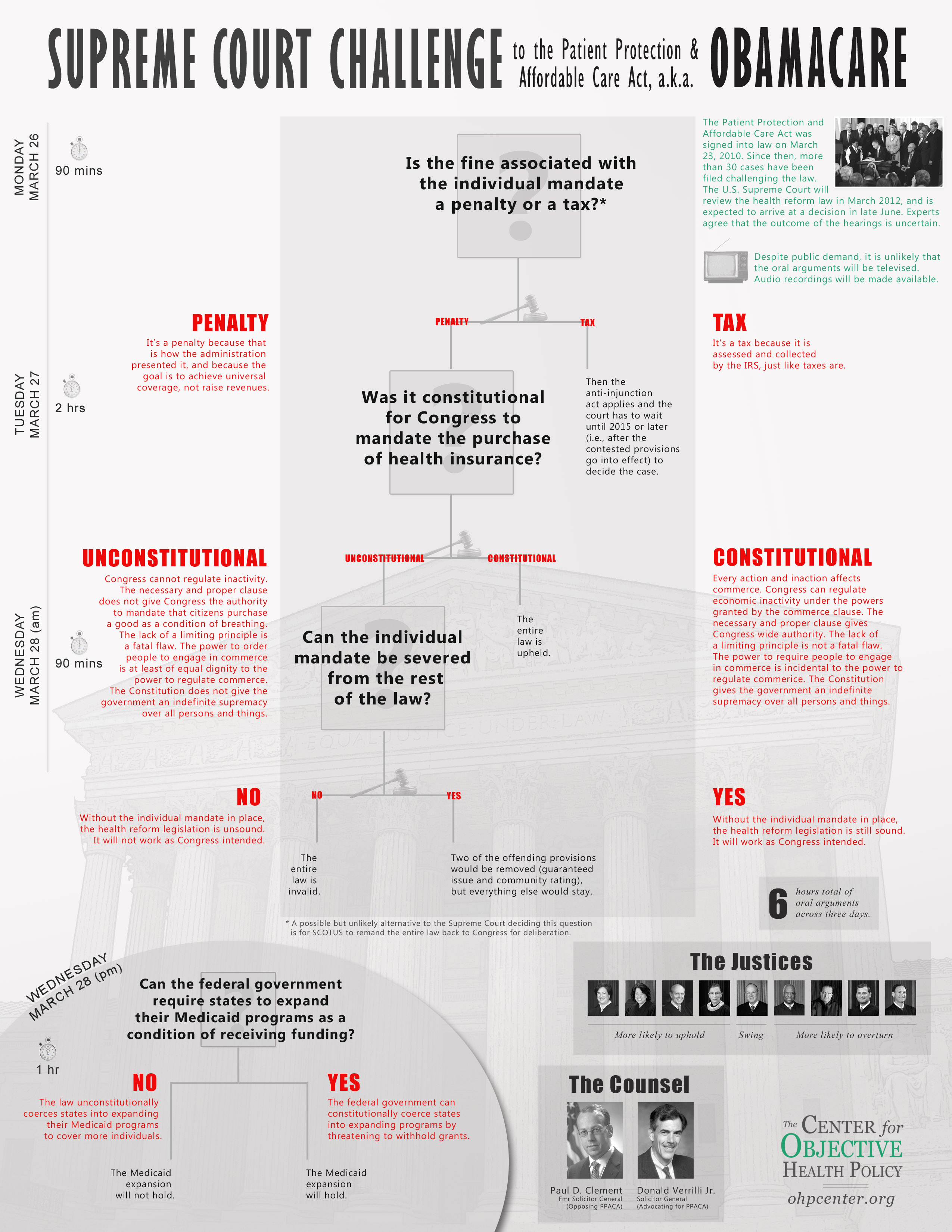
Here's a nice clear flowchart of how the Supreme Court case is going to proceed. It presents alternatives of each issue on the timeline. The original size was too big to post but you can see it here.

-
2012-03-05 18:12 #40I'll change yer fuckin rate you derivative piece of shit
- Join Date
- Sep 2006
- Posts
- 58,681
- BG Level
- 10
Flooding the insurance market with young, healthy, previously uninsured people is going to make the cost of insurance skyrocket? Originally Posted by Gwynplaine
k