 XI Wiki

I'm not implying that the sky is going to packed with debris immediately thereafter. But if we can put that much debris in a period of like 50 years, imagine what will happen in 50 more, or 100.Originally Posted by Greatguardian

I understand spacecraft aren't that fragile, but at the same time it's only designed to handle impact from the smallest of debris because we've been careful not to put anything large in orbit. But if there is anything larger, then I think the fear starts to become more real, and military involvement in space really increases that possibility.
To quote the wiki:
A much smaller number of the debris objects are larger, over 10 centimetres (3.9 in). Against larger debris, the only protection is to maneuver the spacecraft in order to avoid a collision. If a collision with larger debris does occur, many of the resulting fragments from the damaged spacecraft will be in the 1 kilogram (2.2 lb) mass range, and these objects become an additional collision risk. As the chance of collision is a function of the number of objects in space, there is a critical density where the creation of new debris occurs faster than the various natural forces remove these objects from orbit. Beyond this point a runaway chain reaction can occur that reduces all objects in orbit to debris in a period of years or months. This possibility is known as the "Kessler Syndrome", and there is debate as to whether or not this critical density has already been reached in certain orbital bands.[1]
A runaway Kessler Syndrome would render the useful polar-orbiting bands difficult to use, and greatly increase the cost of space launches and missions. Measurement, growth mitigation and active removal of space debris are major activities within the space industry today.
- Navigation
Results 101 to 120 of 235
Thread: Nasa worth it? (thread split)


-
2012-03-05 23:55 #101Salvage Bans

- Join Date
- Nov 2005
- Posts
- 795
- BG Level
- 5
- FFXIV Character
- Stanislaw Ziolkowski
- FFXIV Server
- Durandal

-
2012-03-05 23:59 #102Burninate all the things.
- Join Date
- Apr 2008
- Posts
- 3,356
- BG Level
- 7

Fair point. I dislike military involvement in the sciences in general anyways. It certainly moves things forward, but for all the wrong reasons.
-
2012-03-06 01:36 #103Banned.

- Join Date
- Jul 2005
- Posts
- 17,471
- BG Level
- 9
- FFXI Server
- Ifrit
- WoW Realm
- Area 52
Try to irradiate an older computers with highly energetic particles, do the same with a more recent one, and tell me what happen. My money on the oldest one. Originally Posted by hey
There is a reason why older shit is less likely to break, the electronics component inside (transistor, resistances, memory and everything) are much bigger and resistant to energy fluctuation.
Since you don't need super computers for these kind of stuff, reliability is everything.
[edit]
And I could have used any consoles or computers, they all have a relatively high defect rate.
Not really. A space debris could cause tremendous damages depending of the speed of the collision. Stuff under 1cm aren't very scary, but anything above 5-10cm could destroy a space shuttle. Originally Posted by Greatguardian
-
2012-03-06 13:35 #104CoP Dynamis
- Join Date
- Sep 2008
- Posts
- 257
- BG Level
- 4
- FFXI Server
- Cerberus
space craft are relatively fragile in comparison to what they potentially have to deal with.Nah, spacecraft aren't that fragile. They're built to take a beating. The scale is also a bit deceptive. The asteroid belt looks similarly dense, but NASA doesn't even bother plotting courses around it. They just shoot probes in a straight line. There's so much free space between asteroids in the belt that the chance of a probe or craft actually running into one of them is negligible.
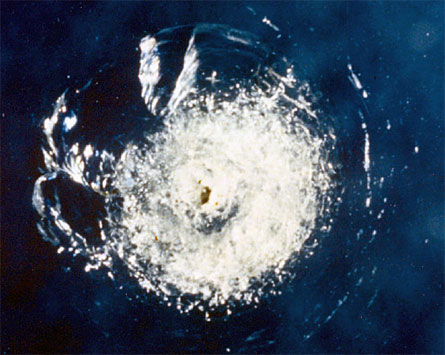
i've done the tour of nasa and they still keep this window on display as it is crazy to see. that is a window from the challenger when it was hit by a fleck of paint in the 80s. the picture doesn't really do it justice for how thick the glass is and how close to came to completely passing through. trying to find a picture of it that give a better sense of scale.
-
2012-03-06 15:08 #105True skill only comes from macro switching all your e-peen gear thru 10 pages
- Join Date
- Sep 2007
- Posts
- 4,740
- BG Level
- 7
- FFXI Server
- Quetzalcoatl
The speck of paint was 0.2 mm. Impact at rate of 4 km per second and created a pit 0.4 mm deep.
larger pic:
Spoiler: show
NASA handbook for limiting orbital debris:
http://www.hq.nasa.gov/office/codeq/...NHBK871914.pdf
The window incident referenced on page 23 of 174.
-
2012-03-06 17:00 #106Relic Shield
- Join Date
- Jan 2005
- Posts
- 1,554
- BG Level
- 6
- FFXI Server
- Odin
I think the biggest benefit of space exploration in the modern era would be possible development of new sustainable energy systems. As has been mentioned about the miniturization (sp?) of electronics and computer systems, longer range manned missions are going to require much more efficient and safer energy sources to be able to actually work.
Keep in mind I am not talking about the commonly discussed green energy sources of wind or water power, but further research into cold fusion. Solar power I think is also applicable from the perspective of keeping basic systems online that do not have a high constant energy requirement.
-
2012-03-06 19:11 #107Banned.
- Join Date
- Jul 2005
- Posts
- 17,471
- BG Level
- 9
- FFXI Server
- Ifrit
- WoW Realm
- Area 52
One benefit of building a new house is that you can cook new meals inside it. Except, not really, you don't need to go that far. Originally Posted by Siatdiat
We don't need space exploration to push our technologies further. I'm even going to say it's a waste of money to do space exploration if you're simply looking for the indirect benefits.
Of course, I'm not saying that space exploration itself is a waste of money, but unless you're trying to terraform Mars, deflect potential asteroid threat (we still got Bruce Willis for that), answer the "is there life?" question, or try to improve QM/GR theories, it's not a good usage of your money.
Also, cold fusion is pretty much a running joke at this point. The fad started after a false claim in 1980, never made much sense physically, and pretty much died near the end of 2000 when everyone gave up and moved on to something useful. It's not something that is likely to be physically.
-
2012-03-06 19:25 #108Relic Shield
- Join Date
- Jan 2005
- Posts
- 1,554
- BG Level
- 6
- FFXI Server
- Odin
Eliminate the cold part. What is your opinion on fusion in general? Will we be able to make a fusion reactor that doesn't require more energy than it produces?
-
2012-03-06 19:45 #109Burninate all the things.
- Join Date
- Apr 2008
- Posts
- 3,356
- BG Level
- 7
Kaylia is far more qualified to answer that question than I am, but my general understanding of the problem with sustainable fusion is the temperatures we'd need to get Hydrogen atoms to in the first place in order to overcome the strong (weak? idr) nuclear force. With solar fusion, gravity does most of the work. Terrestrially? I don't know if it would be feasible.
We do have a pretty efficient fusion generator floating around about 93 million miles away, though. Rather than build a new one, we can always make better use of the one we have.
-
2012-03-06 20:09 #110Banned.
- Join Date
- Jul 2005
- Posts
- 17,471
- BG Level
- 9
- FFXI Server
- Ifrit
- WoW Realm
- Area 52
Kryssan could give you a better answer (or just read his recent posts in LHC thread), but fusion is very promising all around. It's been done inefficiently in the past, and we have every reasons to think that we can improve the technology to a point where it will be usable. There is still significant design issues like the high temperature mentioned by Greatguardian (everything break apart after a few minutes), and converting heat into electricity while minimizing the loss, but progress has been made every year. Originally Posted by Siatdiat
Of course, it doesn't mean without any doubt that it can be done (we might bang on our head on a more fundamental design issue eventually), but there has been constant improvement over the last few decades, and stopping now (or slowing down) would be stupid.
[edit]
If you're wondering, these reactors aren't portable, and couldn't really be used for space exploration. In fact, the future of space travel is pretty grim. Mars is doable with our technologies, but anything outside our solar system isn't worth the trouble if the physics laws as we know them remain the same.
I wish, but I'm probably more qualified to talk about cold fusion than normal fusion at this point (my researches involve similar structure/elements). Everything I know about fusion is from the same source as everyone.Kaylia is far more qualified to answer that question than I am
-
2012-03-07 00:13 #111Campaign
- Join Date
- Aug 2007
- Posts
- 6,547
- BG Level
- 8
I could just be spouting bullshit, but I think I remember reading somewhere (probably a link posted in the LHC thread, or it could have been an answer to a random question in a class a long time ago) that the problem with fusion is maintaining a complete magnetic field around the process to contain the materials. The main problem was that we don't have computers advanced to the point where it can handle all the computations needed to regulate the magnetic field efficiently enough to keep all the particles contained, so particles escape and the reaction eventually dies out.
-
2012-03-07 03:30 #112Final Fantasy XI Music Devotee

- Join Date
- Dec 2005
- Posts
- 723
- BG Level
- 5
- FFXIV Character
- Vianne Nys
- FFXIV Server
- Excalibur
- FFXI Server
- Quetzalcoatl
 The reaction can be contained. The thing is that you'll spend nearly as much energy in containing it as you can obtain from the reaction. Originally Posted by Pirian
-
2012-03-07 03:58 #113Banned.
- Join Date
- Jul 2005
- Posts
- 17,471
- BG Level
- 9
- FFXI Server
- Ifrit
- WoW Realm
- Area 52
Magnetic confinement Originally Posted by Pirian
As far as I know, there is two different types of reactors. The first type, the one you mentioned, does have a design issue that hurt its efficiency. Like Vienna added after, containing the plasma with magnetic fields requires more energy than it cost to trigger the fusion itself, making the whole process a huge waste of time. I'm not exactly sure what is the theoretical potential of such reactor, but what I heard was generally bad news, and on top of this, you have the containment problems mentioned in your post (any small deviation induced by chaos is hard to compensate for).
http://en.wikipedia.org/wiki/Tokamak
Inertial confinement
The 2nd type of reactor doesn't have the same issue, it simply bombard an hydrogen cells from every direction with powerful laser...or something like that. This type of fusion has been shown to be energetically efficient over the last few year, but I don't think we have been able to operate one for more than 30 seconds before it overheat/melt (there is no actual danger of explosion here, unlike fission, everything stop the moment something break).
http://en.wikipedia.org/wiki/Inertia...inement_fusion
Most [meaningful] opinions I've heard seemed to point toward inertial confinement being our best bet, but everyone is always biased...so I don't really know. Both wiki articles seem to contain more information than I could give you, its worth a read if the topic interest you.
-
2012-03-07 06:26 #114Bagel
- Join Date
- Jan 2009
- Posts
- 1,412
- BG Level
- 6
Hmm, should read threads more often.
We will have fusion reactors online in the next 50 years, more than likely. It seems fairly okay to make this claim now, rather than just saying 'some day'. JET got us close, ITER should take us over that precipice that has remained beyond our reach for so long.
By the way, heat damage isn't that much of a concern in a fusion reactor. When you talk about MCF (magnetic confinement fusion), the plasma is held in place by the magnetic fields of the toroidal shape (which is a tokamak). If (and currently when) those fields eventually fail the matter that made up that plasma will have sufficiently cooled before it ever comes into contact with the 'walls' of the reactor. If the plasma undergoes sputtering, the contact of the arc with the walls will actually shut the reaction down as the heavier material (such as steel atoms) begins to interact in the plasma envelope and cool it. Even if the reactor did manage to 'eat itself' (which is a highly impractical possibility no matter how you look at it), you will not see anything like the silliness of a certain Spiderman movie.
Just like always, reactors cannot explode in any nuclear fashion. A rankine plant can undergo steam explosions, and certain fission plants can undergo hydrogen explosions. Fusion plants currently don't have this ability or these concerns (despite the intense heat of the plasma), though some of the talk about how to regain fuel leads to material that can explode. For example, clean fusion is Deuterium Deuterium, but we're not at that level yet. We use Deuterium Tritium, or dirty fusion - called dirty because it makes Helium and neutrons, and neutrons make things glow in the dark. Tritium could be 'recovered' in a fusion plant by using lithium blankets - but those blankets would also be in contact with cooling systems (which lithium doesn't play nice with water, for example), as well as other concerns.
Great strides have been made in control of the plasma, this is what JET accomplished predominantly. JET also showed us that it was capable or producing power, just not contiguous due to the eventual field failure because somehow, somewhere, some of that plasma will escape the field and once it starts it is damn impossible to stop. ITER's scientists and engineers truly believe that when it comes online sometime around 2020 (barring more money issues and delays) we will obtain what we seek with regards to control of the plasma. Of course, the real problem in terms of using it for power production of getting more energy out than you put in also still remains (ITER is designed for a 1:10, or you get 10x as much power out as you put in; the reactor wouldn't actually go into this mode - the use of DT to create a nuclear reaction - until around 2030 though), but this is being combated on a majority of fronts, not the least of which is developing better magnetic field generators and superconducting materials.
Now, assuming ITER does accomplish this, we won't see actual fusion plants until 2060 or later. ITER is huge, and requires the funding assets of multiple nations (current final estimated cost at € 15 billion) - we will need to research ways to make it smaller and cheaper while still obtaining relatively equivocal power output ratio levels.
So, the other fusion we have on our plate right now is ICF. Right now, the only major facility I know of is NiF, or the National Ignition Facility at LLNL in Cali. That unit is already online. NIF's primary purpose is not power research, though it is one of the major purposes. Unlike MCF, which can create a relative steady-state condition once you control the plasma field, ICF is pulsed by nature. You insert a fuel hohlgram, hit it with several heavy ion lasers to force the molecules of the frozen fuel pellet to get so close together that they fuse, and boom. Again and again and again. So you don't have that continuous, self - sustained reaction that we typically shoot for in a power plant
Now, you can still use this type of reactor as a power plant, but it is far newer technology than that of MCF (the first tokamak was presented in the late 60s). We don't know as much about it, and as a result we really can't say one way or another how this type of power generation will fair compared to the other we know so well. As laser technology improves, and as we learn more about the process, we will have a much clearer idea of its application and whether or not it'll provide an alternate solution.
ICF has a lot of promise, but like all things in science what we see as possible we often find to be theoretical at best - as a certain person once said, paper reactors have so many advantages. Unfortunately, real reactors aren't so kind.
For further reading, go to NiF's page or ITER's page.
-
2012-03-07 12:09 #115Banned.
- Join Date
- Jul 2005
- Posts
- 17,471
- BG Level
- 9
- FFXI Server
- Ifrit
- WoW Realm
- Area 52
Say "fusion" backward 3 times in front of a mirror to summon Kryssan.
But seriously, I don't know how you always find these thread so fast.
-
2012-03-07 14:13 #116The Shitlord
- Join Date
- Feb 2008
- Posts
- 11,560
- BG Level
- 9
- FFXIV Character
- Kharo Hadakkus
- FFXIV Server
- Hyperion
- FFXI Server
- Sylph
- WoW Realm
- Rivendare
I always thought it would be helpful if "they" could find a way to draw the power from an unlikely source. Like with wood/coal/oil, you're still losing energy in the process. You put in more potential energy than you get out; only, no one gives a shit, because in its previous state it was relatively useless. With fusion, you're drawing directly on electricity, which is pretty useful. And, since we've already got one inefficient conversion going, it seems doubly wasteful to use it to make another. If "they" could find a way to draw the power from something relatively useless, the reactor's efficiency wouldn't matter as much.
Alas, lasers dont really run on tibanna gas.
-
2012-03-07 19:06 #117Banned.
- Join Date
- Jul 2005
- Posts
- 17,471
- BG Level
- 9
- FFXI Server
- Ifrit
- WoW Realm
- Area 52
Originally Posted by BaneTheBrawler
There won't be a simple solution as long thermodynamics has its word to say in the process.
The "fuel" used in fusion reactor is the most abundant element in the universe (hydrogen). While deuterium (instable hydrogen) isn't as common, it's still easy to find. In this case, it's the reactor itself that is the limiting factor. It would be similar to have a car engine breaks every 10 sec when the fuel tank is filled.
There isn't hundred of way to turn energy into electricity. Beside photovoltaics panel (solar panel) and electrochemical cells (batteries), the only method we have is to transform kinetic energy (heat, movement) into electricity using generators. Even in the case of nuclear energy, it always come down to boiling water to make a turbine spin. A glorified steam machine basically.
The problem you raise can easily be addressed if you look at where the potential energies are stored in the nature. There is only 4 forces (gravity, electromagnetism, weak, strong) that tie thing together, and it doesn't take too long to go over every alternative.
Gravitational potential is useless unless the nature is going to lift/compress something for you. In this scenario, hydroelectricity and geothermal energy are the only viable alternative, but it's rarely a practicable solution.
Electric potential (or chemical energy) is the energy released whenever there is a chemical reaction. Fuel, bio-fuel, hydrogen+oxygen works, but it's not energetically efficient to produce them manually, and the pollution issue are important as well. If you let the nature (Sun's energy converted into chemical energy) do most of the works, you can get away with it, but it wouldn't improve our current situation much. What make this energy interesting is the portability, since they are very easy to move around and harnest.
After that, you have to look at fission (break material heavier than iron) and fusion (fuse material lighter than iron) to generate energy. Fissions is great, but material aren't that common on Earth, and sthere is security issues. Fusion is "cheaper" and better in theory, but it's not viable yet due to our technology.
You can also produce energy by merging matter and anti-matter together, but since there is almost none in our universe, there is no point creating some just to destroy it.
-
2012-03-07 20:07 #118Salvage Bans
- Join Date
- Nov 2005
- Posts
- 795
- BG Level
- 5
- FFXIV Character
- Stanislaw Ziolkowski
- FFXIV Server
- Durandal
Hm? I always thought that there's almost the same amount of anti-matter as matter, it's just that it couldn't be 'seen' with our current technology. Or did I read too much sci-fi and not enough textbooks? Originally Posted by Kaylia
-
2012-03-07 20:10 #119Burninate all the things.
- Join Date
- Apr 2008
- Posts
- 3,356
- BG Level
- 7
You're probably thinking of dark matter, which is pretty common. Antimatter is not as it annihilates matter when they come into contact.
Of course, dark matter being common doesn't do much for us because we're unable to interact with it at all.
-
2012-03-07 20:10 #120Burninate all the things.
- Join Date
- Apr 2008
- Posts
- 3,356
- BG Level
- 7
derp, double

