 XI Wiki

it was an acute statement
- Navigation
Results 241 to 260 of 5867
Thread: Feminism Thread


-
2013-03-12 11:20 #241Banned.


- Join Date
- Jul 2007
- Posts
- 10,330
- BG Level
- 9

-
2013-03-12 11:27 #242
SASSAGE KING OF DA WORLD
cheap hawks gay
- Join Date
- Sep 2007
- Posts
- 26,424
- BG Level
- 10
well I would have complimented her personality but it's hard to do when they're too stuck up to accept a compliment Originally Posted by Kuya

-
2013-03-12 11:55 #243listen!
- Join Date
- Apr 2011
- Posts
- 7,234
- BG Level
- 8
- FFXI Server
- Sylph
Wait, is this really what people think about someone who doesn't like to be complimented?
-
2013-03-12 14:11 #244D. Ring
- Join Date
- Feb 2007
- Posts
- 4,736
- BG Level
- 7
- FFXI Server
- Quetzalcoatl
 A bit late to the party but there's a graph floating about showing that it's not that the women settle for less so much as their perception of an "average" male excluding 90% of the male population. They aren't settling for less by choice. they're settling for less because it's a statistical improbability to even find an "average" guy. Originally Posted by Kuya
-
2013-03-12 14:13 #245
SASSAGE KING OF DA WORLD
cheap hawks gay
- Join Date
- Sep 2007
- Posts
- 26,424
- BG Level
- 10
so basically they're delusional Originally Posted by Khajit
-
2013-03-12 17:34 #246Pandemonium
- Join Date
- Jul 2008
- Posts
- 4,875
- BG Level
- 7
- FFXI Server
- Bismarck
For the record, I find you a much more interesting individual than, say, Lordender, which is why I've never called you a retard. At least, I don't believe I have. Have I? Well, regardless. Originally Posted by Churchill
I believe it's up to extremists to outright refuse to hear anyone else's opinion, and this applies to conservatives, liberals, the religious, the non-religious, and so on, so forth—and I don't believe that's ever productive. Even if I find something that someone says to be fundamentally incorrect, so long as they're not positively stupid in their delivery, I agree with their having the right to say it. After all, if nothing were ever discussed, progress would never come to be—we'd grow bored, stagnate, and quite probably start heading backward.
-
2013-03-12 18:08 #247Renegade Philosopher
- Join Date
- Jul 2004
- Posts
- 4,439
- BG Level
- 7
Out of curiosity, does anyone find what Anita says in her videos and talks to advance discussion on those topics in a substantial way over what's already been written up / discussed by others? Beyond highlighting how easy it is to work some people up on the internet.
-
2013-03-12 18:38 #248Pandemonium
- Join Date
- Jul 2008
- Posts
- 4,875
- BG Level
- 7
- FFXI Server
- Bismarck
This sentence is rather large, and I believe that the question you intended to ask was lost within it. Am I correct in assuming that you meant to say something along the lines of... Originally Posted by Quicklet
"Does anyone find that the content of Anita's videos brings something new to the table?"
If that's not what you meant, I confess to not understanding.
-
2013-03-12 18:47 #249Nidhogg
- Join Date
- Apr 2006
- Posts
- 3,562
- BG Level
- 7
If you wanted to be super fair to her, ignore the editing and the framing, she has a point about lazy story and character development in video games.
-
2013-03-12 18:47 #250Renegade Philosopher
- Join Date
- Jul 2004
- Posts
- 4,439
- BG Level
- 7
Yes, that is what that sentence means, but I'm interested in knowing if people are taking anything away from her videos and speeches other than the notion that her work draws a lot of vilification on the internet. I ask because I've read a number of other articles from people in the game development industry, and I'm curious how people view her message compared to a more nuanced and less confrontational message.
-
2013-03-12 19:08 #251blax n gunz
- Join Date
- May 2005
- Posts
- 11,141
- BG Level
- 9
 I don't find she's enlightened me or succeeded in getting me thinking about/discussing women as objects in video gaming any more than any member of this forum ever has. I suspect her biggest failure in this video is not spending enough time talking about what makes sexist tropes in video games special in comparison to their presence in other forms of media. This would focus the discussion down to something meatier and make it harder to dismiss her rambling nonsense. I don't think she's capable of it after this first segment. Originally Posted by Quicklet
-
2013-03-17 01:18 #252D. Ring
- Join Date
- Feb 2007
- Posts
- 4,736
- BG Level
- 7
- FFXI Server
- Quetzalcoatl
-
2013-03-17 02:40 #253Black Belt
- Join Date
- Aug 2005
- Posts
- 5,907
- BG Level
- 8
- FFXI Server
- Quetzalcoatl
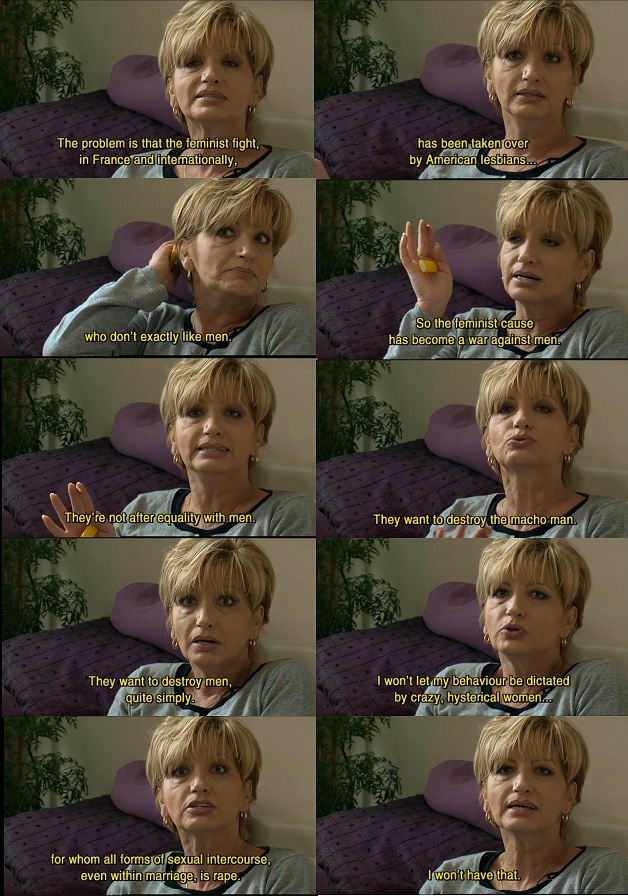
 This is more true than you know. A female politician in Sweden suggested a few years ago that all men should pay an "animal tax" because we're no Better than animals that are on trolled by our urges and spend all o our time fighting and raping women. Therefor, said tax would go towards the damages caused by men. Said woman also quit her political party to create the feminist party, whose every member was a men-hating lesbian. Originally Posted by Khajit
-
2013-03-17 06:11 #254I'm not safe on my island
Nikkei will still get me.
- Join Date
- Oct 2006
- Posts
- 20,043
- BG Level
- 10

So they basically made the republican party, but for women who hate men rather than vice versa. Finally, women are truly equal now.
-
2013-03-17 06:57 #255Yarglebargle
- Join Date
- Feb 2010
- Posts
- 3,304
- BG Level
- 7
- FFXI Server
- Valefor
 Except that has nothing to do with women; it's just lack of innovation and originality. If the original formula had been a man being rescued by a woman, then that would be the standard now instead of the opposite. Her arguments aren't applicable because the reasons behind the things she's arguing against have nothing to do with gender or equality. Originally Posted by quannum
EDIT: You can argue that AT THE TIME the decision to put the damsel in distress was due to views of gender equality, but that's not applicable anymore because they're not re-using that formula because of those views. They're using the formula because they know it works and don't want to risk trying something new, even though some games that have done so are wildly successful. (Bayonetta, Metroid, etc. Those are just the first two examples that come to mind.)
-
2013-03-17 08:12 #256E. Body
- Join Date
- May 2008
- Posts
- 2,392
- BG Level
- 7
- FFXI Server
- Cerberus
- WoW Realm
- Deathwing

while some storys can be poorly written theres nothing inherently lazy about the damsels in distress trope
-
2013-03-17 08:15 #257okay guy I guess
- Join Date
- Nov 2010
- Posts
- 24,393
- BG Level
- 10

-
2013-03-17 16:34 #258Renegade Philosopher
- Join Date
- Jul 2004
- Posts
- 4,439
- BG Level
- 7
One thing that tends to be glossed over in this debate is the question of whether or not games need to have an engaging storyline in the first place. There are developers who believe that storytelling should never come at the expense of gameplay, and some even believe that the two are inherently at odds with each other. The claim that using token plot elements to provide a bare-bones framework for a story is "lazy design" automatically assumes that games should have realistic or deep stories to begin with.
This is something that will be debated for a very long time in the game development community, but if someone wants to critique stereotypes in video game plots, I'm not sure Mario and Zelda are particularly apt franchises to focus on given their histories of focusing on gameplay over story. Of course, this supposes that the person doing this wants to have an honest intellectual discussion about the issues and not just create a highlight reel of out-of-context straw men.
-
2013-03-17 19:09 #259Yarglebargle
- Join Date
- Feb 2010
- Posts
- 3,304
- BG Level
- 7
- FFXI Server
- Valefor
I think that honestly depends on the game. I can overlook a weak story if the gameplay is really fun. I can also overlook some weak gameplay (though admittedly less than I would overlook a weak story) if the story is something I can relate to or like. Something like that is completely subjective though. Originally Posted by Quicklet
I don't think any single aspect of a game should overshadow the game actually being fun to play. If you're not having fun playing the game then what is the point? However you can derive fun from an engaging storyline as well as from engaging gameplay, but again that is subjective.
This type of discussion is a completely different topic though.
-
2013-03-17 20:36 #260Renegade Philosopher
- Join Date
- Jul 2004
- Posts
- 4,439
- BG Level
- 7
Right. My point isn't that one is better than the other. It's clear that there are crowds that enjoy both types of games. My point is that if someone wants to genuinely discuss the depiction of females in video games, it seems like it would be important to make the distinction between games which by their very nature are a series of tropes and games which are meant to be something more than that. This doesn't mean that gameplay-driven games with token plot devices are immune to criticism, but if the goal is to have an unsuperficial analysis of the topic with a time constraint of about 20 minutes, why would the focus be on those games that have a limited ability to treat characters as more than tokens?
As a crude analogy, Mario games are more like Goosebumps books than literary classics. You don't go into a Mario game expecting to get Hemingway. Likewise, you're not going to analyze Goosebumps books and extrapolate their flaws to the entire literary industry.

