 XI Wiki


Hah! Well at least you're honest
- Navigation
Results 181 to 200 of 262
-
2012-10-25 21:49 #181Campaign

- Join Date
- Aug 2007
- Posts
- 6,547
- BG Level
- 8

-
2012-10-25 22:06 #182Onto plan B...
- Join Date
- Aug 2008
- Posts
- 913
- BG Level
- 5
- FFXI Server
- Sylph
That guy gives engineers a bad name... AFK changing my major during senior year.
-
2012-10-26 00:06 #183Sandworm Swallows
- Join Date
- Aug 2007
- Posts
- 7,117
- BG Level
- 8
- FFXIV Character
- Litz Zatsuza
- FFXIV Server
- Sargatanas
- FFXI Server
- Sylph
Why not be the guy that gives engineers a good name? Originally Posted by Fairy-Killer

-
2012-10-26 00:18 #184Bagel
- Join Date
- Jan 2009
- Posts
- 1,412
- BG Level
- 6
Seems like it should be an open enough career. Originally Posted by AoE
http://imgs.xkcd.com/comics/engineering_hubris.png
But then again...
-
2012-10-26 00:21 #185You wouldn't know that though because you've demonstrably never picked up a book nor educated yourself on the matter. Let me guess, overweight housewife?
- Join Date
- Mar 2006
- Posts
- 22,829
- BG Level
- 10
- FFXIV Character
- Allyra Arianos
- FFXIV Server
- Sargatanas
- WoW Realm
- Windrunner

Guy probably has solanis-syndrome anyways and is still in school to be an engineer rather than actually is an engineer.
-
2012-10-26 18:52 #186Onto plan B...
- Join Date
- Aug 2008
- Posts
- 913
- BG Level
- 5
- FFXI Server
- Sylph
I'm giving engineers a good name by staying the fuck out of a subject I am not an expert in. That's what a good engineer does. Originally Posted by AoE
-
2012-10-27 21:31 #187BG Medical's Student of Medicine
- Join Date
- Oct 2006
- Posts
- 34,743
- BG Level
- 10
Wat
-
2012-10-28 06:53 #188Sea Torques
- Join Date
- Jun 2007
- Posts
- 697
- BG Level
- 5
- FFXIV Character
- Helmir Rainteau
- FFXIV Server
- Ultros
- FFXI Server
- Phoenix
I am somewhat sad our buddy seems to have left this topic. >:
-
2012-10-29 01:09 #189Ruke
- Join Date
- Nov 2005
- Posts
- 3,972
- BG Level
- 7
I wanted to see him refute his own source.

-
2012-10-29 10:15 #190Relic Shield
- Join Date
- Jan 2005
- Posts
- 1,554
- BG Level
- 6
- FFXI Server
- Odin
My experience with engineers and engineering students is they think everyone else is retarded and not worth a fuck. However, a lot of them couldn't spell, change the oil in their own car, or use vocabulary correctly in a sentence.
-
2012-10-29 11:38 #191Pied Piper of the Homos
- Join Date
- Feb 2009
- Posts
- 7,380
- BG Level
- 8
- FFXI Server
- Lakshmi
Ha! That made me laugh. Originally Posted by Qalbert
-
2012-10-29 16:07 #192Fake Numbers
- Join Date
- Oct 2012
- Posts
- 78
- BG Level
- 2
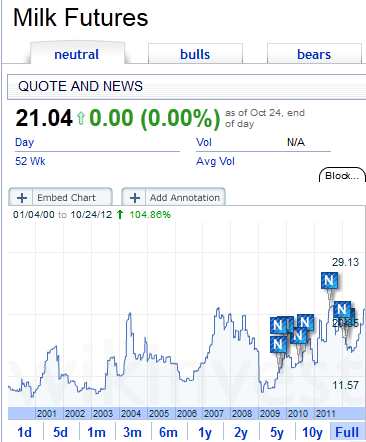
Since when is 8 to 21 a 33% increase? Originally Posted by RKenshin
-
2012-10-29 16:23 #193I'll change yer fuckin rate you derivative piece of shit
- Join Date
- Sep 2006
- Posts
- 58,781
- BG Level
- 10
Third-Party debate - Tuesday October 23rd
Futures don't reflect the cost of the good to consumer, which is what matters. Milk prices are up less than 3% per year over the past 10 years, they are not suffering from runaway inflation.
-
2012-10-29 16:25 #194Fake Numbers
- Join Date
- Oct 2012
- Posts
- 78
- BG Level
- 2
Futures are the most reliable source of actual prices one can find at any time of day week or year. Originally Posted by Pirian
There are two reasons petroleum engineers get paid alot. One is that the only universities that offer it (17 of them) are high-class universities like Stanford. The other is that a petroleum engineer is more well-rounded than a mechanical or chemical engineer. They have to know about chemicals, mechanics, fluid mechanics, the drilling processes. They leave the school knowing alot more useful things than other engineers. Originally Posted by Pirian
It has nothing to do with "selling your soul", half of the countries oil comes from small businesses like the one I work for. And they pay just as well or better, along with a better working environment and less cut-throat corporate bullshit.
People may believe the company I work for is the devil and that I sold my soul but I rest well knowing that there is no plastic, gasoline, rubber, asphalt, or lubricant without people like me. Without oil there is no hospitals, police, food in your grocery store, or vacations to hawaii.
I answered that alot. What isn't clear to you? Originally Posted by Salodin
-
2012-10-29 16:27 #195Fake Numbers
- Join Date
- Oct 2012
- Posts
- 78
- BG Level
- 2
Yes they do, thats how most grocery stores get their milk, by buying it on the futures market then transporting it from the storehouse to their store. The only differing factors here are the transportation costs to the storehouse/store and what day the store bought it. Originally Posted by archibaldcrane
-
2012-10-29 16:38 #196I'll change yer fuckin rate you derivative piece of shit
- Join Date
- Sep 2006
- Posts
- 58,781
- BG Level
- 10
Third-Party debate - Tuesday October 23rd
I already demonstrated that the price of a gallon of milk isn't inflating at even a quarter as fast as the futures. So, it doesn't work in this example. The price of a gallon of milk, over the past 10 years that you've been harping about, has risen less than 3% per year.
-
2012-10-29 16:44 #197Fake Numbers
- Join Date
- Oct 2012
- Posts
- 78
- BG Level
- 2
And I already said that if you're looking at previous highs to current lows, it's going to look like 3% a year. Originally Posted by archibaldcrane
But I said "from 1999 lows" so you're arguing that my favorite color isn't my favorite.
-
2012-10-29 16:48 #198I'll change yer fuckin rate you derivative piece of shit
- Join Date
- Sep 2006
- Posts
- 58,781
- BG Level
- 10
Third-Party debate - Tuesday October 23rd
I'm not looking at intentional highs to lows. Even if you took the lowest a gallon of milk has been in the past 10 years and compared it to the high, you're looking at about a 40% increase. It's not suffering from rampant inflation. Please believe me, I get that this is shattering your worldview but I'm not making things up here.
-
2012-10-29 16:49 #199I'll change yer fuckin rate you derivative piece of shit
- Join Date
- Sep 2006
- Posts
- 58,781
- BG Level
- 10
Third-Party debate - Tuesday October 23rd
If I could find the price of a gallon of milk in 1999 I would, best I can find is 2002-2012. Feel free to look yourself.
-
2012-10-29 16:52 #200Fake Numbers
- Join Date
- Oct 2012
- Posts
- 78
- BG Level
- 2
The chart I just posted shows $8.65 in 2000 to 21.40 in 2007. Originally Posted by archibaldcrane
That's a 40% increase?
a 40% increase from $8.65 would be $12.11


Similar Threads
-
"Yet another third party", or," what else have you got to lose?"
By Cantih in forum Politics: Advanced ShitpostingReplies: 0Last Post: 2012-01-18, 12:08