 XI Wiki


https://en.wikipedia.org/wiki/Health...ystem_in_JapanOriginally Posted by Synbios

https://en.wikipedia.org/wiki/Japan#...and_technologyPayment for personal medical services is offered through a universal health care insurance system that provides relative equality of access, with fees set by a government committee. People without insurance through employers can participate in a national health insurance programme administered by local governments. Patients are free to select physicians or facilities of their choice and cannot be denied coverage. Hospitals, by law, must be run as non-profit and be managed by physicians. For-profit corporations are not allowed to own or operate hospitals. Clinics must be owned and operated by physicians.
Japan is a leading nation in scientific research, particularly technology, machinery and biomedical research. Nearly 700,000 researchers share a US$130 billion research and development budget, the third largest in the world.[119] Japan is a world leader in fundamental scientific research, having produced sixteen Nobel laureates in either physics, chemistry or medicine,
- Navigation
Results 221 to 240 of 980
-
2013-10-01 19:54 #221The Fucking Voice of Actually

- Join Date
- Nov 2007
- Posts
- 10,992
- BG Level
- 9
- FFXIV Character
- Cantih Hacos
- FFXIV Server
- Gilgamesh
- FFXI Server
- Bahamut
- Blog Entries
- 6


-
2013-10-01 20:47 #222Relic Shield

- Join Date
- Jun 2007
- Posts
- 1,693
- BG Level
- 6
- FFXIV Character
- Zimt Zucker
- FFXIV Server
- Sargatanas
Well, okay, but other than Japan are there any?
-
2013-10-01 20:51 #223BG Medical's Student of Medicine
- Join Date
- Oct 2006
- Posts
- 34,661
- BG Level
- 10
So should doctors be in charge of the business side?
-
2013-10-01 21:28 #224You wouldn't know that though because you've demonstrably never picked up a book nor educated yourself on the matter. Let me guess, overweight housewife?
- Join Date
- Mar 2006
- Posts
- 22,829
- BG Level
- 10
- FFXIV Character
- Allyra Arianos
- FFXIV Server
- Sargatanas
- WoW Realm
- Windrunner

Isn't a lot of research in the US done through grants as is?
How much of that money comes from insurance companies which comes from our pockets?
I have never seen anywhere it saying the reason a night in the hospital costs 1k is to fund research on pills. It's always about covering the costs of the uninsured. I don't think this is going to effect medical research all that much, if at all.
-
2013-10-01 21:41 #225Campaign
- Join Date
- Aug 2007
- Posts
- 6,547
- BG Level
- 8
Already posted?
I know, you can edit a video to say anything, but I like how they did get the reaction of 1 person at the end when they told them they were the same thing. Wish they showed more people getting that news
-
2013-10-01 22:21 #226
SASSAGE KING OF DA WORLD
cheap hawks gay
- Join Date
- Sep 2007
- Posts
- 26,424
- BG Level
- 10
All the US medical research goes to diet/boner pills. Originally Posted by Ksandra
-
2013-10-01 22:57 #227The Anti Miz
The Anti Miz of the House of Weave
- Join Date
- Feb 2007
- Posts
- 32,666
- BG Level
- 10
I didn't even know he was back in DC lolol Originally Posted by Ksandra
-
2013-10-01 23:59 #228The Optimistic Asshole
Sweaty Dick Punching Enthusiast
- Join Date
- Aug 2005
- Posts
- 29,726
- BG Level
- 10
- FFXIV Character
- Tyche Six
- FFXIV Server
- Tonberry
To be fair to the question, Japan isn't single payer and their healthcare system is incredibly complex and convoluted.
-
2013-10-02 00:16 #229
Sweaty Dick Punching Enthusiast
- Join Date
- Sep 2010
- Posts
- 21,874
- BG Level
- 10
the Commerce Department did a study (which you currently can't see, yay Congress, http://info.trade.gov/) on funding in pharmaceutical research in single-payer systems and found that annual investment dropped by 5-8 billion, some private studies suggest something more like 15-20 billion in the larger nations. Originally Posted by Synbios
it's clear medical innovation does not magically retard into barbarism because public capital funds the studies as opposed to private capital (for example the Canadians are pioneering a promising new treatment for diabetes with pancreatic islet transplantation, it may render insulin obsolete one day) but the evidence also strongly suggests that private investment goes elsewhere in economies with single-payer systems with price controls. and historically private investment has always gone elsewhere when confronted with price controls. it likely always will.
however, the National Institutes of Health is already the largest funder of medical research in the United States, dropping 31 billion annually. given that the federal government spends around 3.5 trillion every twelve months, a readjustment of priorities could easily cover the private sector's shortfall, but it would require a restructuring of entitlements or cuts to defense spending (as any budget balancement does). the numbers probably don't work otherwise, barring tax increases. to get to a realistic number you'd have to extrapolate the 5-20 billion dollar figure to a population between three to twenty times the size of those studied, and then add all non-pharmaceutical medical research. it would not be an insignificant figure.
-
2013-10-02 00:20 #230
Sweaty Dick Punching Enthusiast
- Join Date
- Sep 2010
- Posts
- 21,874
- BG Level
- 10
also while Japanese healthcare is exceptional and they are a technological powerhouse on an international scale their biomedical research is mediocre; of those sixteen shiny noble laureates only two were medical researchers
http://www.rand.org/content/dam/rand...RAND_DB571.pdfThis report provides an overview of Japan’s health R&D system. Given Japan’s reputation for discovery, innovation, and their commercial applications, the nation’s underwhelming performance in health and medical research may be surprising to some. Within the Japanese research community, however, the diagnoses are well known: some mixed success in basic biomedical research, a weak tradition of clinical research, and a pharmaceutical industry beset with challenges related to drug development. Fortunately, having held the health and medical research sector up to its own country’s high standards, the Japanese government has made reforms over the past decade to help the country compete and contribute globally. So, although it may be true that Japan has a bit of “catching up” to do in this area, there are some recent and encouraging signs that it is doing just that.
-
2013-10-02 00:51 #231THIS IS BREGOR'S STORY
Beard +1
- Join Date
- Feb 2007
- Posts
- 23,089
- BG Level
- 10
- FFXI Server
- Bahamut

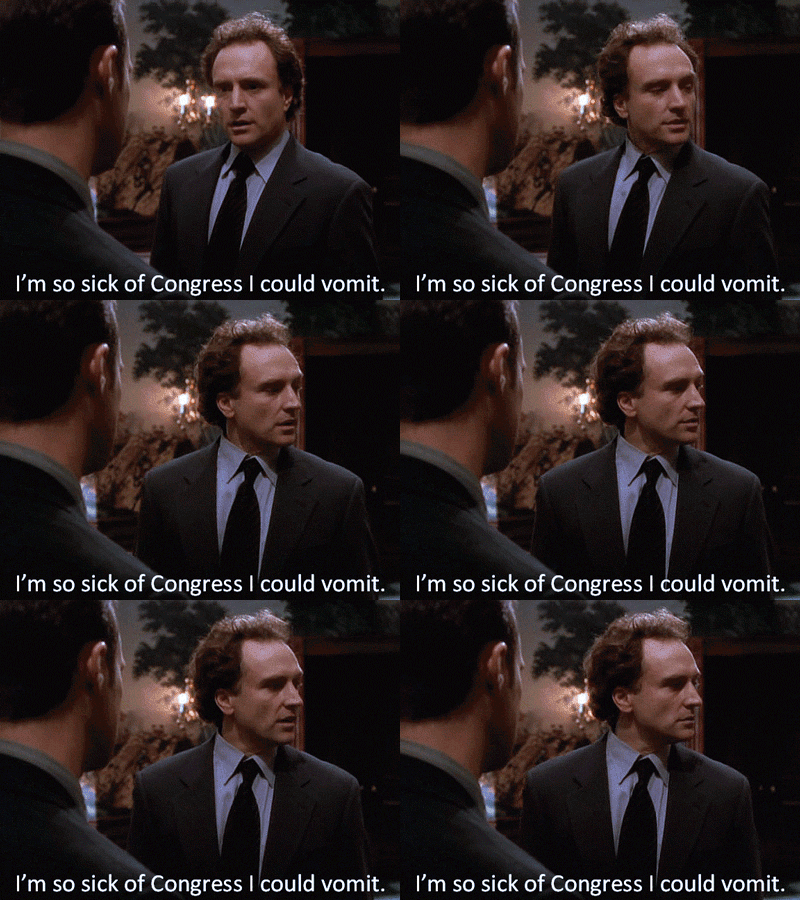
Liz Warren doing work:
Also, the current Republican leadership can't remember shit that happened 18 years ago:
http://en.wikipedia.org/wiki/United_..._1995_and_1996A 1995 ABC news poll had Republicans receiving the brunt of the blame with 46% of respondents compared to the 27% that blamed Clinton.[8] Clinton's approval rating fell significantly during the shutdown.[9] However, once it had ended his approval ratings rose to their highest since his election.
...
The shutdown also influenced the 1996 Presidential election. Bob Dole, the Senate Majority Leader, was running for President in 1996. Because of his need to campaign, Dole wanted to solve the budget crisis in January 1996 despite the willingness of other Republicans to continue the shutdown unless their demands were met. In particular, as Gingrich and Dole had been seen as potential rivals for the 1996 Presidential nomination, they had a tense working relationship.[16][17] The shutdown has also been cited as having a role in Clinton's successful re-election in 1996.[17]
According to Gingrich, positive impacts of the government shutdown included the balanced-budget deal in 1997 and the first four consecutive balanced budgets since the 1920s. In addition, Gingrich stated that the first re-election of a Republican majority since 1928 was due in part to the Republican Party's hard line on the budget.[18][19] The Republican Party had a net loss of three seats in the House in the 1996 elections but retained a 227-206 seat majority. In the Senate, Republicans gained two seats.
Lose the Presidential election, lose House seats, gain two Senate seats. Awesome template for success, that. Also fat chance of a balanced budget that includes one cent of tax increases since the House is at the mercy of insane super PACs and Grover fucking Norquist. My former party makes me very sad indeed.
-
2013-10-02 10:44 #232Sandworm Swallows
- Join Date
- Dec 2006
- Posts
- 7,328
- BG Level
- 8
A corollary question is how many of the new medicines or devices produced in our system are medically necessary? Ever heard of restless leg syndrome? Originally Posted by Synbios
-
2013-10-02 10:54 #233Banned.

- Join Date
- Jul 2007
- Posts
- 10,330
- BG Level
- 9
What do you mean? Main reason the Post Office is having trouble is the Government took money from them because they were the only "office" of government that had a surplus...then they didn't pay the Post Office back and etcetc the Post Office is charging more for stamps and trying to cut delivery of non-parcel mail on Saturdays. This won't ever happen though, most Post Offices have their carriers out doing OT every day. Cutting a day out of the week only means more mail on the worst day of the week. Originally Posted by Callisto
-
2013-10-02 10:59 #234
SASSAGE KING OF DA WORLD
cheap hawks gay
- Join Date
- Sep 2007
- Posts
- 26,424
- BG Level
- 10
I just mean that they aren't really currently pulling in enough cash to be self-sustaining anymore and are having financial difficulties because of what you mentioned. That said the service is surprisingly top-notch.
-
2013-10-02 12:19 #235King Bitcher of Bitchington
- Join Date
- Jul 2006
- Posts
- 3,493
- BG Level
- 7
- FFXIV Character
- Chuggs M'koul
- FFXIV Server
- Cactuar
Just read this: http://www.washingtonpost.com/blogs/...in-parliament/
is anything like that even possible in the states? Could everyone just be fired? lol
-
2013-10-02 12:25 #236RNGesus
Sweaty Dick Punching Enthusiast
- Join Date
- Jan 2005
- Posts
- 43,456
- BG Level
- 10
- FFXIV Character
- Lenette Valkyr
- FFXIV Server
- Gilgamesh

No. The article itself highlights why something like that can't be done. Would be almost nice though.
-
2013-10-02 12:29 #237
SASSAGE KING OF DA WORLD
cheap hawks gay
- Join Date
- Sep 2007
- Posts
- 26,424
- BG Level
- 10
If there were actual potential repercussions none of this would have happened, lol.
-
2013-10-02 13:03 #238Relic Horn
- Join Date
- Sep 2011
- Posts
- 3,379
- BG Level
- 7
- FFXI Server
- Leviathan
Anyone have any links on the "big business" and congressional exemptions from ACA? Not entirely lost on the latter reference, but I'm not having any luck finding source material on the former
-
2013-10-02 13:18 #239The Anti Miz
The Anti Miz of the House of Weave
- Join Date
- Feb 2007
- Posts
- 32,666
- BG Level
- 10
little movement today. Barry summoned the big 4 to the WH for a 530 meeting. Reid wrote to boehner offering to appoint conferees to discuss fiscal issues if boehner would reopen the gov't. Boehner basically told him to eat a dick.
more and more people think that the debt ceiling will be addressed in whatever they do to fix the CR/gov't funding and they think it will be sooner than 10/17 but not today or tomorrow.
-
2013-10-02 13:43 #240Nidhogg
- Join Date
- Apr 2006
- Posts
- 3,562
- BG Level
- 7
SQUAD

