 XI Wiki


Even so, that means they don't have to cut hours till June. I don't remember if it was here or somewhere else, but someone said that companies are essentially using the employer mandate as a scapegoat to cut hours.
- Navigation
Results 961 to 980 of 980
-
2014-02-06 04:43 #961
-
2014-02-06 08:04 #962Ridill

- Join Date
- Jul 2008
- Posts
- 11,383
- BG Level
- 9
 Well in theory a third or fourth party would take enough votes from both Demos and Repubs to force them to come to agreements with other parties in order to get enough votes. In practice in this country....the 3rd and 4th parties would just take bribes from the highest bidder and vote that way.
 Originally Posted by Kerberoz

-
2014-02-06 11:42 #963The Shitlord

- Join Date
- Feb 2008
- Posts
- 11,560
- BG Level
- 9
- FFXIV Character
- Kharo Hadakkus
- FFXIV Server
- Hyperion
- FFXI Server
- Sylph
- WoW Realm
- Rivendare
if they did it openly they'd at least be more honest than the dems or repubs. Originally Posted by Meresgi
-
2014-02-06 12:20 #964I'll change yer fuckin rate you derivative piece of shit
- Join Date
- Sep 2006
- Posts
- 58,875
- BG Level
- 10
What state are you in and how much will you make now? You'll likely be eligible for medicaid if it expanded in your state, or if you are in the 16-19k range the Obamacare subsidy will get you a bronze level insurance plan for free. Originally Posted by djzombie
-
2014-02-06 15:07 #965No, not really. Read up on Duverger's Law in plurality elections. At the core is the idea that rational voters (voters who vote to maximize their utility) will not vote for a party that has no chance of winning. If you arrange voters on a uni-dimensional voting scale (And yes, I know that a lot of people will say voting is more complicated and you can't put people on such a scale, but statistically, this holds up pretty well, so yeah~) and have an electoral system where the winner takes all, the voters can be arranged as a normal distribution and the equilibrium is for two parties to form, about the same distance from the center. Originally Posted by Meresgi
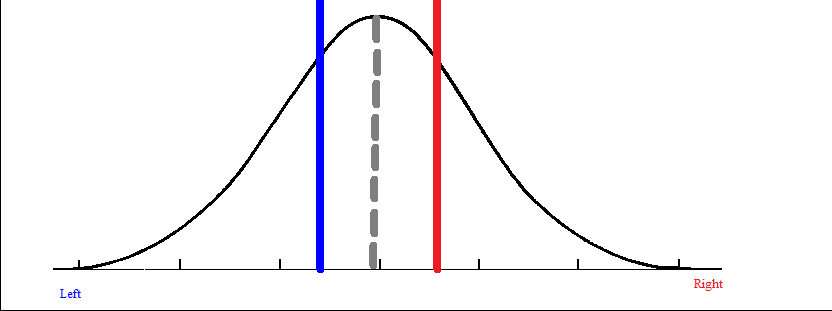
So let's say we have two parties, the blue and red party (original, I know~), represented by the blue and red lines. Anyone to the left of the blue line will vote for the party closest to them, IE the blue party, while those to the right of the red line will vote for the red party. Those in the middle will vote for the party that's ideologically closest to them, with the median voter (represented by the grey line if it was actually in the middle..) essentially flipping a coin. If either party moves away from the center, the other party can shift slightly towards them, end up winning more votes, and win the elections. In reality, the two parties are much closer to the median voter than I've drawn them, but this was in paint and I needed space to draw things between them..
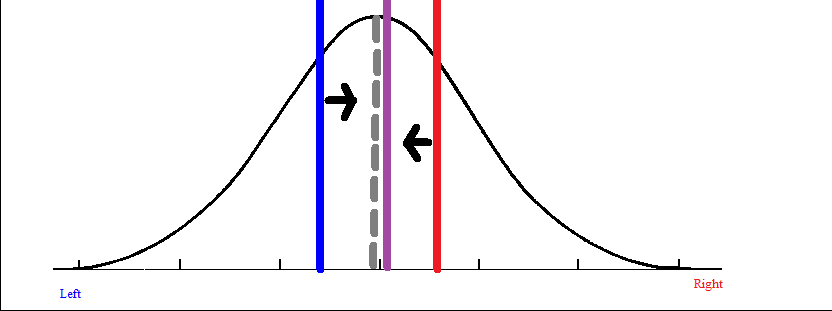
If a third party formed, let's say it's a centrist party (the purple party -- and let's pretend I put that line in the center..), those to the left of the blue line would still vote for the blue party while those to the right of the red line would vote for the red party. Those between the blue and purple (and purple and red) would still vote for the party closest to them. To get more voters, the blue and red parties would shift their positions to be closer and closer to the purple party, pulling more and more voters away. And the purple party doesn't have that same flexibility, so eventually, they wouldn't win any elections and rational voters would stop voting for them.
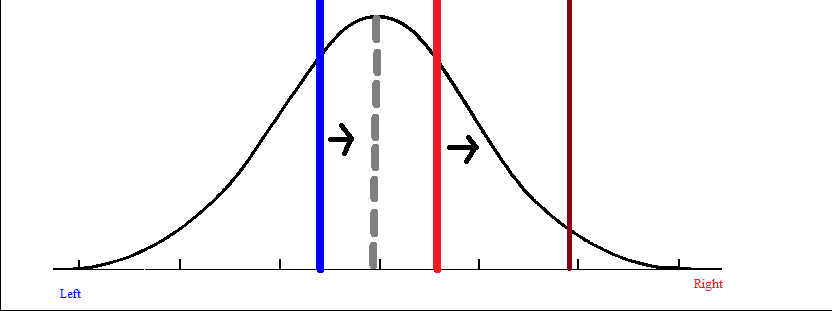
Now, let's say a third party formed to the far right (the russet party). Instead of taking voters away from both parties, they'll only take voters away from the red party. Voters to the right of the russet party will now vote for them while voters between red and russet will vote for the party they're ideologically closest to.
The red party will have two options to get more votes -- either shift to the left (depending on how close the two parties are) or shift to the right (pictured above). If it shifts to the center, either the blue party can stay where it is or shift to the left a bit. However, the blue party would be getting far more votes than the other to, and to win elections, the russet party would eventually shift closer and closer to the red party, eventually creating the same situation as with the purple party where the red party would eventually be deemed unfeasible. The other option is for the red party to move closer to the russet party. While this would peel voters away from the russet part, the blue party can then shift itself slightly to the right and basically ensure it is the ideologically closest party for over 50% of the electorate. Eventually people will realize the russet party isn't feasible and return to supporting the red party, but only after the blue party has forced its liberal agenda on everything, given free health care to everyone, and ruined capitalism.. Ehrm, I mean.. There are actually a number of political scientists who have written about how third parties can form to bring one of the centrist parties closer to them (like what the Tea Party tries to do), but how that can have short term rewards (the Tea Party could force the Republicans to become more conservative) but long term consequences (they'd allow the Democrats to win elections for a long stretch) -- I just can't remember their names atm.. This is why a lot of people believe that if the Tea Party ever fields a presidential candidate, it will only end up causing a lot of damage to the Republican party.
If you had two more parties form at the exact same time and the Democrats and Republicans shifted immediately, you could have more parties for an election or two, but it wouldn't be sustainable. Eventually the parties would adjust so that two of the parties would be made unfeasible.
I think I said everything I wanted, but it's been a few years since I've read any of this stuff, so hopefully I covered everything relevant.. Apologizes for the quality of the pictures -- I quickly made them in paint..
-
2014-02-06 15:40 #966A. Body
- Join Date
- Aug 2008
- Posts
- 4,264
- BG Level
- 7
Makes sense, more so with the current status of the Tea Party and the GoP as a fresh example. Would be entertaining to speculate what will be happening to the Democratic party as it continues its current projected path, what with the change in american voter ideology getting further and further left. I'm sure in a couple of decade we will be having this same discussion about the Democratic party being the conservatives while a new or re-emerging party further to the left taking the place of Republicans.
-
2014-02-06 18:11 #967The Shitlord
- Join Date
- Feb 2008
- Posts
- 11,560
- BG Level
- 9
- FFXIV Character
- Kharo Hadakkus
- FFXIV Server
- Hyperion
- FFXI Server
- Sylph
- WoW Realm
- Rivendare
russet
-
2014-02-06 18:32 #968
I couldn't think of what color that was, so I went with the name of a brownish-red >.>
-
2014-02-07 01:53 #969The Shitlord
- Join Date
- Feb 2008
- Posts
- 11,560
- BG Level
- 9
- FFXIV Character
- Kharo Hadakkus
- FFXIV Server
- Hyperion
- FFXI Server
- Sylph
- WoW Realm
- Rivendare
no no, i dig it. should be a thing. the Russet Party
-
2014-02-07 02:46 #970Campaign
- Join Date
- Aug 2007
- Posts
- 6,547
- BG Level
- 8
And they would be Irish. Or is that racist? Ahh, fuck it
-
2014-02-07 09:13 #971Ridill
- Join Date
- Jul 2008
- Posts
- 11,383
- BG Level
- 9
I see what you're saying. I've always had a fondness for the way Germany does politics.
http://www.washingtonmonthly.com/ten...part048282.php
Though America is far larger and more diverse then a single European country.
-
2014-02-07 11:13 #972
It isn't about the size of the country, it comes down to the electoral system. Germany's elections are Proportional Representation -- meaning the number of seats the party gets is dependent on the percentage of votes they get. That article says there are five parties currently in the German Parliament. Voters feel their vote isn't wasted as long as their party can get to the 5% cutoff point. The US could institute a PR system in Congress (they won't, but let's say they could..) and it would lead to similar results. If a PR system was instituted today, I can almost guarantee that the Tea Party would become a real party and would win at least 5% of the vote. The main reason there are only two parties is because elections are winner take all, so there's no incentive to support 3rd parties.
-
2014-02-10 16:20 #973The Anti Miz
The Anti Miz of the House of Weave
- Join Date
- Feb 2007
- Posts
- 32,666
- BG Level
- 10
employer mandate delayed to 2016 for businesses with less than 100 employees
-
2014-02-10 19:46 #974I'll change yer fuckin rate you derivative piece of shit
- Join Date
- Sep 2006
- Posts
- 58,875
- BG Level
- 10
So sayeth King Obama.
-
2014-02-11 00:20 #975
I don't... why?
It's always going to be "an inconvenience" for businesses and a lot of them are going to fight it. Was there a reason given for the delay?
-
2014-02-11 01:44 #976Relic Shield
- Join Date
- Sep 2010
- Posts
- 1,795
- BG Level
- 6
- FFXI Server
- Titan
I feel like I'm starting to see the effects of this at work. A lot of PT manager job postings are popping up at my work, as people at my theatre and others keep quitting to find something that will give them more than 25 hours a week. I know somebody who was rather pissed that they moved her to salary since it was cheaper than paying her 15-20 hours of overtime a week to cover the staff shortages.
-
2014-02-11 10:50 #977I'll change yer fuckin rate you derivative piece of shit
- Join Date
- Sep 2006
- Posts
- 58,875
- BG Level
- 10
I think jobs will start getting pinched by a lack of PT employees. Some will suck it up and start offering insurance, others will have to scrape the bottom of the barrel for workers.
-
2014-02-11 11:53 #978BG Medical's Student of Medicine
- Join Date
- Oct 2006
- Posts
- 34,907
- BG Level
- 10
I think if anything that this will force employers to stop practicing the art of part time, which I'm cool with. It's pretty annoying that people can't get many full time jobs anymore because of this. Originally Posted by archibaldcrane
-
2014-02-11 12:34 #979Relic Shield
- Join Date
- Jun 2008
- Posts
- 1,941
- BG Level
- 6
- FFXI Server
- Valefor
I don't think the part-time exemption will last too long. Kuro is right. There comes a point when you have to stop trying to save money by limiting employees hours and look at the bigger picture of job satisfaction which leads to better, more productive employees.
What about temp agencies though? How are the employees of those companies handled? I know our company used to use a temp agency and we were all over the board on hours. We would have 10+ people working 40 hours one week, then only 3 people working 18 hours the next week. The joys of industrial packaging supply. I'm off to google to sate my curiosity!
-
2014-02-11 12:46 #980
SASSAGE KING OF DA WORLD
cheap hawks gay
- Join Date
- Sep 2007
- Posts
- 26,424
- BG Level
- 10
Looks like Boehner doesn't want to fight this time around, and is going to hold a vote on a clean debt ceiling bill.

