 XI Wiki

Frack other people but don't you dare frack near me or my family.
- Navigation
Results 41 to 54 of 54
Thread: A Fracking thread.....HA!


-
2014-02-24 01:38 #41New Odin

- Join Date
- Jul 2006
- Posts
- 8,659
- BG Level
- 8
- FFXIV Character
- Sparthia Abysseant
- FFXIV Server
- Excalibur
- FFXI Server
- Lakshmi

-
2014-02-24 09:15 #42Relic Horn
- Join Date
- Jul 2007
- Posts
- 3,411
- BG Level
- 7
- FFXI Server
- Asura
they've been fracking there since before he moved in
he's made no effort to stop it since he moved in
but it must be about the fracking and not at all a trivial zoning conflict initiated by a rich neighbor over an ugly tower and hurr noise pollution
what's sad is that, if it were framed rightly as rich people problems, i could get behind it
-
2014-02-24 09:25 #43
Sweaty Dick Punching Enthusiast
- Join Date
- May 2005
- Posts
- 9,273
- BG Level
- 8
- FFXI Server
- Fenrir
yeah that lawsuit verbage is ridiculous - such a waste of effort and resources to hear that case
And we're pretty tidy with our drilling and production in North America. Just wait til large-scale fracturing happens in Nigeria; currently, it and Angola are about the worst places on the planet, thanks entirely to Oil&Gas + Continent of Corruption. That shit is such a mess of theft and earth-raping, and it's relatively simply produced in terms of depths and formation types.
-
2014-02-24 12:21 #44Electric Six groupie
- Join Date
- Sep 2007
- Posts
- 5,451
- BG Level
- 8
- FFXIV Character
- Jayne Barsala
- FFXIV Server
- Lamia
Rich NIMBYs - the bane of every urban planner, municipal zoning controller, and architectural designer - and now Frackers.
-
2014-02-24 17:41 #45I'll change yer fuckin rate you derivative piece of shit
- Join Date
- Sep 2006
- Posts
- 58,867
- BG Level
- 10
I'm squealing with delight watching the Beverly Hills NIMBYs continually lose court challenges against the subway being built underneath it.
-
2014-02-24 20:39 #46The Fucking Voice of Actually
- Join Date
- Nov 2007
- Posts
- 11,047
- BG Level
- 9
- FFXIV Character
- Cantih Hacos
- FFXIV Server
- Gilgamesh
- FFXI Server
- Bahamut
- Blog Entries
- 6
 ^
^ Originally Posted by archibaldcrane

My only regret is I'll be a senior citizen before LA county is properly mass-transited up.
-
2014-02-24 20:48 #47Chram
- Join Date
- Sep 2010
- Posts
- 2,667
- BG Level
- 7
- FFXI Server
- Quetzalcoatl
At least you'll make a cameo in an old Futurama episode. Originally Posted by Cantih
-
2014-03-10 18:07 #48BG Content
- Join Date
- Oct 2005
- Posts
- 70,413
- BG Level
- 10
- FFXIV Character
- Six Souls
- FFXIV Server
- Gilgamesh
- FFXI Server
- Quetzalcoatl
- WoW Realm
- Malorne
- Blog Entries
- 9

 It has been Determined that Fracking caused a 5.7 magnitude Quake in Oklahoma in 2011
 http://www.weather.com/news/science/...mined-20140309One of Oklahoma's biggest man-made earthquakes, caused by fracking-linked wastewater injection, triggered an earthquake cascade that led to the damaging magnitude-5.7 Prague quake that struck on Nov. 6, 2011, a new study confirms.
The findings suggest that even small man-made earthquakes, such as those of just a magnitude 1 or magnitude 2, can trigger damaging quakes, said study co-author Elizabeth Cochran, a seismologist with the U.S. Geological Survey.
"Even if wastewater injection only directly affects a low-hazard fault, those smaller events could trigger an event on a larger fault nearby," she told Live Science.
The Prague earthquake was the largest of thousands of quakes that rattled Oklahoma in late 2011. Three were magnitude-5 or stronger. The 2011 quakes struck along the Wilzetta fault, a fault zone near Prague. Earthquakes break faults like a boat plowing through thick ice — the fault zips open as the earthquake ruptures the fault, and then seals itself shut behind. Each of the three biggest quakes tore apart a different part of the Wilzetta fault, the researchers said.
Triggered Foreshock
The magnitude-5.7 earthquake near Prague was preceded by a 5.0 quake that hit a day earlier, on Nov. 5. This "foreshock" occurred near an active wastewater disposal well. The wastewater injection triggered the Nov. 5 earthquake, researchers concluded in a study published in March 2013 in the journal Geology. However, the Nov. 6 earthquake was farther from the wells.
"Just because two earthquakes occur close to each other in time and space doesn't necessarily mean they are related," said Cochran, who also co-authored the 2013 Geology study. "We wanted to look one step further and determine whether the stress change from the foreshock actually pushed the main shock rupture plane [the fault] to failure."
Earthquakes linked with fracking are rarely triggered by the actual oil-and-gas extraction. Rather, these quakes are caused by fluid disposal in deep wells. Fracking, short for hydraulic fracturing, involves injecting water, sand and chemicals into the Earth to crack open rock and remove oil and gas. The millions of gallons of waste fluids are usually pumped back into the Earth via deep "wastewater injection wells." The wastewater can lubricate or jack open fractures and faults, triggering earthquakes.
Fault Primed
In the new study, the researchers modeled the stress added to the Wilzetta fault by the Nov. 5 earthquake (the foreshock). The findings suggest that the first earthquake primed the fault for another, larger earthquake, which, in this case, hit the next day. The study was published March 7 in the Journal of Geophysical Research.
"When you have an earthquake, the stress goes up in some places and down in other places," Cochran said. "We determined that the mainshock [the Nov. 6 Prague earthquake] occurred in an area that had an increase in stress."
The boom in fracking in the central United States has paralleled an uptick in seismicity, with moderate-size earthquakes increasing in Colorado, Texas, Oklahoma, Ohio and Arkansas. The number of quakes in the central United States has jumped 11-fold in the past 30 years, according to the March 2013 Geology study.
http://www.livescience.com/28221-was...arthquake.html
-
2014-03-10 18:10 #49
Sweaty Dick Punching Enthusiast
- Join Date
- May 2005
- Posts
- 9,273
- BG Level
- 8
- FFXI Server
- Fenrir
Fuck that map. I was arrested south of Chandler and taken there.
Oklahoma and try-hard rent-a-cops are the worst.
-
2014-03-10 18:12 #50
Sweaty Dick Punching Enthusiast
- Join Date
- May 2005
- Posts
- 9,273
- BG Level
- 8
- FFXI Server
- Fenrir
And yet the total horsepower available for the fracturing services in North America is healthy and not really disappearing.
We just need to find a pay zone closer to the hot spot under the NA plate that's near Yellowstone now. Go rumble that loose prematurely.
-
2014-03-10 18:22 #51Relic Horn
- Join Date
- Jul 2007
- Posts
- 3,411
- BG Level
- 7
- FFXI Server
- Asura
Originally Posted by 6souls
huh Originally Posted by Article
-
2014-03-10 18:31 #52A. Body
- Join Date
- Aug 2008
- Posts
- 4,264
- BG Level
- 7
I think its the difference in method of how the wells are constructed before the pumping begins in earnest. Originally Posted by Drex
-
2014-03-10 22:37 #53
Sweaty Dick Punching Enthusiast
- Join Date
- May 2005
- Posts
- 9,273
- BG Level
- 8
- FFXI Server
- Fenrir
It's likely an older vertical well rather than a more recently drilled well with a fractured horizontal section. Old, shorter, vertical wells with a dated pump jack (prob drilled in the 50s, 60s, or 70s) litter Oklahoma and TX panhandle in the Granite Wash. Even more so in the Permian Basin in Midland / Odessa area in west TX. It was a busier field back in the day and busier today. The Permian and the Bakken (North Dakota) are gonna get sodomized with wellbores relentlessly, allowing our presidents to boast about energy independence rabble rabble for another two decades or so.
-
2014-03-14 15:01 #54BG Content
- Join Date
- Oct 2005
- Posts
- 70,413
- BG Level
- 10
- FFXIV Character
- Six Souls
- FFXIV Server
- Gilgamesh
- FFXI Server
- Quetzalcoatl
- WoW Realm
- Malorne
- Blog Entries
- 9
Hundreds of Oil Wastewater Wells Near Active Faults and Major Cities
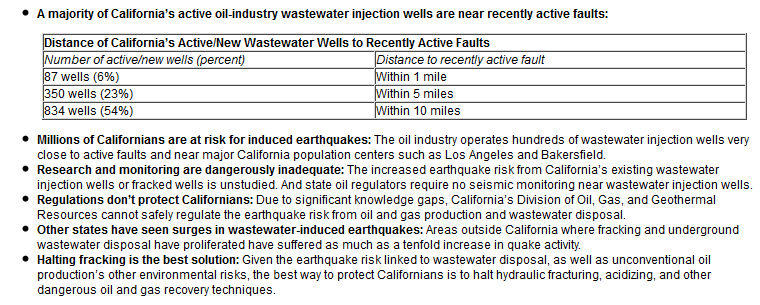
Already Raising Quake Risk for Millions of Californianshttp://www.biologicaldiversity.org/n...3-13-2014.htmlOil companies are increasing California’s earthquake risk by injecting billions of gallons of oil and gas wastewater a year into hundreds of disposal wells near active faults around Los Angeles, Bakersfield and other major cities, according to a new report from Earthworks, the Center for Biological Diversity and Clean Water Action.
A boom in hydraulic fracturing (“fracking”) in California would worsen the danger of earthquakes, the report found, by greatly increasing oil wastewater production and underground injection. Extracting the Monterey Shale’s oil could produce almost 9 trillion gallons of contaminated wastewater, which could expose California to a surge in damaging earthquakes like those seen in Oklahoma, Texas and other states experiencing rapidly increased fracking and wastewater production.
On Shaky Ground: Fracking, Acidizing, and Increased Earthquake Risk in California found that millions of Californians live in areas threatened by oil industry-induced earthquakes. Academic research and government experts have concluded that wastewater injection can reduce faults’ natural friction and trigger earthquakes.
State officials have not examined whether past earthquakes were triggered by fracking or disposal wells, and existing and proposed regulations do not adequately address the risk. Because of research and knowledge gaps and inadequate monitoring, state officials cannot protect Californians from induced quakes.
“This isn’t rocket science. We’ve known for decades that wastewater injection increases earthquake risk,” said Earthworks’ Oil and Gas Accountability Project California Organizer Jhon Arbelaez. “Since Gov. Brown resolutely refuses to learn from other communities’ experience with fracking across the country, our only option to protect California families is to prevent fracking altogether.”
“An oil fracking boom in California could raise the risk of devastating earthquakes in some of our biggest cities,” said report coauthor Shaye Wolf, Ph.D., of the Center for Biological Diversity. “State officials are ignoring the problem, but as risky new oil-production techniques spread, we could see trillions of gallons of wastewater shot into the ground near active faults. We need to nip this danger in the bud by halting fracking and acidizing.”
“The risk of seismic impacts is yet another illustration that the massive wastestream resulting from oil production threatens California's drinking water and public safety," said report coauthor Andrew Grinberg of Clean Water Action. "While threats to water, air and health have been well-documented, our emerging understanding of the risk of induced seismicity is yet another reason for a time-out on fracking. The findings in this report continue this troubling trend: The more we learn about California's oil industry, the more cause we find for alarm.”
The On Shaky Ground report’s key findings:
http://www.shakyground.org/

