 XI Wiki


x+2y=6Originally Posted by Nevermore

2y=-x+6
y=(-x+6)/2
y=-0.5x+3
Edit: line passes through (1, -6) so
-6 = -0.5 * 1 + b
b = -6 + 0.5
b = -5.5
Equation should be y=-0.5x -5.5
- Navigation
Results 61 to 75 of 75
-
2014-02-05 00:34 #61Ridill

- Join Date
- Feb 2006
- Posts
- 11,977
- BG Level
- 9

-
2014-02-05 00:41 #62Relic Shield
- Join Date
- Jun 2008
- Posts
- 1,941
- BG Level
- 6
- FFXI Server
- Valefor
Edit....beaten to it.
-
2014-02-05 00:50 #63Fake Numbers
- Join Date
- Dec 2008
- Posts
- 97
- BG Level
- 2
- FFXI Server
- Alexander
Nevermore, don't use the point-slope equation. You were right in subtracting over the x to get 2y=6-x, you then do divide through by 2 to get y = (-1/2)x+3. In this form you can see the line has a slope of (-1/2) with a y-intercept of 3. You're looking for a line parallel, so it has to have the same slope and a different y-intercept. Now, use y=mx+b equation. You have m=(-1/2) and are given a point (x,y), so plug that in and solve for b; giving you -6=(-1/2)+b or b=-5.5.
Can usually follow this same method, depending on the variables they give you to begin with- find the slope of the first line, then use that slope and the given point to find the y-intercept of the new line, giving you the full equation of the desired line.
-
2014-02-05 03:23 #64Remit One (1) Custom Title
- Join Date
- Sep 2007
- Posts
- 2,397
- BG Level
- 7
- FFXIV Character
- Qeomash Pandemonium
- FFXIV Server
- Cactuar
- FFXI Server
- Asura
 For a second, I thought you were talking about one of the idiotic rules that was taught to me when first learning algebra. Passing through the equals sign changes the sign, something about cows jumping a fence, and several others. None of them made sense until we had a substitute teacher who used to teach higher level math than middle school and explained it with what you're really doing: you are just changing the equation to suit your needs. x+2y=6...you don't want x on the left, so subtract x out to get rid of it. But in order to keep the equals sign true, you have to do the same to the other side. ( 4 = 4. You can't just add 2 to the left side and expect 6 = 4 to still be true. You have to do the same to both sides.) 2y=6-x. Originally Posted by octopus
As for the -x^y vs (-x)^y: with no leading term before the dash, it means that the term is negative. There is no reason to ever say nothing subtract x. That's just negative x. I'm guessing that this has become muddled because of computers and the odd way they do math.
Computer math talk:
Spoiler: show
-
2014-02-05 13:56 #65And they're spectacular!
- Join Date
- Feb 2007
- Posts
- 609
- BG Level
- 5
- FFXIV Character
- Mitzy Mystfire
- FFXIV Server
- Gilgamesh
- FFXI Server
- Titan
Chiming in late, but in my back-asswards, "I-was-third-in-my-class-but-there-was-only-11-of-us-LOL", Christian school math, I always learned that any equation basically starts at zero, which helps in interrupting scenarios like this where a negative sign is the first operator in the equation. So, I read:
-6^2
as
0-6^2
And according to PEMDAS, that would be equated as:
0-(6^2) = -36
/lolChristianschooleducation
-
2014-02-05 23:31 #66New Spam Forum
- Join Date
- Jul 2010
- Posts
- 193
- BG Level
- 3
- FFXI Server
- Valefor
Thanks for the help/explanations Octo/Qeo/Marokko. I really appreciate it. My apologies for the really delayed response, work and school today made for a very long day. Plus wading through 3 feet puddles just sucked so much. Spring, where are you?!
Back to math though. The answer the book provides is x + 2y + 11 + 0. I don't see where they are getting it from. Does it make sense to you guys?
-
2014-02-06 00:19 #67An exploitable mess of a card game
- Join Date
- Sep 2008
- Posts
- 13,197
- BG Level
- 9
- FFXIV Character
- Gouka Mekkyaku
- FFXIV Server
- Gilgamesh
- FFXI Server
- Diabolos

 That's what they wrote but restructured. Originally Posted by Nevermore
What they wrote
y=-0.5x -5.5
Add 5.5 to the left side
y + 5.5 = (-0.5x)
Divide by 0.5
(1/0.5)y + (5.5/0.5) = (-x)
Simplify the division
2y + 11 = (-x)
Add x
x + 2y + 11
-
2014-02-06 00:45 #68New Spam Forum
- Join Date
- Jul 2010
- Posts
- 193
- BG Level
- 3
- FFXI Server
- Valefor
Heh damn, how embarrassing. I need like a live in math tutor lol. Thanks for that Yugl.
-
2014-02-06 16:53 #692600klub

- Join Date
- Feb 2006
- Posts
- 9,098
- BG Level
- 8
- FFXIV Character
- Vandole Horsegod
- FFXIV Server
- Gilgamesh
- WoW Realm
- Windrunner
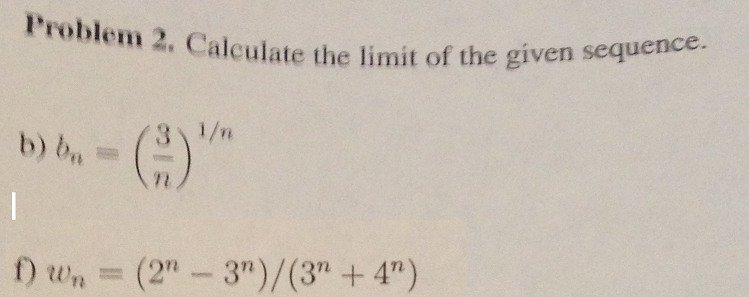
HIJACKED CAUSE I WANT SOME HELP. These two problems please, not sure where to start.
-
2014-02-06 16:54 #70Cerberus
- Join Date
- May 2007
- Posts
- 426
- BG Level
- 4
- FFXI Server
- Phoenix
- WoW Realm
- Duskwood
I've been hi jacked !! Glad to see my thread is helping people out !!
-
2014-02-06 16:55 #712600klub
- Join Date
- Feb 2006
- Posts
- 9,098
- BG Level
- 8
- FFXIV Character
- Vandole Horsegod
- FFXIV Server
- Gilgamesh
- WoW Realm
- Windrunner
too lazy to make my own thread cause im an asshole
-
2014-02-06 16:58 #72Cerberus
- Join Date
- May 2007
- Posts
- 426
- BG Level
- 4
- FFXI Server
- Phoenix
- WoW Realm
- Duskwood
We all talking math here it's all gewd in the hood.
-
2014-02-06 17:13 #73
log(b) = log(3/n)/n = log(3)/n - log(n)/n
Limit of log(3)/n as n goes to infinity is 0, as is log(n)/n. So:
log(b) = 0
b = 10^0 = 1
So the limit is 1.
w = (2^n + 3^n)/(3^n + 4^n)
log(w) = n*log(2 + 3) - n*log(3 + 4) = n*( log(5) - log(7) )
As n approaches infinity, log(w) approaches negative infinity. Thus, w approaches 0.
Edit: Actually, I'm not sure about the italicized step here. Is that legit? Either way, Wolfram Alpha agrees with me! The second way to solve that problem is just to look at it and go, "Top is gonna always be smaller than the bottom. Zero"
-
2014-02-06 17:35 #742600klub
- Join Date
- Feb 2006
- Posts
- 9,098
- BG Level
- 8
- FFXIV Character
- Vandole Horsegod
- FFXIV Server
- Gilgamesh
- WoW Realm
- Windrunner
Ah, shit. That's what I thought. Thanks
-
2014-02-06 18:30 #75Relic Shield
- Join Date
- Jun 2005
- Posts
- 1,906
- BG Level
- 6
- FFXI Server
- Asura
It's been a long time, but I'm pretty sure that is not a proper use of logarithmic rules. Originally Posted by Byrthnoth
Edit: Also, original problem was 2^n - 3^n on top, if it matters.


Similar Threads
-
MATH: Help with integer proof
By madpersian in forum General DiscussionReplies: 5Last Post: 2012-02-23, 14:27 -
Random Request: Help with nonsense products apple could release
By jinkazama in forum General DiscussionReplies: 43Last Post: 2010-03-14, 06:24 -
Random math question...
By TomodachiF in forum General DiscussionReplies: 5Last Post: 2010-01-06, 08:58 -
Other Random Math Help Prz
By Keno in forum General DiscussionReplies: 1Last Post: 2007-12-03, 11:24 -
need math help again :D
By untouchable in forum General DiscussionReplies: 11Last Post: 2006-02-28, 21:34 -
need math help part2
By untouchable in forum General DiscussionReplies: 12Last Post: 2006-02-01, 13:58