 XI Wiki


wow, how did Ramirez go that late? he's quietly in the top portion of SS in the league
looks like you and I will be rooting for some of the same people this year, my draft also included Lee, Galliardo, Perez, and Ramirez... i'm in a 16 team league though, no miggy for me. my first pick was encarnacion at 12
- Navigation
Results 41 to 60 of 995
-
2014-03-28 11:51 #41

- Join Date
- Jul 2006
- Posts
- 6,936
- BG Level
- 8

-
2014-03-28 12:00 #42Member since 2006 and still can't think of a title.
- Join Date
- Oct 2006
- Posts
- 28,169
- BG Level
- 10
- FFXIV Character
- Acanis Lindri
- FFXIV Server
- Midgardsormr
- FFXI Server
- Bismarck
- WoW Realm
- Kil'jaeden
 Some of these guys I swear just want to throw 40 bucks away. One guy not paying attention drafted jarred parker not realizing he had tommy john surgery and is out. Think it was the leading to my sixth round pick there was like 7 pitchers and 5 offensive people that all justified a sixth pick and was just a horrible run of pitchers. I'll admit I'm a little worried about my pitching but i'm hoping I can flip one of my guys for a starting pitcher. Holding out hope Abreu has a Puig like influence on the sox.
 Originally Posted by Xajii

-
2014-03-28 12:38 #43Chram
- Join Date
- Mar 2006
- Posts
- 2,702
- BG Level
- 7
Yeah, the Tigers basically need him to put up a HOF career just over the life of this contract to make it worth it. Originally Posted by archibaldcrane
-
2014-03-28 17:15 #44GATTACA!
Sweaty Dick Punching Enthusiast
- Join Date
- Dec 2009
- Posts
- 25,823
- BG Level
- 10
Keith Law on the (awful) Cabrera contract
http://insider.espn.go.com/blog/keith-law/post?id=2124In analyzing Miguel Cabrera's enormous contract extension with the Detroit Tigers, I might as well just rerun my column on the Ryan Howard contract from April 2010: Teams just do not need to extend veteran players who are two years from free agency out into their late 30s (or beyond).
The Tigers might as well just light much of the $292 million they're giving to Cabrera on fire or invest it in downtown Detroit real estate.
Cabrera is one of the best hitters in the game but not the best player even in his own league, because being the best player involves more than just hitting -- defense matters, position matters, baserunning matters, and Miggy, although preternaturally gifted at hitting, isn't very good at those other things. He's been worth about seven WAR (wins above replacement) per season over the past few, and paying $30 million per year for that kind of production is probably reasonable, even if it implies that a free-agent version of Mike Trout would be worth the GDP of a small island nation.
Way too many years
The issues with the deal are the timing and the length. The timing makes no sense -- Cabrera had two seasons to go to free agency, and the Tigers could just as easily have taken care of this next winter, perhaps after making sure Miggy stays healthy through the whole season. The leverage wouldn't have shifted; Cabrera would have been a year closer to free agency but a year older and perhaps a year heavier, too. He might even have declined offensively in the interim, although I wouldn't have bet on it. They could have waited even into 2015.
Any number of variables could have changed in the meantime that allowed them to strike a better deal; it is inconceivable that Cabrera's price would have gone up in that same span of time.
As for the length, we just went through this with Albert Pujols, who signed a heavily backloaded 10-year deal with the Los Angeles Angels before 2012, only to enter his decline phase on the flight to Anaheim, Calif. His body has begun to break down, too, as we often see with bigger players in their 30s. Cabrera is now signed through an age-40 season that, as likely as not, won't happen.
History not on Miggy's side
Cabrera is peaking now, but hitters of his type -- bat-only corner guys -- no matter how good, decline into their 30s and do so, in general, more precipitously than more athletic or up-the-middle players. Many corner players who were nearly as productive in their 20s as Cabrera didn't even make it to age 40, guys such as Ron Santo, Vladimir Guerrero, Bobby Bonds, Buddy Bell and Dick Allen, none of whom played past age 37.
The history of players like Miggy in their 30s and early 40s isn't promising for Detroit. Only seven corner position players (first base, third base, left field, right field or designated hitter) have generated 40-plus WAR past age 30 since 1961. All but Roberto Clemente played at least through age 39. No pure first baseman has done it; Edgar Martinez, who played through age 41, is the only DH to do so. The top first basemen on the list were Willie Stargell at 36.2 and Rafael Palmeiro, whose career ended in disgrace after a positive test for performance-enhancing drugs, at 35.8.
None of the players on the list of 35-plus WAR has a listed weight higher than Chipper Jones' 210 pounds, although I think we can safely say Barry Bonds weighed north of that in his late 30s; Miggy is listed, somewhat conservatively, at 240. Jim Thome, listed at 250 pounds, had the highest WAR after age 30 of any player listed at 240 or above, with 32.9, followed by Frank Thomas at 23.3 and David Ortiz at 23.0.
Ortiz might be the best comparison for what the Tigers can reasonably hope to get from Cabrera. Papi has stayed healthy and productive into his late 30s, averaging 132 games and 4.1 WAR over the past seven seasons. He earned $28.5 million over the past two seasons and will make $31 million over the next two, or just a little more than what Miggy will make per season under the new deal. And the Boston Red Sox have kept his contracts limited in duration rather than committing to him a decade in advance -- with no evidence at all that this has cost them any kind of significant premium.
Cabrera most likely will be a $30 million-per-year player in 2014 and 2015, but the Tigers already had those years under control at salaries well below that mark. The problem is that, even with increasing revenues across MLB driving salaries up, he's unlikely to be a $30 million-per-year player in 2016 or 2017, and the odds of him being that in 2023 are infinitesimal.
He and Justin Verlander are set to make about $58 million combined in 2019, playing in a market that is shedding population. It's not any better a formula from a business perspective than it is from a baseball one.
-
2014-03-28 17:19 #45Member since 2006 and still can't think of a title.
- Join Date
- Oct 2006
- Posts
- 28,169
- BG Level
- 10
- FFXIV Character
- Acanis Lindri
- FFXIV Server
- Midgardsormr
- FFXI Server
- Bismarck
- WoW Realm
- Kil'jaeden
Way prices are going, I would not be surprised in 3-4 years Trout gets a 350-400mil ten year contract.
-
2014-03-28 17:40 #46GATTACA!
Sweaty Dick Punching Enthusiast
- Join Date
- Dec 2009
- Posts
- 25,823
- BG Level
- 10
that's what's expected, but in his case he deserves it
-
2014-03-28 19:47 #47GATTACA!
Sweaty Dick Punching Enthusiast
- Join Date
- Dec 2009
- Posts
- 25,823
- BG Level
- 10
this is random and old but hilarious
http://www.baseballnation.com/2011/8...giants-marlins
-
2014-03-28 20:08 #48Special at 11:30 or w/e
Sweaty Dick Punching Enthusiast
- Join Date
- Feb 2012
- Posts
- 10,263
- BG Level
- 9
- FFXIV Character
- Kalmado Espiritu
- FFXIV Server
- Gilgamesh
- FFXI Server
- Sylph
- Blog Entries
- 4


Detroit radio was pretty unanimous that it's a horrible contract, but it's not Cabrera's fault and no one blames him for taking it. They also talked about how if the owner/gm want to give away all of their tv money for a few studs and the rest duds that's their problem and we probably will have a shit team in about 4 years. But, if a world series is won like, now, all would be forgiven in the city.
-
2014-03-28 20:33 #49GATTACA!
Sweaty Dick Punching Enthusiast
- Join Date
- Dec 2009
- Posts
- 25,823
- BG Level
- 10
But it's not like they had to give him a huge deal to keep him from leaving... he was under contract for two more years.
-
2014-03-28 21:53 #50BG's worst Rangers fan
Fleury 2; Lundqvist 0
Sweaty Dick Punching Enthusiast
- Join Date
- Nov 2007
- Posts
- 23,755
- BG Level
- 10
- FFXIV Character
- Bad Karma
- FFXIV Server
- Hyperion
- FFXI Server
- Quetzalcoatl
- WoW Realm
- Kel'Thuzad
Mike Trout signs 6 years 144 mil
-
2014-03-28 22:25 #51I'll change yer fuckin rate you derivative piece of shit

- Join Date
- Sep 2006
- Posts
- 58,691
- BG Level
- 10
What does that buy out? 1 free agent year?
-
2014-03-29 00:12 #52Member since 2006 and still can't think of a title.
- Join Date
- Oct 2006
- Posts
- 28,169
- BG Level
- 10
- FFXIV Character
- Acanis Lindri
- FFXIV Server
- Midgardsormr
- FFXI Server
- Bismarck
- WoW Realm
- Kil'jaeden
2 years of free agency and all his arbitration years. Will be 29 when he hits free agency, so if he continues to perform he'll get another massive pay day.
-
2014-03-29 00:37 #53I would prefer not to.
Moms Spaghetti
Philly Special
- Join Date
- May 2006
- Posts
- 39,032
- BG Level
- 10
changes to mlb drug policy/suspensions announced:
1st offense used to be 50 games, now 80
2nd offense used to be 100 games, now 162 (full season)
3rd offense lifetime ban
amount of tests done more than doubles: from 1400 urine samples to 3200, and an additional 400 blood samples during the season
if you are suspended during the regular season, you are automatically ineligible for that seasons postseason (ie, sit out 50 or 100 games, can return for last games of regular season, but if team makes playoffs, cu)
http://www.nydailynews.com/sports/i-...icle-1.1738443
-
2014-03-29 07:17 #54Special at 11:30 or w/e
Sweaty Dick Punching Enthusiast
- Join Date
- Feb 2012
- Posts
- 10,263
- BG Level
- 9
- FFXIV Character
- Kalmado Espiritu
- FFXIV Server
- Gilgamesh
- FFXI Server
- Sylph
- Blog Entries
- 4
I don't keep up on the ins and outs of contracts and what truly is a good deal, but radio made it sound as if this was smarter to get it taken care of ahead of time. Miggy is loved here and they are gambling with the odds stacked against them. I just hope they stay competitive and put on good games. Originally Posted by Moss
-
2014-03-29 12:30 #55GATTACA!
Sweaty Dick Punching Enthusiast
- Join Date
- Dec 2009
- Posts
- 25,823
- BG Level
- 10
If you want to be informed, here is another article that explains why it makes no sense: Originally Posted by Kalmado
Miguel Cabrera’s Historic Extension Is an Unconscionable, Indefensible, All-But-Guaranteed Mistake
and another, from Buster Olney:
To understand just how terrible the industry reviews are of the Detroit Tigers' deal with Miguel Cabrera, it's appropriate to draw on the examples from the movie industry.
The Cabrera deal, in the eyes of rival executives, is "Disaster Movie" bad.
The Cabrera deal, in the eyes of officials with other teams, is "Battlefield Earth" bad.
It's is "Heaven's Gate" bad. It is "Sahara" bad.
Folks from around the sport believe that Cabrera's deal is a guaranteed loser, and they do not understand what the Tigers could be thinking to sign on for this money pit that they know will have ripple effects on the entire industry.
"I just don't get it," one high-ranking NL executive said. "They lost their minds."
Said another: "It's an awful deal for the Tigers, and it's worse for baseball."
The criticism of the contract should not be confused with criticism of Cabrera, whose skills as a hitter are universally respected. But executives with teams other than the Tigers ticked off a bunch of ideas Thursday evening that they believe would have been better than Detroit giving Cabrera -- who turns 31 in 21 days -- the largest contract in the history of professional sports.
Among those:
1. The Tigers could've waited
"Why now?" was the most-asked question among officials who talked about the deal Thursday evening. They noted that Cabrera would not be eligible for free agency until after the 2015 season, and the officials questioned believe that if the Tigers had taken the same offer to Cabrera in the fall or next spring, there's no chance he would've passed on it because of the scope of the contract.
"If they had waited, they would've gotten another year of information, another year to monitor his health," one AL evaluator said. "Maybe he'll suffer an injury this summer. He's a big guy, and you don't know how long his body will be able to hold up [at that weight]."
Said another: "If you give a player a long-term deal two seasons before free agency, you usually can expect some sort of discount. Where's the discount?"
An NL official: "When A-Rod got his deal from the Yankees, he was a free agent. Cabrera's not even close to free agency, and he gets the biggest deal ever. It makes no sense."
An NL evaluator: "Why assume risk when you don't have to?"
2. The Tigers could've saved money and reduced risk with a different contract structure
Under the terms of Cabrera's extension, he will get the highest annual salary for any player, ever. Executives with other teams are convinced the Tigers could've signed him without committing for so many seasons.
"You could give him $35 million for three seasons [in an extension]," said one official, "and you would've saved yourself more than $100 million in risk. Hell, you could give him $45 million a year for three years, and it would've been impossible for him to turn that down -- and you save money on the back end."
3. The Tigers could've used the David Ortiz deal as a talking point in the negotiations
Defensively, Cabrera is viewed -- at best -- as a subpar first baseman, the position he will play in the immediate future, and rival officials assume that there will be a time within two or three years when the Tigers will shift Cabrera into a designated hitter role.
The highest-paid DH, by far, is David Ortiz, who just signed a one-year, $16 million extension. The DH spot is generally being de-emphasized within the industry, with teams veering away from identifying a full-time player at that position -- and paying a high salary.
Elite starting pitchers, shortstops, second basemen, third basemen and center fielders are paid a premium because of how production at their respective positions is valued, and on the other hand, designated hitters and closers are generally at the bottom end of that scale.
"You could make the [negotiating] argument that his salary should go down over time, because once he becomes a DH, he loses some value," an AL executive said. "Maybe you could've said to him, 'Hey, we'll pay you X for the next few years, but after that, we'll have an adjustment.' But Cabrera's salary goes up."
The NL evaluator said, with a high degree of astonishment: "He's going to get double what Ortiz will make. At least with A-Rod, the Yankees had a player who was playing a premium position where his production is outsized. Cabrera adds nothing defensively. He actually is a negative defensively, and that's not going to improve over time."
Said an AL executive: "They basically gave him $100 million-plus in a retirement package."
-
2014-03-31 00:28 #56GATTACA!
Sweaty Dick Punching Enthusiast
- Join Date
- Dec 2009
- Posts
- 25,823
- BG Level
- 10
Baseball tomorrow yay!
-
2014-03-31 08:33 #57The 69th Donor
Pens win! Pens Win!!! PENS WIN!!!!!
- Join Date
- Mar 2008
- Posts
- 15,071
- BG Level
- 9
- WoW Realm
- Kil'jaeden
I'm so ready, they've been hyping up Rays opening day here for the past week. Unfortunately, I have to work, but I showed up in style. I love having a casual dress code, Rays t-shirt and jeans on a Monday.

-
2014-03-31 08:38 #58THIS IS BREGOR'S STORY
Beard +1
- Join Date
- Feb 2007
- Posts
- 23,089
- BG Level
- 10
- FFXI Server
- Bahamut
Bonifacio 8, Lake 7, Castro 6, Rizzo 3, Olt 5, Castillo 2, Schierholtz 9, Barney 4, Samardzija 1
I can live with that this year.
THEO
-
2014-03-31 08:42 #59The 69th Donor
Pens win! Pens Win!!! PENS WIN!!!!!
- Join Date
- Mar 2008
- Posts
- 15,071
- BG Level
- 9
- WoW Realm
- Kil'jaeden
Balls I just realized that I'm an idiot and I missed out on fantasy.
-
2014-03-31 11:46 #60The 69th Donor
Pens win! Pens Win!!! PENS WIN!!!!!
- Join Date
- Mar 2008
- Posts
- 15,071
- BG Level
- 9
- WoW Realm
- Kil'jaeden
I just won free tickets at work - great seats, right on the 1B line.
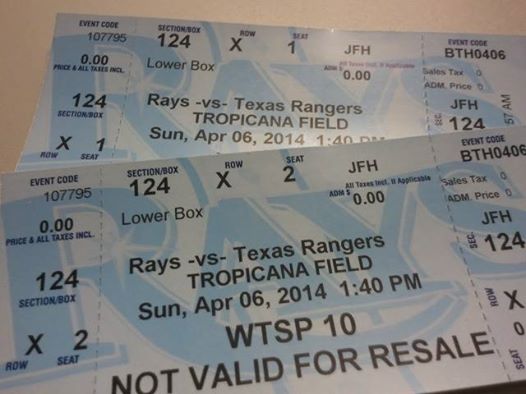
Fucking stoked.


Similar Threads
-
2014 NFL Off-season Thread: The Prince and the Piece of Shit
By Bregor in forum SportsReplies: 2422Last Post: 2014-07-31, 02:16 -
2013-2014 NBA Season Thread: LET'S GO SPURDS!
By Dimmauk in forum SportsReplies: 1980Last Post: 2014-06-22, 10:43 -
2013-2014 NHL Season Thread: EVERY GOALIE MUST BE TRADED, MISSION ACCOMPLISHED!
By Callisto in forum SportsReplies: 17287Last Post: 2014-04-15, 12:05 -
2013 MLB Off-season Thread: Official THEO Appreciation Thread
By Bregor in forum SportsReplies: 561Last Post: 2014-03-21, 16:42 -
MLB 2013 Season Thread: TEFLON BRAUN Episode V: The Selig Strikes Back
By Melena in forum SportsReplies: 1736Last Post: 2013-10-01, 03:26 -
2012 MLB Season Thread: I used to be a third baseman till I took a baseball to the eye
By Melena in forum SportsReplies: 3256Last Post: 2012-10-04, 09:45