 XI Wiki


i never get those things
and i never care
- Navigation
Results 2781 to 2800 of 3578
-
2015-06-24 16:03 #2781The Shitlord

- Join Date
- Feb 2008
- Posts
- 11,560
- BG Level
- 9
- FFXIV Character
- Kharo Hadakkus
- FFXIV Server
- Hyperion
- FFXI Server
- Sylph
- WoW Realm
- Rivendare

-
2015-06-24 16:51 #2782Campaign
- Join Date
- Aug 2007
- Posts
- 6,547
- BG Level
- 8
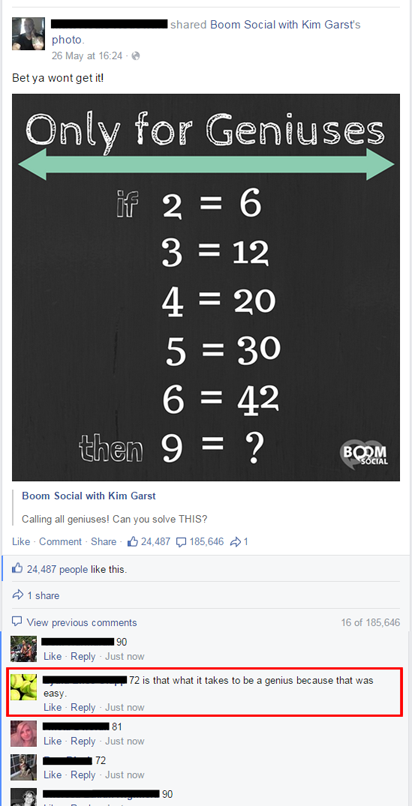
multiply by 3, then 4, then 5, etc.
-
2015-06-24 17:00 #2783Black Belt
- Join Date
- Nov 2006
- Posts
- 5,703
- BG Level
- 8
- FFXIV Character
- Adajer Vonte
- FFXIV Server
- Gilgamesh
- FFXI Server
- Asura
- WoW Realm
- Tichondrius

 multitply by itself, then add original number
 Originally Posted by Pirian

2 x 2 +2
3 x 3 +3
9 x 9 + 9 =90
not 72 I guess that is what makes it funny, cause he is wrong and not a genius
-
2015-06-24 17:02 #2784Banned.

- Join Date
- Aug 2007
- Posts
- 2,547
- BG Level
- 7
It's interesting that there's multiple ways to solve things like this. You seem to have found the pattern based on how the left side correlates to the right side. I found a pattern purely on the right side. To go from line 1 to line 2, add 6, line 2->3, add 8, then add 10, then 12, and so on. Math is neat. Originally Posted by Pirian
-
2015-06-24 17:05 #2785Sea Torques
- Join Date
- Oct 2006
- Posts
- 710
- BG Level
- 5
- FFXI Server
- Carbuncle
Couldn't it be either 72 or 90? It will result in 90 if you make the assumption that each number is multiplied by the following equation x(x+1). It will result in 72 if you make the assumption that i=i+1, where i starts at 2, for x*i. Then 9 just follows 6 in the sequence of x (skipping 7 and 8). The only answer that was truly wrong is 81.
-
2015-06-24 17:09 #2786Banned.
- Join Date
- Aug 2007
- Posts
- 2,547
- BG Level
- 7
It'd be a stretch to make that argument for 72, considering the question is phrased as "if... then". Originally Posted by Bardicrune
-
2015-06-24 17:15 #2787Shootin' rocks at monsters
- Join Date
- Sep 2007
- Posts
- 3,693
- BG Level
- 7
- FFXI Server
- Shiva
No, because the pattern doesn't continue to show you 7 and 8. It's 90. The trick is not showing you the missing numbers; by your thinking, we could replace the 9 with any number, and the next will be 72, but that seems silly since it's only continuing 1/2 the pattern, since the left side is part, too. Originally Posted by Bardicrune
-
2015-06-24 17:21 #2788Certified Enhancement Shaman
- Join Date
- May 2008
- Posts
- 1,872
- BG Level
- 6
- FFXIV Character
- Meph Taru
- FFXIV Server
- Diabolos
 I went that route first (used to logic tests) then I noticed the x * ( x + 1 ) = y Originally Posted by Blubbartron
-
2015-06-24 17:22 #2789Salvage Bans
- Join Date
- Feb 2008
- Posts
- 990
- BG Level
- 5
- FFXI Server
- Bismarck

I just multiple the first digit by the one under it. If 2=6, multiply by the 3. 4=20, multiply by the 5.
-
2015-06-24 17:36 #2790TrigunGuestThank you Originally Posted by Galkaeater

-
2015-06-24 17:42 #2791Cerberus
- Join Date
- Sep 2010
- Posts
- 490
- BG Level
- 4
- FFXI Server
- Bismarck
This is what I did and made sense to me lol. Originally Posted by Firedemon
-
2015-06-24 18:00 #2792Campaign
- Join Date
- Aug 2007
- Posts
- 6,547
- BG Level
- 8
Yeah, I spent 5 seconds looking at it after I read the text and tainted myself with "72". Hard to tell if I would have still thought 72 or I would have noticed that it jumped from 6 to 9 Originally Posted by Marootsoobutsu
-
2015-06-24 19:05 #2793Doesn't take it for granite
- Join Date
- Dec 2006
- Posts
- 2,370
- BG Level
- 7
- FFXI Server
- Asura
Originally Posted by Brill Weave
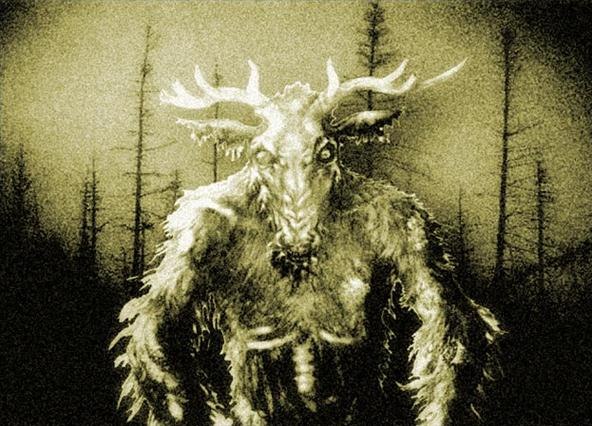
I wouldn't worry about it, Brill.
-
2015-06-24 23:11 #2794and the traveler
- Join Date
- Sep 2008
- Posts
- 591
- BG Level
- 5
added bonus for MGS fans! Originally Posted by Trigun
http://streamable.com/e/ou93
-
2015-06-25 10:04 #2795Brown Recluse
Sweaty Dick Punching Enthusiast
- Join Date
- May 2006
- Posts
- 28,255
- BG Level
- 10
- FFXI Server
- Unicorn
Btw, on the genius question. Since the pattern is multiples of 2, then the next three in the pattern is 14, 16, 18. So 14+16+18 = 48. 48+42=90
-
2015-06-25 12:17 #2796
The problem would have been more accurately written:
f(x) = y
f(2) = 6
f(3) = 12
f(4) = 20
f(5) = 30
f(6) = 42
f(9) = ?
There are probably any number of genuinely different possible equations defined by those first 5 points, but x(x+1) is the most obvious one. Most (all?) of the alternatives proposed in this thread are either incorrect or are just a series or algebraic reformulation of the simpler x(x+1).
For instance, Dimmauk's:
Alternatively, you could use:Code:6 12 (=6+3*2) 20 (=12+4*2) 30 (=20+5*2) 42 (=30+6*2) ? (=42+7*2=56) ? (=66+8*2=72) ? (=82+9*2=90)<--- What is this number
x^2+x
(x+1)^2-(x+1)
etc.
-
2015-06-25 15:11 #2797VuittonGuestEach number multiplies itself with the next higher number. Fun! Originally Posted by Meph
2 x 3 = 6; 2 = 6
3 x 4 = 12; 3 = 12
4 x 5 = 20; 4 = 20
5 x 6 = 30; 5 = 30
6 x 7 = 42; 6 = 42
7 x 8 = 56; 7 = 56
8 x 9 = 72; 8 = 72
9 x 10 = 90; 9 = 90
-
2015-06-25 15:32 #2798
Vamos los Perds!
- Join Date
- May 2006
- Posts
- 10,582
- BG Level
- 9
- FFXIV Character
- Wulfgang Amadeus
- FFXIV Server
- Hyperion
- FFXI Server
- Sylph
 This is exactly how I saw it Originally Posted by Vuitton
-
2015-06-25 15:39 #2799Absolute Messenger of Promathia
- Join Date
- Jan 2008
- Posts
- 13,228
- BG Level
- 9
- FFXIV Character
- Blaise Destin
- FFXIV Server
- Sargatanas
- FFXI Server
- Asura
I looked for a pattern above most things since thats usually how these work. I kinda saw it as the Right Column started at +6 and went up by +2 for each number next. I.e 6 to 12 is +6, 12 to 20 is +8, 20 to 30 is +10, 30 to 42 is +12. (Left column goes up by 1, right column goes up in increments of 2 to the previous, 6, 8, 10, 12, 14 and so forth) Originally Posted by Wulfgang
Also they usually have multiple conclusions based on how you view the pattern, which is why so many people can be "Right" based on how they came to the answer (though there are still wrong...)
-
2015-06-25 15:49 #2800Brown Recluse
Sweaty Dick Punching Enthusiast
- Join Date
- May 2006
- Posts
- 28,255
- BG Level
- 10
- FFXI Server
- Unicorn
Yes, the morons. Originally Posted by Karbuncle
Random
I want her to change my oil and other stuff




Similar Threads
-
Random Image Thread IX: load mrseptimus.dll
By Sonomaa in forum General DiscussionReplies: 1499Last Post: 2008-03-20, 16:54 -
Random Image Thread VIII: Just as planned
By Sonomaa in forum General DiscussionReplies: 1482Last Post: 2008-02-05, 20:51 -
Random Image Thread VII: !uno
By Sonomaa in forum General DiscussionReplies: 1478Last Post: 2007-12-10, 18:18 -
Random Image Thread VI: Erif-Fo-Eca
By Rocl in forum General DiscussionReplies: 1470Last Post: 2007-10-02, 00:31 -
Random Image Thread 5: Elmer the Random Chronicles
By Sonomaa in forum General DiscussionReplies: 1480Last Post: 2007-07-18, 08:06 -
Random Image Thread 3: Return of the Random
By Rocl in forum General DiscussionReplies: 2008Last Post: 2007-02-15, 12:03 -
Random Image Thread 2: Random Harder
By Sonomaa in forum General DiscussionReplies: 1984Last Post: 2006-12-17, 15:08 -
Random Image Thread
By Eddie in forum General DiscussionReplies: 1494Last Post: 2006-11-08, 12:47