 XI Wiki

Ferguson reveals depths of racial divide
jfc these numbers bother me.A new Pew Research Center poll shows many more African Americans than whites say:
The shooting of an unarmed black teenager Michael Brown by a white police officer "raises important issues about race" (80 percent of blacks and 37 percent of whites)
The police response to the shooting has gone too far (65 percent black, 33 percent white)
They have no or not much confidence in the investigation into the shooting (76 percent black, 33 percent white)
- Navigation
Results 701 to 720 of 4613
Thread: The Ferguson, Missouri thread


-
2014-08-18 14:11 #701Nidhogg

- Join Date
- Apr 2006
- Posts
- 3,717
- BG Level
- 7

-
2014-08-18 14:20 #702
SASSAGE KING OF DA WORLD
cheap hawks gay
- Join Date
- Sep 2007
- Posts
- 26,424
- BG Level
- 10
Did they only poll whites with Confederate flags on their trucks? Originally Posted by Talint

-
2014-08-18 14:23 #703Relic Shield
- Join Date
- Jun 2008
- Posts
- 1,941
- BG Level
- 6
- FFXI Server
- Valefor
There are other whites in the south? Originally Posted by Callisto
-
2014-08-18 14:25 #704I trusted Zet and this is what happened

Eleven owes me $40 bucks
- Join Date
- Jun 2007
- Posts
- 21,248
- BG Level
- 10
- FFXIV Character
- Kaslo Essyx
- FFXIV Server
- Famfrit
- FFXI Server
- Carbuncle

o.o/
But technically I'm between South, Midwest, and Southwest. Still the reddest state in the union.
-
2014-08-18 14:34 #705The 69th Donor
Pens win! Pens Win!!! PENS WIN!!!!!
- Join Date
- Mar 2008
- Posts
- 15,071
- BG Level
- 9
- WoW Realm
- Kil'jaeden
On what planet exactly? I know more vets (NG, Reserve, or otherwise) who can't find a job to save their lives. The only guarantee National Guard soldiers have is that when they return from any deployment that their job will be available for them. Originally Posted by kuronosan
Besides, it wouldn't surprise me if some of the Ferguson officers are actually in the state National Guard.
-
2014-08-18 14:39 #706I trusted Zet and this is what happened
Eleven owes me $40 bucks
- Join Date
- Jun 2007
- Posts
- 21,248
- BG Level
- 10
- FFXIV Character
- Kaslo Essyx
- FFXIV Server
- Famfrit
- FFXI Server
- Carbuncle
The vets didn't shoot african americans Originally Posted by Aksannyi
-
2014-08-18 14:46 #707blax n gunz
- Join Date
- May 2005
- Posts
- 11,141
- BG Level
- 9
 Originally Posted by Talint
Don't kid yourselves, this is a huge problem with white perception of our inequitably applied laws. Originally Posted by Callisto
Originally Posted by Talint
Don't kid yourselves, this is a huge problem with white perception of our inequitably applied laws. Originally Posted by Callisto
Telling white people the criminal justice system is racist makes them like it more
The first experiment was conducted in San Francisco in 2012, when the state of California was considering a reform to its "three-strikes" law. Researchers showed white commuters a short video that featured a series of inmate mugshots. One version of the video reflected the total prison population: 25-percent black. The other reflected the population imprisoned under the three-strikes law: 45-percent black.
Both groups agreed that the three-strikes law was too harsh. But if the video they'd seen had more black inmates in it, they were less likely to agree to sign a petition to change it. More than half of the first group signed the petition; only a quarter of the second group did.
In other words, according to the researchers, "the blacker the prison population, the less willing registered voters were to take steps to reduce the severity of a law they acknowledged to be overly harsh."The second experiment involved asking white New Yorkers about the stop-and-frisk program — after telling some of them that the New York state prison population was 40 percent black, and the rest that New York City's prison population was 60 percent black. Both groups agreed that stop-and-frisk was punitive. But again, the group that heard the 60-percent statistic was substantially less likely to want to sign a petition to end stop-and-frisk.tl;dr Whites are more convinced if you tell them the broken criminal justice system is a waste of money than if you tell them it's a racist shitcan designed to disenfranchise millions of blacks and latinos nationwide, despite both being equally true and the latter being a far more monstrous indictment of our society.As depressing as it is that telling white people about structural racism makes them support the structure more, what makes this study particularly interesting is that the criminal-justice reform movement isn't just made up of people concerned about racism. Some fiscal conservatives want to reform the system to spend less money on prisons; some cultural conservatives are motivated by Christian notions of mercy and forgiveness. And some of the states that have most successfully worked to reform their prison policies are red states.
The argument that prison should be reformed to save taxpayer dollars can seem a little bloodless. And it can lead to support for policies like private probation agencies that end up being just as repressive. But when it comes to persuading the public — at least the white public — that criminal-justice reform is a good idea, activists already have an idea of what works:
-
2014-08-18 15:29 #708BG Medical's Student of Medicine
- Join Date
- Oct 2006
- Posts
- 34,735
- BG Level
- 10
*sigh* Originally Posted by Aksannyi
Fuck sake, Aks.
-
2014-08-18 15:30 #709The 69th Donor
Pens win! Pens Win!!! PENS WIN!!!!!
- Join Date
- Mar 2008
- Posts
- 15,071
- BG Level
- 9
- WoW Realm
- Kil'jaeden
Were you being facetious before? Because if you were, I didn't quite catch it.
-
2014-08-18 15:51 #710SF Fan circa 1988
- Join Date
- Jun 2007
- Posts
- 916
- BG Level
- 5
- FFXIV Character
- Rakiel Kanan
- FFXIV Server
- Sargatanas
- FFXI Server
- Asura
If Missouri's National Guard is anything like my state's, they actually have a Civil Support Team (CST) who trains SPECIFICALLY for these situations. Our CST trains multiple times a month and features a large number of full-time personnel rather than traditional weekend-warriors. Originally Posted by Xno Kappa
-
2014-08-18 16:08 #711BG Medical's Student of Medicine
- Join Date
- Oct 2006
- Posts
- 34,735
- BG Level
- 10
Yes. Originally Posted by Aksannyi
-
2014-08-18 16:25 #712The Shitlord
- Join Date
- Feb 2008
- Posts
- 11,560
- BG Level
- 9
- FFXIV Character
- Kharo Hadakkus
- FFXIV Server
- Hyperion
- FFXI Server
- Sylph
- WoW Realm
- Rivendare
because it puts them in a defensive state of mind. they identify as part of the system. saying its racist makes them feel like youre calling them racist, and no one likes that. peons; l2have self identity Originally Posted by Correction
-
2014-08-18 16:33 #713E. Body
- Join Date
- Nov 2005
- Posts
- 2,010
- BG Level
- 7
Yes, but we're from the north so... Originally Posted by Acevalefor
-
2014-08-18 16:35 #714
Sweaty Dick Punching Enthusiast
- Join Date
- Dec 2006
- Posts
- 4,428
- BG Level
- 7
Be a real shame if these guys throw molotov cocktails at the reserve/guard folks, being a safe bet the majority of them are multiple deployment vets. That's not going to have a very positive outcome for anyone.
-
2014-08-18 16:40 #715Black Belt
- Join Date
- May 2010
- Posts
- 5,603
- BG Level
- 8
Too bad that, as of right now, the molotov cocktail narrative is pure fairytale and the residents of Ferguson will probably never live out that dream scenario.
On that note, if you'd like to make a quick Benji:
the silver burrito @occbaystreet 36m
Offering $100 to anyone who produces an image or video of lit, thrown, or exploded Molotov in #Ferguson before this tweet. #ObamaParrotsLies
-
2014-08-18 16:41 #716E. Body
- Join Date
- Nov 2005
- Posts
- 2,010
- BG Level
- 7
The unfortunate thing in all of this is that everyones mind is already made up. Even IF, brown did exactly what he's accused if in assaulting, going for the gun, and charging and everything in evidence points to wilson being justified in his actions. He's already lost and the people will never accept that Brown could be in the wrong.
I'm not saying that's the case, if Wilson is shown to be in the wrong, then fry his ass. But, even if he's cleared of everything people will blame the system and continue their racist thoughts.
-
2014-08-18 16:44 #717E. Body
- Join Date
- Nov 2005
- Posts
- 2,010
- BG Level
- 7
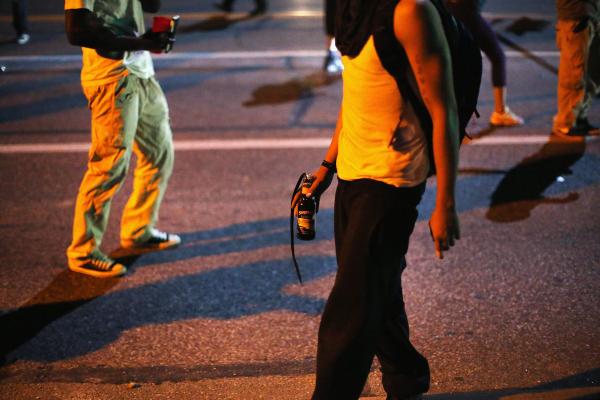
6souls posted this a few pages back. That guy is holding a molotov cocktail. Just because it isn't lit, thrown, or exploding doesn't mean they aren't there and being used.
Since it doesn't meet your criteria you can keep the money. But this is evidence enough that they are there and likely being used.
-
2014-08-18 16:45 #718Black Belt
- Join Date
- May 2010
- Posts
- 5,603
- BG Level
- 8
The autopsy report already came out. Stop posting your theory diarrhea.
-
2014-08-18 16:46 #719E. Body
- Join Date
- Nov 2005
- Posts
- 2,010
- BG Level
- 7
Yes but the investigation isn't over and the autopsy doesn't support the eye witness and what they are claiming. So stop being stubborn and just assuming you know what happened.
-
2014-08-18 16:48 #720blax n gunz
- Join Date
- May 2005
- Posts
- 11,141
- BG Level
- 9
Yes that's the unfortunate thing in this all, that a cop looks bad after killing a black guy. That's the big problem, that the cop looks bad. Originally Posted by Skyylya

