 XI Wiki

Sure is 2007 in here.
- Navigation
Results 61 to 80 of 152
Thread: Investment for Noobs


-
2014-09-11 13:41 #61Death by snoo snoo

- Join Date
- Sep 2006
- Posts
- 22,117
- BG Level
- 10
- FFXIV Character
- Syntax Error
- FFXIV Server
- Cactuar

-
2014-09-11 13:55 #62The 69th Donor
Pens win! Pens Win!!! PENS WIN!!!!!
- Join Date
- Mar 2008
- Posts
- 15,071
- BG Level
- 9
- WoW Realm
- Kil'jaeden
Test seems to have once again missed the part where I said I had already tried to get a mortgage. Twice. Both times, I was denied for having high debt. I do want to buy a home but I currently can't. It isn't going to work.
-
2014-09-11 13:57 #63Piece of shit Bruins fan

- Join Date
- Jun 2008
- Posts
- 5,520
- BG Level
- 8
- FFXIV Character
- Beat Daisukenojo
- FFXIV Server
- Hyperion

 Was coming here just to post this. Investing in a trailer in FL is like buying a stove that burns paper money. It's probably not safe and there's definitely better ways to waste your money.
 Originally Posted by Ksandra

-
2014-09-11 13:59 #64Death by snoo snoo
- Join Date
- Sep 2006
- Posts
- 22,117
- BG Level
- 10
- FFXIV Character
- Syntax Error
- FFXIV Server
- Cactuar
Buying any home in Florida is a risk. Especially longer mortgages
-
2014-09-11 14:01 #65You wouldn't know that though because you've demonstrably never picked up a book nor educated yourself on the matter. Let me guess, overweight housewife?
- Join Date
- Mar 2006
- Posts
- 22,829
- BG Level
- 10
- FFXIV Character
- Allyra Arianos
- FFXIV Server
- Sargatanas
- WoW Realm
- Windrunner
 Yeah. They are cheap as shit though. Originally Posted by Headspace
But as stated, she isn't going to get approved anyway.
-
2014-09-11 14:27 #66If you stopped to actually learn something you might not post these uninformed posts.
- Join Date
- Oct 2006
- Posts
- 1,493
- BG Level
- 6
 There is a bigger problem you can't "invest" your pennies out of. Originally Posted by Aksannyi
Rethink your priorities or that list will look longer the next time around. Originally Posted by Aksannyi
-
2014-09-11 14:29 #67Un-Rad Conrad
- Join Date
- Oct 2006
- Posts
- 5,019
- BG Level
- 8
- FFXI Server
- Carbuncle
Ak, do you have a Mint/You Need a Budget/Personal Capital/Excel spreadsheet that you use to track your spending and debt? I really cannot recommend more that you track every single dollar and put whatever excess money you have each month into your debt. This website is a little more extreme than how I expect most people to live (family of 3 lives in CO on $25,000/year and both adults retired at 30), but the general idea is sound and I enjoy the foundations of the blog. It's all about planning and willpower to get your debt down and start saving & investing. Mint is great for an at-a-glance view of your money.
-
2014-09-11 14:53 #68The Shitlord
- Join Date
- Feb 2008
- Posts
- 11,560
- BG Level
- 9
- FFXIV Character
- Kharo Hadakkus
- FFXIV Server
- Hyperion
- FFXI Server
- Sylph
- WoW Realm
- Rivendare
maybe you missed the part where THIS WHOLE THREAD IS ABOUT DOING EXACTLY THAT Originally Posted by test123
christ you're dumb, and apparently not limiting your stupid to poopdeck anymore
-
2014-09-11 15:11 #69Puppetmaster
- Join Date
- Oct 2006
- Posts
- 64
- BG Level
- 2
- FFXI Server
- Shiva
Getting out of debt is tough. I went through it 6 years ago and during that, my husband and I almost divorced! It took us 3 painful years of sacrifice but it was worth it. I didn't invest during that time but once the debt was gone, we had all this extra money that we weren't using to pay debt. Once you're ready to invest, look into Vanguard Target Retirement funds. They're less risky and the returns are pretty stable.
-
2014-09-11 15:11 #70Nidhogg
- Join Date
- Jun 2007
- Posts
- 3,528
- BG Level
- 7
- FFXI Server
- Odin
- WoW Realm
- Lightbringer
Why pay money to your landlord when you can pay even more to the bank, and the US Government! Who cares if you are spending twice as much as renting! The interest is tax deductible! That means you will lose slightly less than without it! Subsidies to slow the bleeding and give you hope! I only charge a 3% agent fee! Call today! Representatives are standing by! His name is Robert Paulson!
-
2014-09-11 15:14 #71If you stopped to actually learn something you might not post these uninformed posts.
- Join Date
- Oct 2006
- Posts
- 1,493
- BG Level
- 6
I paid 25k in interest last year on my mortgage, and my house rose 60k in value at the same time. Being 35k richer for just owning a house is hell of a lot better than being out 25k in rent. And that's not even counting deductibles. But what do I know.... Originally Posted by Seraph
-
2014-09-11 15:39 #72Special at 11:30 or w/e
Sweaty Dick Punching Enthusiast
- Join Date
- Feb 2012
- Posts
- 10,263
- BG Level
- 9
- FFXIV Character
- Kalmado Espiritu
- FFXIV Server
- Gilgamesh
- FFXI Server
- Sylph
- Blog Entries
- 4

It's a process and it sounds like you're sick and tired of being in debt and are willing to do what it takes to get out. As Skirkle stated, having a program that you can track your spending is a great thing to do. Two words really stood out in his post. Planning and willpower. It's the little things that really catch up. While this example is excessive, a friend and his fiance looked back at his spending over a six month period that they knew it related to food, energy drinks, and cigarettes. He works outside sales so he's constantly on the road and in the car. His average monthly tally was between $350-$400. That really motivated him to quit smoking, stop with the energy drinks, and start bringing a cooler with him every day.
I would print out two months of bank statements and examine where all of your money has went and then see where to lower bills and sacrifice. You will have to live like a pauper, but it will be worth it in the long run. A few suggestions:
Cut out all eating out and live off of the absolute cheapest food for awhile. You can do this without eating garbage. Take a page out of Cream Soda's book on that one.
Cut any tv you are paying for and internet if you can. If you absolutely cannot live without internet drop to the lowest plan.
Shop your auto insurance if you haven't recently. Try an independent agent that works with numerous insurance carriers. They will do the shopping for you and will have access to better markets. Another thing, is some companies offer huge discounts for multiple policies so look into renters insurance. Eg: Whenever I do an auto for a renter I always look at Auto Owners first because auto coupled with the lowest renters policy of $10k in coverage will be less than the auto policy on it's own.
Consider changing cell phone carriers if possible. If you can bare to have a cell phone carrier that isn't perfect you can save a lot of money. RingPlus offers an unlimited talk/text with 200mb data for $12.99 per month. They run off of Sprint's towers. You must use a Sprint phone with a clean esn. I've been using it for a week now on a test run and I have been told I'm much clearer on calls versus Metro Pcs.
I hope these suggestions help in your fight against debt!
-
2014-09-11 16:36 #73Black Guy from Predator.
Uppity Negro
Secret Admin
The Immortal Bill Duke
- Join Date
- May 2008
- Posts
- 15,697
- BG Level
- 9
pretty sure test is just being a cunt for the sake of sounding high and mighty. get off your horse and shut the fuck up, guy.
i think im gonna get in trouble for calling someone a cunt in an aks/ksan thread, oh well
-
2014-09-11 17:24 #74Ruke
- Join Date
- Nov 2005
- Posts
- 3,972
- BG Level
- 7
How can you talk about inflation as an important consideration, and then in the same breath post charts that are NOT inflation adjusted in sale prices? Originally Posted by test123
Quick search & source:
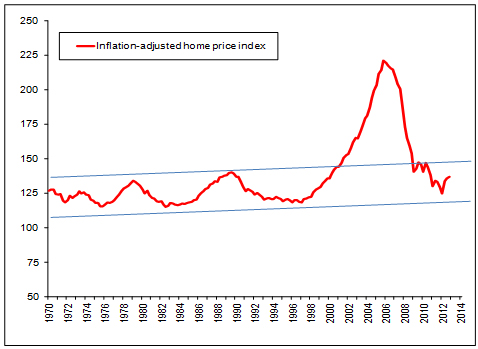
http://www.forbes.com/sites/rickferr...estment-again/
Or a better chart/more info here:
http://www.jparsons.net/housingbubble/
tl;dr: If you bought a house for ~$150,000 around 44 years ago (in today's dollars), you would now have a house worth ~$200,000. Congrats on earning 33% on your money over 44 YEARS.
(note: This is equivalent to making an average of a 0.66% return on your investment, per year)
BUT DONT MIND THAT LOL
EDIT: Even IF you take the price at the peak of the housing bubble at ~$220,000, you're only up to an average yearly return of 0.87%.
The inflation adjusted S&P Index, by the way, averages ~7% in returns each year. Which would turn $150,000 into ~$2,994,000 over the same period.
BUT DONT MIND ANY OF THAT EITHER LOL
EDIT2: This is all also ignoring the fact that the sale price is not what you paid on the house, if you took out a loan. A $150,000 house with a 20% downpayment and a 30-year term, and a 5% interest rate, would have a total cost of $231,906. So, 44 years later, you would actually still be in the hole on your housing investment by $10,000-30,000.
BUT DONT MIND ANY OF THAT AS WELL LOL
-
2014-09-11 17:27 #75Ridill
- Join Date
- Jul 2008
- Posts
- 11,354
- BG Level
- 9
Interesting shit in here, I didn't know about that thing with Sallie Mae. Good to know because when I start paying back, I was going to pay a lot extra per month and if it all went to future payments and not the principle I would have been fucking livid...how is this legal again for them to do that? Luckily all my loans are under 7%. I'm guessing the 13% is from a bank or private lender and not from FAFSA loans? I feel bad if you did private loans because they are a fucking nightmare.
Currently have over $55k in student loan debt. Luckily I landed a job paying over $60k/yr and prospects of making over $70k within in next year. Just need to move out of this shit area, paying $1400 for rent is balls.
-
2014-09-11 20:36 #76Yoshi P
- Join Date
- Jan 2006
- Posts
- 5,297
- BG Level
- 8
- FFXI Server
- Sylph
I feel like for every story of someone who talks about how much their house is up, I've heard stories about people (not dumb ones either) who have the opposite. My grandparents? On paper, their house is doubled in value since they bought it nearly 30 years ago, though if you look at it, it just kept pace with inflation, if that (a point laid out by Ruke's diagram). Mom? Underwater on her mortgage since the market tanked shortly after. I don't deny that real estate can be a solid investment at times, but it seems like you're really gambling if you're trying to have the place you live in double as an investment. Colleague of mine? Recently sold hers well above what she paid, but Bay Area housing, so.I paid 25k in interest last year on my mortgage, and my house rose 60k in value at the same time. Being 35k richer for just owning a house is hell of a lot better than being out 25k in rent. And that's not even counting deductibles. But what do I know....
But I also get a little testy (ha ha! pun) when the people who advocate "buy a house!" are doing it with help from family and such. But maybe I'm also a little annoyed because LOL CA housing prices.
..That aside, good advice in this thread.
I've seen a lot of posts on 401k's, but how about those of us with 403b's that don't offer matching?
My employer just gives us a list of vendors and after doing my own research (already have another retirement account open), Vanguard seems like the best bet. Unfortunately, they have a list of about 40 different funds I can invest the money in. I've read some things about asset allocation and thought about spreading out the money across a few different funds (sadly, admiral shares are not included). Or I could take the easy route and put the money in a Lifecycle fund, though I've heard mixed things about those.
The prime argument I've heard is that they don't perform as well as a more actively managed portfolio, and that they haven't been around long enough to really gauge. But when I looked at the performance data available, it wasn't *terrible" over a span of about 5 years.
Mostly, I like the idea of that fund (the 403b) being a 'toss money into it, forget about it into retirement, trust that it isn't totally hemorrhaging money'. As was pointed out by someone earlier, I'm one of those 'my goal isn't to make the most amount of money possible'. I have other money that I play around with in a few index funds.
I actually had to call Sallie Mae up and get this changed. I'd paid down a smaller loan with some extra money I had, and while there were hoops to jump through, I was able to get that loan paid off.I didn't know about that thing with Sallie Mae. Good to know because when I start paying back, I was going to pay a lot extra per month and if it all went to future payments and not the principle I would have been fucking livid...how is this legal again for them to do that?
I have one more loan through them, but the interest rate's stupidly low and it's such a small amount that I really just do it to help my credit score.
-
2014-09-11 21:07 #77The 69th Donor
Pens win! Pens Win!!! PENS WIN!!!!!
- Join Date
- Mar 2008
- Posts
- 15,071
- BG Level
- 9
- WoW Realm
- Kil'jaeden
You're not offending me with that at all. I am pretty much right along with you on the cunt bandwagon lol. Originally Posted by Abandon
Kalmado, those are good pointers. Some of those are not feasible for me at the moment (looking at the cell phone plan, because I just switched providers and I'm not all about the early termination fees) but I do live actually very frugally already. Basically, without my VA payments for school, I'd be making exactly enough money to survive each month. I'm trying to pay off the truck so my insurance will go down - because I have to carry collision as long as I'm financing the truck - once that's paid off my monthly bills will drop over $400. Then all of that money is going to Sallie Mae.
-
2014-09-12 22:55 #78I'll change yer fuckin rate you derivative piece of shit
- Join Date
- Sep 2006
- Posts
- 58,856
- BG Level
- 10
Just read the first page, but your first step is paying off all your loans with 5%+ interest at least (in order of interest from high to low).
Don't worry about investing til that is done.
-
2014-09-12 23:00 #79I'll change yer fuckin rate you derivative piece of shit
- Join Date
- Sep 2006
- Posts
- 58,856
- BG Level
- 10
Ok, Skirkle did the thing. Do that.
-
2014-09-13 03:34 #80If you stopped to actually learn something you might not post these uninformed posts.
- Join Date
- Oct 2006
- Posts
- 1,493
- BG Level
- 6
Dude, you missed the point. You don't adjust for inflation, you rely on inflation to eat up the loan. Originally Posted by RKenshin
The "If you bought a house for ~$150,000 around 44 years ago (in today's dollars), " is a useless argument. You don't count in today's dollars, that's the point. You buy a house 44 years ago for $25,000 which in today's dollars are $150,000. A 20% down payment on 20k is 5,000$. So you loan $20,000 and buy the house. If you only paid interest for 44 years on those 20,000$ your loan would still be 20,000$. Say the house is now worth $200,000 as in your example. You now have $180,000 in value.
Had you instead rented for 44 years you would not have 180,000$. That is why you want to stop paying rent asap! Paying rent is like paying down someone else mortgage!
If this lady can't get a mortgage, live with another person or lower her living standards then I can only think of one more option. Ask family or friends for a loan to cover and consolidate all your smaller loans. You might even get away with a 3%, better then 12%+.... With all loans paid down, go seek the bank for mortgage and keep your mouth shut about owing family money. Buy a place.


Similar Threads
-
Chuckie says farewell for awhile.
By Chuckie in forum General DiscussionReplies: 7Last Post: 2004-07-22, 11:35