 XI Wiki

The problem stems from when laws are in effect and are being enforced, at least in theory, but when you have things like the wage gap, which is illegal, still occurring - then it becomes a burden of proof thing, and unfortunately, there are always loopholes around it.Originally Posted by Blubbartron

So yes, we do need to change fundamental ways of thinking about things if we want things like that to change, otherwise, things like racial discrimination, sexism, sexuality discrimination, religious discrimination, will continue to be perpetuated "under the table" while people still believe that just because the slaves were freed that racism is gone. You already have a generational shift in the way children are being raised, where gender roles are being enforced much less stringently, where women are stepping up to the way they're poorly depicted in the media so that we can stop imposing these things on our children, children who grow up thinking that women are inherently lesser and having no idea why that is. It isn't a quick change, that's for sure. But change is happening.
And we don't have to make everyone like each other. I dislike a whole lot of people. But ending our inherent biases towards people simply because of who/what they are, be they black, Hispanic, gay, female, Asian, Muslim, Christian, trans, etc., means that we can dislike people simply because, "Well, that guy is an asshole," and not because of aforementioned physical or social characteristic that they cannot change, religion notwithstanding. There's a difference. I certainly don't expect everyone to like me, but I absolutely should be respected, I should have a say in what I do with my body (including sex, birth control, abortion, tattoos, hair color, etc.), I should be paid the same amount of money for doing the same job, and I should be viewed as an equal to a person with the same qualifications who just happens to be male.
Unfortunately, those things are not the case, and I refuse to stop fighting for equal rights for men and women until that happens.
- Navigation
Results 121 to 140 of 1523
Thread: Feminist Philosophy


-
2015-02-02 00:06 #121The 69th Donor

Pens win! Pens Win!!! PENS WIN!!!!!
- Join Date
- Mar 2008
- Posts
- 15,071
- BG Level
- 9
- WoW Realm
- Kil'jaeden

-
2015-02-02 00:15 #122Banned.

- Join Date
- Aug 2007
- Posts
- 2,547
- BG Level
- 7
Please, please, please stop bringing up the mythological wage gap. It's been covered to death that it does not exist in any meaningful way. The rest of your argument 100% hinges on the wage gap being a thing that exists, and that it exists because of discrimination (sexism, in this case). Neither of those things have any evidence supporting them. Do I really need to link the study showing that something like 96% of the "wage gap" is explained by choices of individuals again? How about the study showing that women out of college, prior to having children, make more than males in the same jobs by around 5%? Originally Posted by Aksannyi
The wage gap isn't up for debate anymore. Women are not discriminated against in terms of salary/wages. People that continue to think this are either willfully ignorant or delusional.
-
2015-02-02 00:31 #123The 69th Donor
Pens win! Pens Win!!! PENS WIN!!!!!
- Join Date
- Mar 2008
- Posts
- 15,071
- BG Level
- 9
- WoW Realm
- Kil'jaeden
I've personally seen it in action twice (and, of course, was unable to prove it), but okay. Gender equality still doesn't exist, and gender discrimination when hiring still exists as well. https://www.esa.org/esablog/research...an-a-jennifer/ Originally Posted by Blubbartron
Also, I would like to hear your thoughts on
And when I say sex, that doesn't just mean my right to consent, it means my right to be sexual however I please without judgment. It also means my right to dress how I please without being criticized based oh how much (or little) skin I show. My right to breastfeed my children in public without being shamed for baring my breasts (which, in most countries, are not considered sexual organs and are not regarded as taboo).And we don't have to make everyone like each other. I dislike a whole lot of people. But ending our inherent biases towards people simply because of who/what they are, be they black, Hispanic, gay, female, Asian, Muslim, Christian, trans, etc., means that we can dislike people simply because, "Well, that guy is an asshole," and not because of aforementioned physical or social characteristic that they cannot change, religion notwithstanding. There's a difference. I certainly don't expect everyone to like me, but I absolutely should be respected, I should have a say in what I do with my body (including sex, birth control, abortion, tattoos, hair color, etc.).
I would really like to hear your thoughts on internal biases. You have stated that you don't believe that you can stop people from being racist or sexist, that it'll always be the case. I strongly disagree, and I outlined my thoughts on that before - but you chose to focus on the wage gap part of my argument. I would like to hear your thoughts on internalized biases and changing how people view others.
-
2015-02-02 00:33 #124Bagel
- Join Date
- May 2010
- Posts
- 1,277
- BG Level
- 6
- FFXI Server
- Lakshmi
The way people think about you for the things you do aren't a right. Originally Posted by Aksannyi
-
2015-02-02 00:47 #125Kevin Chang
- Join Date
- Oct 2007
- Posts
- 10,617
- BG Level
- 9
- FFXI Server
- Sylph

 That is correct. Originally Posted by Teryu
But the question at hand is whether or not those judgments reflect ingrained biases. For example, they can be a slut because dress provocatively or they're a prude for covering up too much and not putting out.
In the workplace, the juggling act is so bad that it often reaches the level of discrimination. For example there was a case in the 90's or early 00's involving Pricewater House where a qualified female manager wasn't promoted to partner because they felt her aggression was "unladylike." However that same aggression and assertiveness was something they looked for when they considered whether to promote male partners.
So basically a female partner had to succeed like males to get promoted, but had to do it in "a lady way." The result was the amount of female partners to males was massively disparate compared to the female employee pool, and no one saw a problem with this. It wasn't that they were explicitly sexist, it's that they had certain expectations of a woman they didn't have of a man. And it ended up being, in effect, a near impossible standard for the women to meet. That's tantamount to discrimination in effect, if not in intent.
The thing about breastfeeding is the objectification of women's bodies vs. men's. The criticism is that women's bodies have become objectified in our society to the point they are inextricably sexual. So even something "innocent" and "natural" like breastfeeding is offensive due to the sexuality of breasts.
The point can be illustrated by The Fappening.* Consider also that there is a roughly 50/50 split between males and females in the world, so why is the demand for naked female celebrity pictures so much higher? How did our culture get to the point where there was a massive hacking ring going around collecting these photos and trading them underground? Some would posit that it has to do with how objectified and borderline commercialized the female body has become. It's "expected" that we get to consume a naked celebrity's photo. It's the price of being famous... but only for women.
That's what has precipitated the rise "nude feminism" - the emphasis is on the woman's control of the presentation and consumption of her body.
* Yes it's undeniable that if you want to be safe you just never take nude pictures. But, regardless of whether or not that's a wise decision, it's still an invasion of privacy that many people had apparently no qualms with if it meant getting to see naked pictures of so-and-so.
-
2015-02-02 00:53 #126Banned.
- Join Date
- Aug 2007
- Posts
- 2,547
- BG Level
- 7
I think it's hilarious that you're linking an article about a study that was literally discussed on page 1 of this very thread as being obviously biased and generally bad science. Originally Posted by Aksannyi
As far as the other stuff goes, I'm generally of the opinion that people should mind their own business if someone is doing something that isn't hurting anyone (whether that be breastfeeding, dressing a certain way, or whatever). However, no, you don't have a right to not be "shamed" (this is such a vague term, and I'm really hoping you don't pull a motte-and-bailey on me for calling you out on it). This kind of thinking is dangerously close to the idea that people have a right to never be offended. This is essentially what I was getting at by the "people don't LIKE ME" thing. You can't determine how people interact with you in every day life. You'll meet people who will be rude, who won't like you because of how you look or how you act, and that just needs to be accepted. What you don't have to accept is people trying to physically stop you from doing something you're legally allowed to do. That's the line.
You have a right to do basically whatever the hell you want to do, but you don't have a right to respect. Nobody does. And nobody can really say which actions qualify for respect and which don't, because there is no universal answer. Everyone has their own thoughts on the matter.
-
2015-02-02 01:08 #127Kevin Chang
- Join Date
- Oct 2007
- Posts
- 10,617
- BG Level
- 9
- FFXI Server
- Sylph
The idea is you want a "fair shot" society. No one is entitled to respect per se - it's completely fine to be a jerk... as long as you're an equal opportunity jerk. Originally Posted by Blubbartron
Discrimination is not about everyone being treated well, it's about being treated equally. That means, generally speaking, no one should be denied equal terms (respect, opportunities, etc.) specifically because of a "protected" characteristic. That includes race, religion, sex, gender, color, sexual orientation, etc.
-
2015-02-02 01:34 #128HABS SUCK!!!!!
Sepukku is my Hero
Therrien's Cum Dumpster
- Join Date
- Mar 2005
- Posts
- 37,884
- BG Level
- 10
- FFXI Server
- Gilgamesh
 How much of the sexuality of breasts is a byproduct of needing them to be covered when out in public? If you go into a culture where women dont cover their breasts, no one bats an eye to them. Originally Posted by Gredival
Women used to have to wear skirts/dresses that atleast went past the knees, or it was "showing too much" and anyone who wore shorter was seeming sexualized. Then the knees became more commonly exposed, and anything above was sexualized. And so on.
-
2015-02-02 01:43 #129Tekki's Bitch
Sweaty Dick Punching Enthusiast
- Join Date
- Mar 2006
- Posts
- 8,978
- BG Level
- 8
I have seen women on these forums sexualize breasts in general and talk about how great they are in the same manner a guy would.
-
2015-02-02 01:52 #130Kevin Chang
- Join Date
- Oct 2007
- Posts
- 10,617
- BG Level
- 9
- FFXI Server
- Sylph
Chicken or the egg argument. They have to be covered because we interpret them as sexual. We interpret them as sexual because they have to be covered. Originally Posted by NynJa
The ideal is to be able to non-sexualize like other cultures. The point isn't to completely desexualize to breasts; you want it to be contextual. A lover's breasts in bed should be different from a mother breastfeeding. However the way women's bodies are currently consumed by our society, that isn't possible.
The point is that gender norms seep into all of our thinking, not just men's. See my example about stay-at-home dads becoming less attractive as mates to their partners, even when the decision to be stay-at-home was a joint one. Originally Posted by thetruepandagod
-
2015-02-02 01:59 #131Banned.
- Join Date
- Aug 2007
- Posts
- 2,547
- BG Level
- 7
The only reason anyone would argue that way is if they're working from the fundamentally wrong perspective that men and women are exactly the same as blank slates (they're not - it's not just social conditioning). Originally Posted by Gredival
A much better explanation for why there was no one clamoring for nudes of male celebs is because men and women are different. Men are more turned on through their eyes, and women are more turned on through their brain (thoughts/feelings). This immediately and completely explains the situation without having to get into a series of ridiculous propositions like society objectifying women and the patriarchy suggesting that men are "owed" nudity of females. Most males want to SEE things that excite them sexually, and most males are straight, therefore most males want to see naked females (celebrity or otherwise). Most females want to think/feel sexy exciting things, and most females are straight, therefore most females want to think/feel sexy exciting things involving men (e.g. beefcake romance novels - a market that is literally dominated by a female demographic).
-
2015-02-02 02:04 #132Tekki's Bitch
Sweaty Dick Punching Enthusiast
- Join Date
- Mar 2006
- Posts
- 8,978
- BG Level
- 8
Originally Posted by Gredival
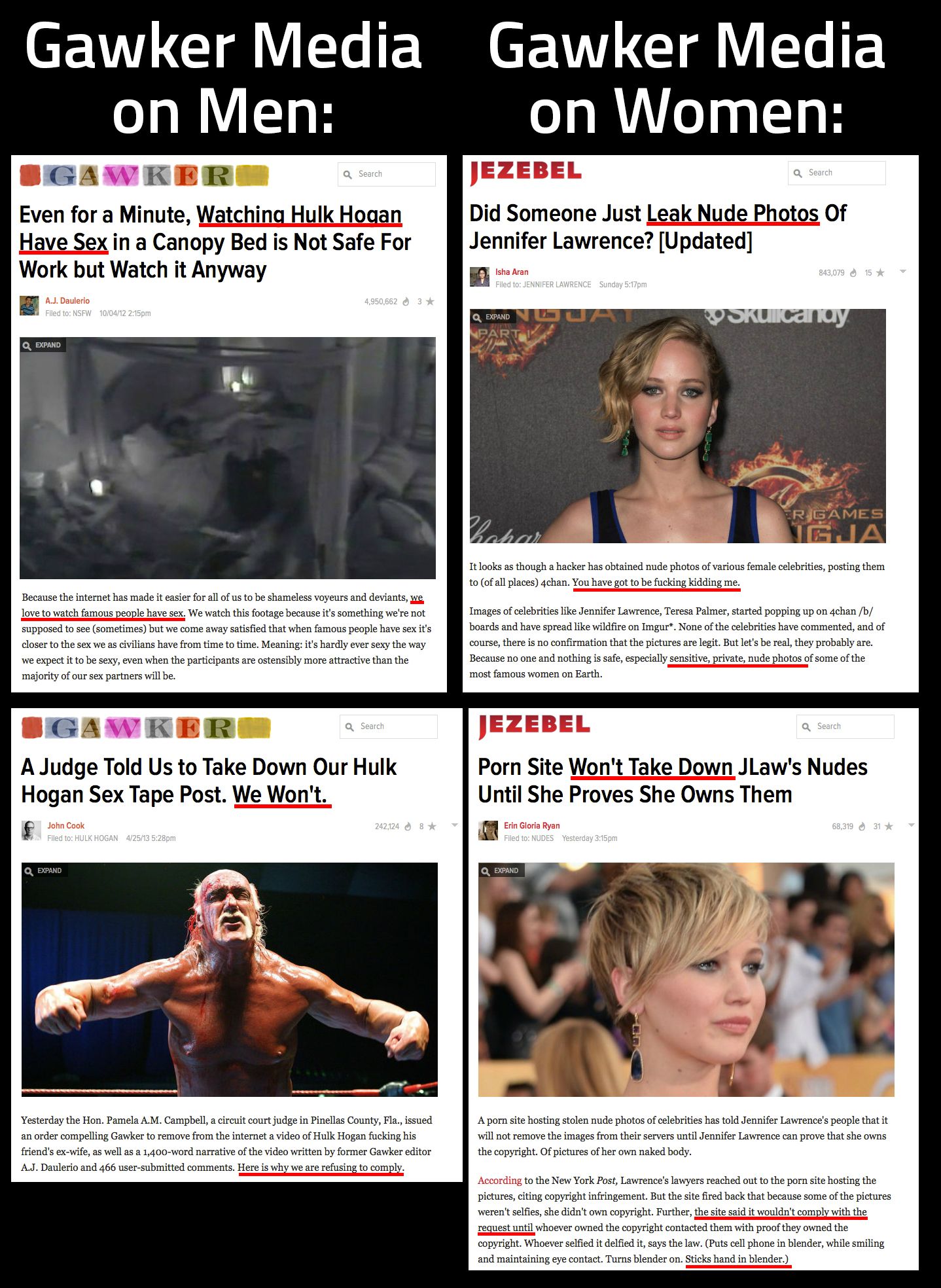
Also I am curious how feminists feel about the pay gap between male models and female models? Women on average make 146% more than male models. In 2014 the highest paid female model made 47M$ where as the highest paid male model made 1.4M$. Should feminists just tell the fashion industry to start catering more-so to males so that the there isn't such a huge discrepancy in the same manner of video games lately?
-
2015-02-02 02:10 #133The Shitlord
- Join Date
- Feb 2008
- Posts
- 11,560
- BG Level
- 9
- FFXIV Character
- Kharo Hadakkus
- FFXIV Server
- Hyperion
- FFXI Server
- Sylph
- WoW Realm
- Rivendare
I can't find the article I read, but the essence of it was that developing breasts during puberty is unique to humans, and serves no obvious purpose. Some scientists speculate that they serve(d) as an indicator of nutritional health, in an effort to attract a mate. Again, trying not to get too involved, but it's something interesting.
-
2015-02-02 02:31 #134RNGesus

Sweaty Dick Punching Enthusiast
- Join Date
- Jan 2005
- Posts
- 43,288
- BG Level
- 10
- FFXIV Character
- Lenette Valkyr
- FFXIV Server
- Gilgamesh
I also don't remember where I read this but it supported the attracting males thing. Men are attracted to well rounded buttocks and supposedly larger breasts evolved in order to resemble said butts and attract potential mates. This might also be the reason the humans are the only (or one of the few?) species that have sex outside of the doggystyle position.
-
2015-02-02 02:59 #135Kevin Chang
- Join Date
- Oct 2007
- Posts
- 10,617
- BG Level
- 9
- FFXI Server
- Sylph
It's not about whether or not people believe it's right to objectify or whether they would say "Yes she's a female celebrity, I'm entitled to see her naked body." But, if you want an explicit example of how that manifests, take 4chan's "Tits or GTFO" requirement for females. Originally Posted by Blubbartron
In practice though, it's not about those types of situations as much as it's about how we are subtly conditioned to accept disparity. As I said, it happens in the work place when women are held to different behavioral standards. It happens in advertising (Target photoshopping a gap between a ten year old's legs for swimsuits). It happens when guys want to fool around with girls who put out but marry the chaste girl.
Now of course men and women are different, but are you honestly going to argue there aren't vestiges of a mostly patriarchal history that affect society today by creating unnatural societal pressures on women? As you yourself pointed out, valuing chasteness in women is one such vestige of patriarchy, and it is reflected subtly in society to this day.
This is an experiment that I personally haven't done in a few years, but was pretty reliable whenever I tried it. Take a random men's magazine and a random women's magazine off the periodical shelves. Compare the love/sex related articles and headlines. Usually women's magazines are about getting "the" guy, figuring out if he's "the one," etc. There's a slant towards content being about long term relationships and finding/keeping one man. Even sex advice is usually presented such that the context is pleasing one guy and hanging onto him. Comparatively, men's magazines are about getting girls. It's about pick-up moves to get more dates, it's about sex moves that will please more women.
It's not that the people who write this content are sexist. But they write what sells. They are catering to the implicit assumptions of society that exert force on what their readers are trying to do. That men play the field, and women should look to settle down and have to work on making themselves that girl the guy settles for.
In the long term, one hopes that just as much as we accept whatever natural differences there are between the sexes, we don't limit individuals based on expectations of their sex. We don't ostracize people for not adhering to gender norms. As I said earlier, the point of gender equality movements isn't to create equal outcome, it's to the create equal opportunity. For example in STEM, it's not about getting 50/50 splits in those fields, it's about the final split being reflective of whatever the natural split is. (And I'm not bringing that example up to open a debate, just to illustrate how the theoretical goal looks in effect.)
And again, gender norms work against men too. As we've briefly discussed earlier, boys who don't fit the typical masculine standards are made to feel bad, including by women who are influenced subconsciously by how they are told men are supposed to be. Or as you said, men are stuck paying child support for kids who aren't theirs because our system was founded on the idea of men as the provider and mothers who can't fend for their own children.
Jezebel is terrible. That being said, I do think there was a distinct difference in purpose between the audiences who consumed one vs the other. Originally Posted by thetruepandagod
I know zero about the fashion industry.
-
2015-02-02 03:07 #136Tekki's Bitch
Sweaty Dick Punching Enthusiast
- Join Date
- Mar 2006
- Posts
- 8,978
- BG Level
- 8
I can't cope with the amount of cishetero privilege oozing from this statement. Originally Posted by Gredival
But really it's just a microcosm of the fact that in this day and age the (usually younger) female form is the most attractive as dictated by sales in anything regarding aesthetics. Where as young boys were the pinnacle of beauty in say ancient greece. Also female fashion industry nets around 22B$ a year where as the male industry is around 10B$. Males and gay males generally run all aspects of fashion at the higher levels. I just really would like to see a hardcore feminist's view on it for shits and giggles. I dare say men in fashion is the equivalent to women in video games.
-
2015-02-02 05:43 #137The 69th Donor
Pens win! Pens Win!!! PENS WIN!!!!!
- Join Date
- Mar 2008
- Posts
- 15,071
- BG Level
- 9
- WoW Realm
- Kil'jaeden
Not sure if you'd count me as a "hardcore feminist," but I look at it as simple capitalism. There is a larger market for female models, and a higher demand, hence the higher price. As much as I truly hate to say it, models are a product. Their body, their face - those are products. You are absolutely an object in the fashion industry. And products that are in higher demand fetch a higher price.
It's gross objectification on both sides of the fence, but that's what it basically boils down to, at least how I view it.
-
2015-02-02 06:28 #138E. Body
- Join Date
- May 2008
- Posts
- 2,392
- BG Level
- 7
- FFXI Server
- Cerberus
- WoW Realm
- Deathwing

Are we not all products
-
2015-02-02 10:16 #139Banned.
- Join Date
- Aug 2007
- Posts
- 2,547
- BG Level
- 7
You wrote a lot here Gred, so I'll do my best to be concise in responding to it.
I think you've misunderstood the culture of 4chan. Tits or GTFO is not about entitlement to see females naked - it's about punishing women who deny their anonymity, which everyone has in equal measure, in order to seek the privilege of female status on the internet. There are no "femanons". There is just anon. I can go into this more if you'd like, but it doesn't seem to be the meat of your argument. Originally Posted by Gredival
I can absolutely agree that we as a society need to be more accepting of people as they are. However, an important piece of that is recognizing that maybe society is a reflection of the average person, as opposed to society determining what the average person is. If you watch that Brainwash series on youtube, you'll see that time and time again sociologists give far too much credit to society shaping humanity, when society has little impact on how people think and feel.In practice though, it's not about those types of situations as much as it's about how we are subtly conditioned to accept disparity. As I said, it happens in the work place when women are held to different behavioral standards. It happens in advertising (Target photoshopping a gap between a ten year old's legs for swimsuits). It happens when guys want to fool around with girls who put out but marry the chaste girl.
Now of course men and women are different, but are you honestly going to argue there aren't vestiges of a mostly patriarchal history that affect society today by creating unnatural societal pressures on women? As you yourself pointed out, valuing chasteness in women is one such vestige of patriarchy, and it is reflected subtly in society to this day.
This is an experiment that I personally haven't done in a few years, but was pretty reliable whenever I tried it. Take a random men's magazine and a random women's magazine off the periodical shelves. Compare the love/sex related articles and headlines. Usually women's magazines are about getting "the" guy, figuring out if he's "the one," etc. There's a slant towards content being about long term relationships and finding/keeping one man. Even sex advice is usually presented such that the context is pleasing one guy and hanging onto him. Comparatively, men's magazines are about getting girls. It's about pick-up moves to get more dates, it's about sex moves that will please more women.
It's not that the people who write this content are sexist. But they write what sells. They are catering to the implicit assumptions of society that exert force on what their readers are trying to do. That men play the field, and women should look to settle down and have to work on making themselves that girl the guy settles for.
In the long term, one hopes that just as much as we accept whatever natural differences there are between the sexes, we don't limit individuals based on expectations of their sex. We don't ostracize people for not adhering to gender norms. As I said earlier, the point of gender equality movements isn't to create equal outcome, it's to the create equal opportunity. For example in STEM, it's not about getting 50/50 splits in those fields, it's about the final split being reflective of whatever the natural split is. (And I'm not bringing that example up to open a debate, just to illustrate how the theoretical goal looks in effect.)
And again, gender norms work against men too. As we've briefly discussed earlier, boys who don't fit the typical masculine standards are made to feel bad, including by women who are influenced subconsciously by how they are told men are supposed to be. Or as you said, men are stuck paying child support for kids who aren't theirs because our system was founded on the idea of men as the provider and mothers who can't fend for their own children.
There is utterly no defending the photoshopping of children (or anyone for that matter), but I absolutely will argue against the notion that the content in magazines seemingly pushing women towards settling down and men towards promiscuity is some kind of holdover of patriarchal society. As I went into a few posts ago, men and women are biologically different when it comes to mating, and these differences combined with hundreds of thousands of years of evolution (biological and social) has lead to men ensuring their genes continue via promiscuity, and women ensure their genes continue via monogamy and sexual choosiness. When you say "they are catering to implicit assumptions from society that exert forces on what their readers do" you are literally giving credit to society where credit is actually due to biology. The reason those things sell is because a majority of the demographic for a magazine implicitly agrees that those are desirable things. I can't stand economics at the large scale, but on the small scale like this, it's a well-accepted and obvious notion that free market products will, over time, become more targeted towards their consumers. There is such a thing as creating false demand, but that's nigh impossible to do with media. If people thought the stuff in the magazines was bullshit, backwards, and they had no interest in it, then they wouldn't buy it.
This is getting a bit into a nature vs. nurture argument, and maybe that's where the heart of the disagreement lies. I hate to reference it again, but those Brainwash videos are really fucking good, and they have one that goes into a few studies about nature vs. nurture, and the science overwhelmingly indicates that nature is the dominant factor at play. Nurture can push us a little bit this way or that, but the majority of who we are is determined by our brain patterns, which is determined by hormones, which is determined by genes.
To summarize, expecting everyone in a certain demographic to be homogeneous is stupid, but thinking gender norms are societal pressure causing people in the demographic to behave a certain way is equally stupid. Gender norms should go by their more common name - stereotypes. Stereotypes come into existence when people see patterns over and over again from a group of people. Stereotypes are not created and then used to mold people into those stereotypes.
-
2015-02-02 10:56 #140Caesar Salad
- Join Date
- Nov 2009
- Posts
- 31,728
- BG Level
- 10
This exact same kind of logic applies so many times in discussions about feminism and video games, and we all know how well those go. Demographics matter, but only when it benefits women. Originally Posted by Aksannyi

