 XI Wiki

It's all on Google. Any one with a college education knows this. I'd cite but I'm on a phone wondering why I continued once I hey said he wasn't being sarcastic.
- Navigation
Results 41 to 60 of 77
Thread: Non-Human Personhood


-
2015-01-11 20:27 #41Caesar Salad

- Join Date
- Nov 2009
- Posts
- 31,763
- BG Level
- 10

-
2015-01-11 20:35 #42
You guys are conflating a few ideas when you talk about this.
Psychology is a field of linked black boxes, but there are reasons to believe certain black box psychological constructs are more valid than others. Consciousness is kind of an ambiguous term in the field. Autonoetic awareness is similar to episodic memory with the knowledge that you are currently remembering, and probably is closer to what you actually mean. I'm busy irl for tonight, but I'll try to write a post in this thread at some point this week.
I can't find a free link to some of the best reviews on this topic, but here's one that's at least by a big name in the field (Tulving): http://cogweb.ucla.edu/Discourse/Nar...Wheeler-97.pdf
Edit: AFAIR, imagine you're looking around a room. You're either looking around the room and know that what you're seeing is what you're looking at, or you're remembering looking around a room, or you're imagining a room that may not even exist anywhere in space. A being without autonoetic awareness lacks knowledge of their own thought processes, so they would be unable to distinguish the three cases.
-
2015-01-11 21:07 #43listen!
- Join Date
- Apr 2011
- Posts
- 7,234
- BG Level
- 8
- FFXI Server
- Sylph
I am arguing that what you state as fact is not proven. There's no magic sorting hat that can just give us an answer to this. We learn new things about what animals are capable of all the time. We don't know everything about all of them. Even if god descended from the heavens tomorrow and gave us another animal, telling us it could think the same way as humans, how would you even go about proving that? With no way of communicating, determining how an animal thinks is not as easy as you're making it out to be. Originally Posted by Salodin

I need research to back up the fact that we don't know?Right now Salodin is no more correct than Hey because neither of you are backing up your arguments in even the weakest sense. This information exists, if you're going to argue and defend legitimate scientific research, you should probably cite some to make sure you aren't talking out your ass.
-
2015-01-11 21:10 #44Absolute Messenger of Promathia
- Join Date
- Jan 2008
- Posts
- 13,211
- BG Level
- 9
- FFXIV Character
- Blaise Destin
- FFXIV Server
- Sargatanas
- FFXI Server
- Asura
How about simply researching what we do know about animal mind so you can make more educated statements than "but we don't know everything!". Originally Posted by hey
Or simply wait for Byrth to provide us with his awesome knowledge \o/
-
2015-01-11 21:16 #45listen!
- Join Date
- Apr 2011
- Posts
- 7,234
- BG Level
- 8
- FFXI Server
- Sylph
That's all i know for sure. I'm not an expert, and not really interested in becoming one, but i do know that much. Originally Posted by Karbuncle
-
2015-01-11 21:19 #46Ridill
- Join Date
- Oct 2006
- Posts
- 18,369
- BG Level
- 9
- FFXIV Character
- Sath Fenrir
- FFXIV Server
- Cactuar
- FFXI Server
- Fenrir
We don't know absolutely everything about why objects fall at 9.8m/s^2 to a 100% infallible certainty.
Don't tell me you're gonna take the position that gravity may not exist, are you?
-
2015-01-11 21:45 #47listen!
- Join Date
- Apr 2011
- Posts
- 7,234
- BG Level
- 8
- FFXI Server
- Sylph
lol
-
2015-01-11 21:45 #48listen!
- Join Date
- Apr 2011
- Posts
- 7,234
- BG Level
- 8
- FFXI Server
- Sylph
The issue at hand is how they think. We don't know.
-
2015-01-11 22:56 #49BG Medical's Student of Medicine
- Join Date
- Oct 2006
- Posts
- 34,650
- BG Level
- 10
This. This is actually really good information right here. Originally Posted by Byrthnoth
-
2015-01-11 23:32 #50This has been Byrth, with another edition of "Thoughts to get high to" Originally Posted by kuronosan
-
2015-01-12 01:18 #51King Bitcher of Bitchington
- Join Date
- Jul 2006
- Posts
- 3,489
- BG Level
- 7
- FFXIV Character
- Chuggs M'koul
- FFXIV Server
- Cactuar
That's a really trippy way of putting it, I like it lol Originally Posted by Byrthnoth
When I think about this stuff I just think about self-awareness. If an existence has self-awareness and is able to communicate it's ideas/needs/wants/whatever in a fashion similiar to humans, it should have similiar/some human rights. Otherwise, it shouldn't. I'm not saying humans should be able to go around wacking beaks off of toucans because fuck those things, they're just animals! I just don't feel like the Orangutan should be granted human-like rights, regardless of it's cognitive capabilities.
If I was to wager, the organization representing the Orangutan is probably just staunchly anti-zoo people who probably want them all shut down because the poor animals are all miserable everywhere and the zookeepers hate animals and abuse them physically and mentally and blahblahblha. sarcasm.
-
2015-01-12 01:28 #52BG Medical's Student of Medicine
- Join Date
- Oct 2006
- Posts
- 34,650
- BG Level
- 10
The point is, an orangutan isn't a person. Whether or not it's human is an existential question because we define what a human is based on our knowledge and understanding of what it is to be human. Under the current definition, it isn't.
-
2015-01-12 11:38 #53Salvage Bans
- Join Date
- May 2005
- Posts
- 943
- BG Level
- 5
Other way around. Personhood is a hotly debated subject and I don't know that there's a strict definition. Interestingly it's only up to humans whether or not we consider another species a "person", no other species gives two fucks either way. Because of this I side with the "only humans are persons" crowd. Originally Posted by kuronosan
-
2015-01-12 11:41 #54Relic Horn
- Join Date
- Sep 2009
- Posts
- 3,196
- BG Level
- 7
- FFXI Server
- Phoenix
Here's a test for person hood if you are reading this sentence you are a person. Or a very smart orangutan.
-
2015-01-12 12:15 #55E. Body
- Join Date
- Jan 2011
- Posts
- 2,283
- BG Level
- 7
- FFXIV Character
- Warren Castille
- FFXIV Server
- Balmung
- FFXI Server
- Ragnarok
- WoW Realm
- Cenarion Circle


If something is granted human rights and it doesn't understand the concept, cannot understand the language, and doesn't know how to exercise them, what exactly has been accomplished? Let that orangutan out on the streets as a free manperson and hold it to the same laws everyone else has to abide by: it'll be arrested in an hour, tops.
-
2015-01-12 12:24 #56Banned.

- Join Date
- Aug 2007
- Posts
- 2,547
- BG Level
- 7
I don't think the idea is to say that anything with a mind is equal to humanity and capable of joining our society. The point is to try and determine moral boundaries. If a species demonstrates their intellect then it's no longer moral to hold them in captivity for our amusement, and it's definitely not moral to hunt them for food/clothing/amusement. Originally Posted by Lyall
-
2015-01-12 12:28 #57E. Body
- Join Date
- Jan 2011
- Posts
- 2,283
- BG Level
- 7
- FFXIV Character
- Warren Castille
- FFXIV Server
- Balmung
- FFXI Server
- Ragnarok
- WoW Realm
- Cenarion Circle
I suppose I can agree with that. If the argument is being made that animal captivity is wrong (read: zoos, Seaworld) is wrong, this could be big in changing a mainstay in collective human culture. Still, how do you decide if an animal is unlawfully denied their rights? A lot of those born into captivity (read: zoos) would never be able to survive outside of their arrangements.
It really just sounds like some animal rights org finally got the right connections and went about freeing animals through litigation and not the stereotypical "Release all of the monkeys being tested on" kind of thing.
-
2015-01-12 12:55 #58Relic Horn
- Join Date
- Sep 2009
- Posts
- 3,196
- BG Level
- 7
- FFXI Server
- Phoenix
One step closer to orangutans forming a union to get paid for living in a zoo.
Next prediction they will go on strike for the sub par living condition of the zoos.
Also what type of lawyer defends a orangutang of human like rights ? The best kind a money loving kind.
“Judges in Kiko’s case says the right of habeus corpus does not apply when the distinction is not confinement versus freedom, but one form of confinement versus another,” the UPI said. “Lawyers working on behalf of Kiko say such logic ignores a long legal history of employing habeus corpus to transferring custody of child slaves or indentured servants from abusive owners to lawful guardians.”
-
2015-01-12 15:04 #59BG Medical's Student of Medicine
- Join Date
- Oct 2006
- Posts
- 34,650
- BG Level
- 10
You're right, sorry. I got them mixed up (as orangutans often do). Originally Posted by Enkidu
Also, not to go internet semantics here, but reading and comprehending are two totally different things. Simians can learn sign language and communicate without written "English". So your "test" for personhood is silly, wipers.
We know animals have the ability to communicate. How they do so and whether they show capacity for higher function (reasoning) is probably what sets us apart as a species.
-
2015-01-12 21:45 #60Electric Six groupie
- Join Date
- Sep 2007
- Posts
- 5,451
- BG Level
- 8
- FFXIV Character
- Jayne Barsala
- FFXIV Server
- Lamia
I'm reminded of this wonderful comic -
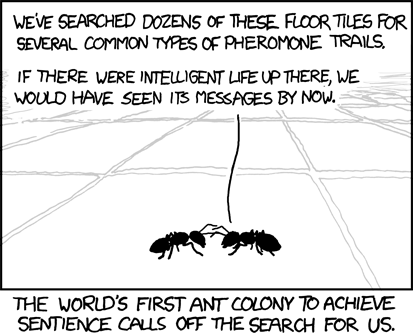
"Do Androids Dream of Electric Sheep" is a very appropriate philosophical read on this subject as well - as the author, Philip K. Dick, supposes its our empathy towards others (whether animals or "persons") which defines us as humans/persons. I don't believe there's any methodical way to determine if other species have empathy - but I'd like to know if there was! So if we can suppose orangutans can feel empathy for us as humans then perhaps it deserves some kind of personhood recognition.

