 XI Wiki

What are the ethics papers you've read? The "trade-offs" at the societal level aren't 100% to my knowledge. The irreconcilable nature thing in your example isn't one where the person literally can only be happy when killing/torturing, that's just the symptom of a deeper problem and that person can be curbed into doing a different career that leverages those "problems" as strengths.Originally Posted by Gredival

Psychopaths make for great CEOs, construction managers (whatever the guys with the white hats are called), etc (just a super broad example of the above - there's a textbook I've got on evolutionary psychology that talks about this.. can't find it, but it goes into extreme length at "sick" people being able to function in society just fine with the right guidance)
Afaik, thanks to capitalism in the market and society, what is best for the individual is best for society. The individual will always get more out of win-win than win-lose in the long run
- Navigation
Results 41 to 60 of 86
Thread: Ethics - What is best in life?


-
2015-01-18 18:21 #41

Sweaty Dick Punching Enthusiast
- Join Date
- Dec 2008
- Posts
- 3,097
- BG Level
- 7

-
2015-01-18 19:04 #42GATTACA!
Sweaty Dick Punching Enthusiast
- Join Date
- Dec 2009
- Posts
- 25,823
- BG Level
- 10
this is an oversimplification. while sociopaths are more commonly found in CEO positions, this doesn't necessarily make them all effective at their jobs. in the sense that they can make cold, calculating decisions without a second thought, yes, it gives them an "edge." but in the context of this discussion, I would argue the "greatest good" is not achieved by employing cutthroat CEOs that only care about company profits and give no fucks about individuals within or outside of their company Originally Posted by Thunder
-
2015-01-18 19:20 #43
Sweaty Dick Punching Enthusiast
- Join Date
- Dec 2008
- Posts
- 3,097
- BG Level
- 7
It's just a common example of a typically "bad" person by social standards being able to do something better than murdering and torturing. Didn't really want to make it a talking point since I admit it's really, really broad Originally Posted by Moss
I don't think getting into specifics of mental disorders and personalities is gonna be very fruitful - especially since in this case we'll just hit a wall about how "helpful" things like walmart are, "employees who choose to work at a place complain about being taken advantage of", and how much capitalism is too much capitalism. But maybe that's where the conversation should go?
-
2015-01-18 20:15 #44Kevin Chang
- Join Date
- Oct 2007
- Posts
- 10,679
- BG Level
- 9
- FFXI Server
- Sylph

 It's basically an Aristolean theory of ethics modeled after the ancient Greek concept of "eudaimonia." Martha Nussbaum was one of the more prominent philosophers who discussed the issue but I can't remember the title of any papers specifically. Originally Posted by Thunder
I tried mounting my old hard drive to my dock to see if I could pull my old PDFs off, but it's not reading so I need to find the papers the old fashioned way.
-
2015-01-18 21:17 #45The vast majority of threads in this subforum are ethical quandaries disguised as the hot-button topic of the night, and the vast majority of disagreements in those threads are fundamental ethical disagreements. However, you seem to be proposing that BG has a user base incapable of giving defensible ethical answers. Originally Posted by SathFenrir
I don't disagree that it is difficult form and defend objective opinions on ethical issues, but our ethos guides our every behavior. You can either go with some "whatever I'm feeling today" grab-bag, or you can form a more logically sound ethos and build on it. Furthermore, I'd actually argue that as a society we have much more agreement on theoretical ethical issues than on specific applications of the theory, which means this thread isn't necessarily destined to be quite the unproductive train wreck that you believe. For instance, if the majority gets some minor enjoyment out of tormenting a marginalized group to such an extent that the immediate net happiness of society increases from their torment, is the torment good? I'd argue it is not, and I think that would be a common viewpoint.
Personally, I think that the emotion we describe as happiness is an internal representation of "good," which is somewhat unique to each individual. Conversely, misery would be the unique internal representation of "bad." The greatest good would therefore be obtained by optimizing the long-term happiness of all creatures proportional to their ability to be happy while minimizing misery proportional to their ability to be miserable. The immediate acceptable trade-off between happiness and misery that is optimal for long-term happiness/misery, as well as the constants for each individual's capacities, could quite possibly be defined by science.
In the absence of those constants, the logical framework still gives me a set of guiding principles that I can apply to make decisions. Examples:
1) I try to avoid eating smart animals (octopi, big lobsters, pigs, etc.) and try to minimize the amount of suffering per pound (for instance, cows are both dumb and huge).
2) I try to avoid randomly making other people miserable.
3) I'm in favor of globalization, free trade, and social programs.
4) I'm in favor of both animal testing, to the extent that it enhances long-term happiness, and animal rights, to the extent that suffering is minimized and gains are maximized when an animal does experience pain.
5) I'm in favor of abortion rights. Fetuses have a limited capacity to suffer or be happy, while an unwanted child develops the ability to suffer more each day.
6) On a related note, I'm in favor of saving the environment (and limiting population growth), because in the long term our happiness is going to decline precipitously if we end up riding a barren atmosphere-less rock around the sun.
etc.
I'd love to hear criticisms of my logic/etc., but I'll be analyzing data (still, which is why I haven't been posting here as much as I wanted to) and may not get back for a day or two. I'm still youngish. Better to correct my thinking now than in 40 years when I finally take my nose away from the grindstone long enough to think.
-
2015-01-18 22:35 #46Relic Horn
- Join Date
- Sep 2009
- Posts
- 3,196
- BG Level
- 7
- FFXI Server
- Phoenix
All I'm seeing is utilitarianism. I'm more of a nihilist personally.
-
2015-01-18 23:19 #47BG Medical's Student of Medicine
- Join Date
- Oct 2006
- Posts
- 34,865
- BG Level
- 10
I'm going to have to do some thinking so I can join in on the discussion after reading more posts.
I don't want to pull a Maz and one-in-one-out, as I'm sure he's done.
-
2015-01-19 02:15 #48Banned.

- Join Date
- Aug 2007
- Posts
- 2,547
- BG Level
- 7
This is a really tough topic.
I think that I'm frequently torn between two positions in ethics. From a purely logical standpoint, I think that the best thing in life is for all of humanity to be happy and thrive. I believe it is possible to reach an equilibrium with our planet and its ecosystems and still continue to improve our quality of life through scientific and technological advancement. And perhaps one day we'll colonize other systems. However, as much as I believe these things to be true possibilities, I feel utterly powerless as an individual to do anything to get us there. Between capitalism, authoritarian bullshit (including religion), and the general ignorance of the average person, I don't know what I can do to push us closer to the aforementioned goals. Because of how powerless I feel, from an emotional standpoint, I stop caring about the well-being of the whole and start caring only about myself and those immediately around me. I might be a bit odd in that I do mean immediately around me - I don't really maintain a "social group" of friends/family that I care about very deeply, but I often go out of my way to be kind and helpful to people I see near me that I'm capable of helping.
For what it's worth, I'd tend to agree with Byrth, although I place much less emphasis on animals than people. There's an interesting conundrum when it comes to food-stuffs. If you value the life of the animal, and you know the animal was raised and butchered (however humanely), is it really more "right"/ethical to let food go to waste rather than eat it? I'm not currently convinced that the amount of livestock raised for meat in the U.S. is 100% driven by demand for meat. A lot goes to waste, and that's even more of a tragedy given how many people go hungry in our country, let alone the entire world. It often feels like a synthetic demand; the producers create, and people buy because it'd be wasteful to let it rot, disrespectful to the animal to let it rot, and on a more hedonistic level, it's tasty and nutritionally useful.
-
2015-01-19 02:23 #49Renegade Philosopher
- Join Date
- Jul 2004
- Posts
- 4,439
- BG Level
- 7
There are flaws in trying to reduce "objective" normative ethics to an optimization or symbolic logic problem, the first of which is that you are inherently committing yourself to a subjective framework, and the choice of a framework is itself framework-dependent. There is also the unknowability problem which plagues lots of other disciplines, notably economics and other soft sciences. Even if you have some methodology for approximating or modeling highly imperfect knowledge for determining your inputs, you're still left with ad hoc adjustments to your model to keep it afloat when it doesn't correctly tell you what the optimal choices/policies are.
I'm not sure how far you can really go with normative ethics because of those limitations. As uncomfortable as it makes a lot of people, it's hard not to see normative ethics as a social construct based around a loose set of principles that we generally interpret as things like survivability, the golden rule, hedonic calculus, etc. Frankly, that's why we see things go "wrong" so often in history. The ethical zeitgeist is often a reaction to the events that preceded it -- for instance, existentialism becoming very prominent in Europe in the aftermath of WW2.
Regarding overpopulation, the problem is more subtle than has been presented and may not be as dire as it would appear on first glance, but I agree with the general theme: industrializing third-world countries will put an incredible strain on global resources, and we are not at present technologically or socially equipped to deal with it.
-
2015-01-19 08:06 #50Annihilation Banwave
sprout sprout sprout
2031 No.1 Draft Pick
Pittsburgh Penguins
Sweaty Dick Punching Enthusiast
- Join Date
- Aug 2006
- Posts
- 19,830
- BG Level
- 9
- FFXI Server
- Bismarck
For those of you that have any interest. Here's a link to a paper written regarding the ethics of Nazi experimentation. I read it years ago and found it to be extremely interesting.
http://www.jlaw.com/Articles/NaziMedEx.html
-
2015-01-19 08:39 #51okay guy I guess

- Join Date
- Nov 2010
- Posts
- 24,377
- BG Level
- 10
wtf does that have to do with Jennifer Lawrence
-
2015-01-19 13:03 #52Banned.
- Join Date
- Aug 2007
- Posts
- 2,547
- BG Level
- 7
I read that paper, and found myself generally disgusted with the lack of intellectual integrity of the author. Quoting lawyers and military personnel (non-scientists) in regards to whether the data has any scientific validity, and making ridiculous assertions like "this data is so tainted that if you want to use it, you must PROVE that the benefit is of enormous magnitude to society." Because it's totally possible to know where data can get you before you have even used it as a starting point for further (humane and ethical) research. I stopped reading around 60-70% of the way through because the bias was getting too irritating to continue.
My opinion of the Nazi research data is pretty similar to my argument regarding meat above - the meat (data) is there, and letting it go to waste is more evil than eating (using) it. Except in this case, it's way, way more evil because there's literally no chance we'll ever even attempt to replicate the data (which is a good thing, because the experiments were unequivocally evil). I'll grant you that many of the experiments are pointless to most people, but just sweeping all the data under the rug because you don't like how it was obtained is childish and naive. Using the data to better humanity isn't even remotely similar to condoning the way the data was obtained.
-
2015-01-19 13:26 #53Ridill
- Join Date
- Oct 2006
- Posts
- 18,369
- BG Level
- 9
- FFXIV Character
- Sath Fenrir
- FFXIV Server
- Cactuar
- FFXI Server
- Fenrir
Ethics - What is best in life?
There are problems, yes, and a lot of what you said rings true. Originally Posted by Quicklet
Fortunately, and without sidetracking too much, one of the benefits of forward progression of technology is increased ability to model and predict highly stochastic or chaotic variables.
Increased computing power and computational technology should, if used correctly, allow for long-term analysis of many variable systems in reasonable timeframes. This is something that will (hopefully) be useful in all areas of science and indeed society.
As an a example: many base pattern matching schemes are currently being developed (one such being reduced basis method) that, given enough data, can mix and match pieces of information together in the most optimized ways to form a desired end result. Currently it is limited in application by computing power, but is one of the types of schemes that will benefit from quantum computing (unlike systems that need time differentiation schemes).
Whether politicians and those in power globally choose to listen to or ignore such models is really out of the hands of those developing the tools. But the tools are absolutely here, and more are on their way. In fact it is softer sciences such as economics that will probably feel their impacts most heavily.
Data analysis is beautiful and honestly probably one of the most terrifyingly powerful tools to ever be created by humans. It is only getting more and more powerful as well. I suppose in an ironic twist we are faced with ethical dilemmas about how to properly use it. The only limitations of the predictive power of data are the amount of historic data available and computing power.
To this end I propose that, in time, there won't be problems that exist that cannot be reduced to major variables and modeled to high degree of probability. Will the technology be used appropriately? Responsibly? That I can't say. But science can definitely give us the tools we need to get there.
Intro to QC: http://link.springer.com/chapter/10....-84628-887-6_1
Good intro to sample scheme I discussed (RBM, one of many): http://www.sciencedirect.com/science...31073X04004248The most important quantum effects are superposition, interference, non-determinism, and entanglement. Superposition allows a quantum computer to act upon an input state representing an exponential number of different classical inputs simultaneously.
-
2015-01-19 13:34 #54The Shitlord
- Join Date
- Feb 2008
- Posts
- 11,560
- BG Level
- 9
- FFXIV Character
- Kharo Hadakkus
- FFXIV Server
- Hyperion
- FFXI Server
- Sylph
- WoW Realm
- Rivendare
I am the very model of a scientist Salarian!
Maz isn't even participating in this discussion yet; please refrain from this sort of thing. It's off-topic, among other issues. Originally Posted by kuronosan
Carry on. Fascinating discussion.
-
2015-01-19 13:42 #55Ridill
- Join Date
- Oct 2006
- Posts
- 18,369
- BG Level
- 9
- FFXIV Character
- Sath Fenrir
- FFXIV Server
- Cactuar
- FFXI Server
- Fenrir
He did on page 1. 5th post godwin. Originally Posted by BaneTheBrawler
-
2015-01-19 13:51 #56The Shitlord
- Join Date
- Feb 2008
- Posts
- 11,560
- BG Level
- 9
- FFXIV Character
- Kharo Hadakkus
- FFXIV Server
- Hyperion
- FFXI Server
- Sylph
- WoW Realm
- Rivendare
I had forgotten that, but my point stands. It's not really something to be engaging in.
-
2015-01-19 14:08 #57Ridill
- Join Date
- Oct 2006
- Posts
- 18,369
- BG Level
- 9
- FFXIV Character
- Sath Fenrir
- FFXIV Server
- Cactuar
- FFXI Server
- Fenrir
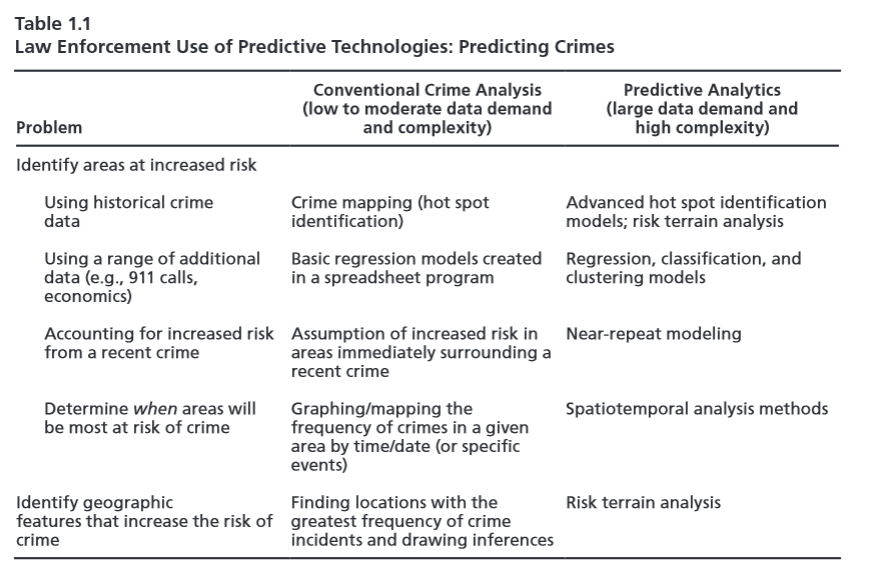
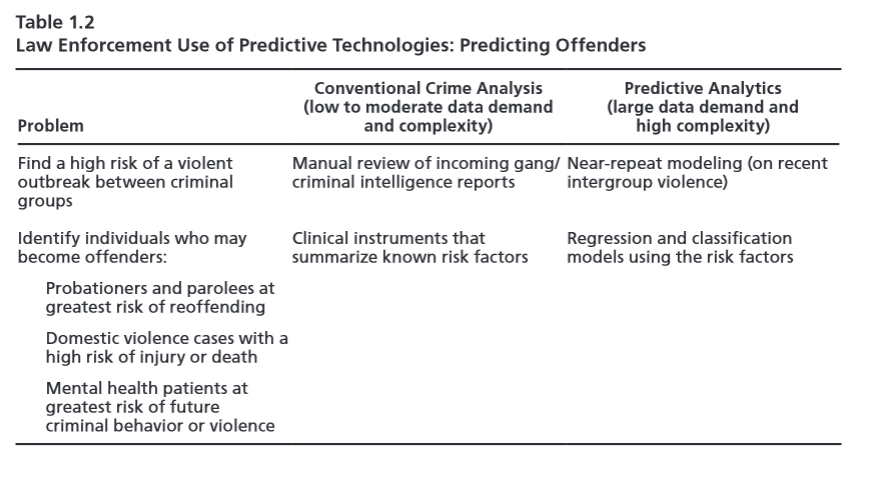
Also, we've discussed it before (or at least I have on here), but here is an example of the usability of big data with only classical computing power. Predictive data analysis used to prevent crime.
http://www.rand.org/content/dam/rand...RAND_RR233.pdf
http://www.sci-int.com/pdf/884123194...composed++.pdf
http://www.popcenter.org/library/cri...3/03-Groff.pdf
So it's not science fiction. That's enough as I don't want to derail enough, but I know that to people who aren't familiar with the application of data it can all sound a bit wibbly-wobbly. It isn't.
It's currently been used by LAPD and Memphis PD (I believe). And there have been non-negligible reductions in crime rate in the areas where it has been tested.
Edit: And this is just with classical computing power and basic algorithms that are in dire need of refinement. It's by no means an example of how far the ideas can be taken. Just putting this out there as interesting reading / proof-of-concept at a basic level. Some of these sources are also 8+ years old (which is a lifetime in computational science), but I admittedly only took a few minutes to peruse abstracts and conclusions to give baseline info.
-
2015-01-19 16:29 #58Relic Horn
- Join Date
- Sep 2009
- Posts
- 3,196
- BG Level
- 7
- FFXI Server
- Phoenix
This came to mind also when I saw "ethics" topic:
http://classics.mit.edu/Aristotle/nicomachaen.1.i.html
-
2015-01-19 17:14 #59Relic Shield
- Join Date
- Sep 2010
- Posts
- 1,795
- BG Level
- 6
- FFXI Server
- Titan
You try to avoid eating bacon. All of your opinions are now null and void. Originally Posted by Byrthnoth
Seriously, I am forever hopeful and naive. I tend to think of ethics in the simplistic term of never intentionally causing harm to another person. I don't like the idea of bettering yourself if you have to knock somebody else down in order to do it. Golden rule and all that.
Treatment of animals though? I am no animal lover, but I'm not going to advocate senseless torture of them. An out of sight, out of mind approach. I love my meat, but would prefer not to know what the animal goes through before it hits my plate.
-
2015-01-19 17:23 #60Absolute Messenger of Promathia
- Join Date
- Jan 2008
- Posts
- 13,259
- BG Level
- 9
- FFXIV Character
- Blaise Destin
- FFXIV Server
- Sargatanas
- FFXI Server
- Asura
I kinda feel this way, but its nearly impossible to accomplish if you think financially... I mean, for every job you get, someone else (usually multiple people) did not... for every promotion you earn, its likely someone else was considered, and rejected for you. Almost every path you can take on a road to success is littered with the crushed hopes of people who, inadvertently, were alongside you.I don't like the idea of bettering yourself if you have to knock somebody else down in order to do it. Golden rule and all that.
As far as the current ethical debate. Far too deep for me. But if I had to weigh in on the Nazi experimentation bit, I'd have to side on the "Letting it go to waste is worse". The deed is done, now all those people can have died entirely in vain, or we can try to pull some positives from the data collected.

