XI Wiki

Back when I was a teenager many moons ago, I recognized an interesting pattern in squares, one that to this day I have never seen repeated elsewhere. Granted, I haven't looked that hard in the two decades since, and never went on to study any higher mathematics past high school level trig, either, but it's always bothered me on/off throughout the years on whether or not I came across something rather unique.
The pattern that I noticed, when spoken logically, is:
The square of a number is equal to the number less one squared, plus the number less one, plus the number.
Algebraically, that would equate to:
x^2 = (x-1)^2 + (x-1) + x
Factoring out the right side of the equation, you end up with:
x^2 = x^2
While I realize that all basically ends up boiling down to simple algebra and pattern recognition, I'm wondering if there's an actual established principle under which this would fall, or if there's any real relevance to it other than "oh, that's kind of neat, but not terribly useful".
- Navigation
Results 1 to 9 of 9
Thread: X² = ?


-
2016-05-29 00:28 #1And they're spectacular!

- Join Date
- Feb 2007
- Posts
- 609
- BG Level
- 5
- FFXIV Character
- Mitzy Mystfire
- FFXIV Server
- Gilgamesh
- FFXI Server
- Titan

X² = ?
-
2016-05-29 01:00 #2New Merits
- Join Date
- Jan 2007
- Posts
- 241
- BG Level
- 4
- FFXIV Character
- Aumaan Prime
- FFXIV Server
- Hyperion
- FFXI Server
- Valefor
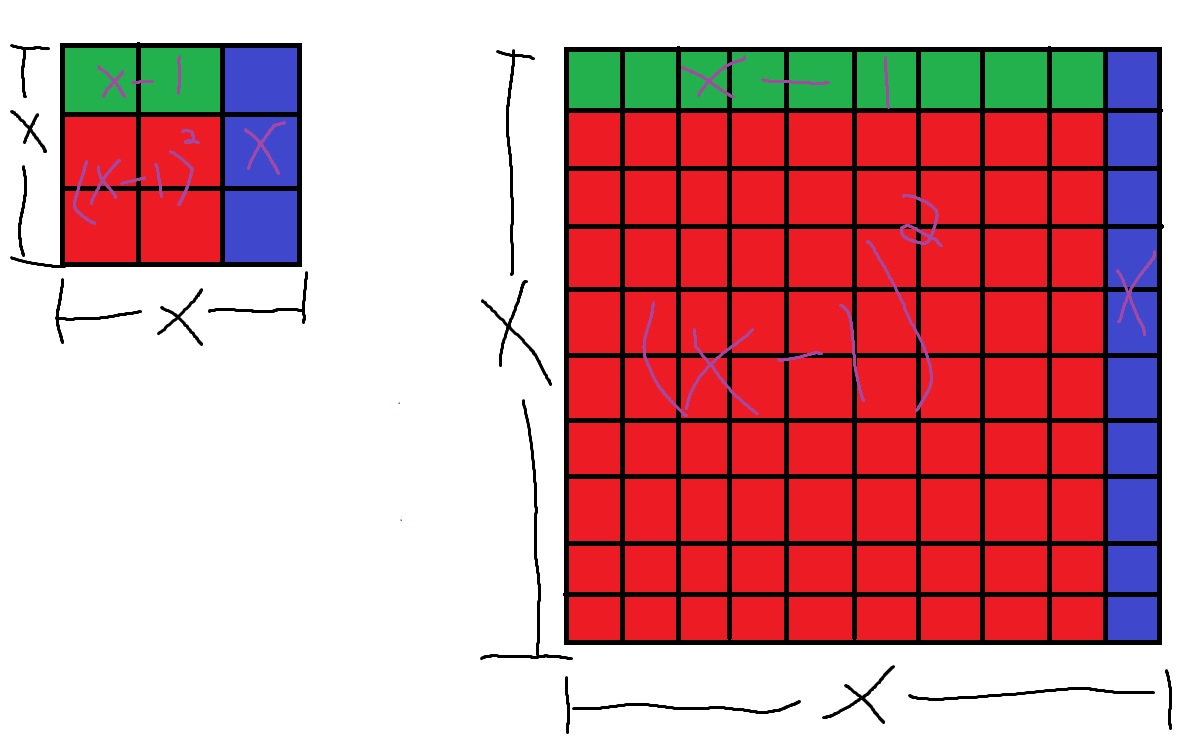
It's the geometric view, more or less. Picture the square number as a square gridded up into little 1x1 squares, then count how little squares you have to knock off the top and side to get the last square number. There's your extra "number and number less one".
-
2016-05-29 01:16 #3Banned.

- Join Date
- Aug 2007
- Posts
- 2,547
- BG Level
- 7
In general it's referred to as a sequence. More specifically a recursive sequence because you would need to know the value of the preceding place to calculate the next one. The formula would be written as:
a(n) = a(n-1) + (n - 1) + n, a(1) = 1
-
2016-05-29 01:20 #4Relic Horn
- Join Date
- Sep 2008
- Posts
- 3,311
- BG Level
- 7
- FFXIV Character
- Nmtd Natlhom
- FFXIV Server
- Coeurl
 A quick mspaint to help visualize.
 Originally Posted by Aumaan_Kujata

-
2016-05-30 13:06 #5Ridill
- Join Date
- Oct 2006
- Posts
- 18,369
- BG Level
- 9
- FFXIV Character
- Sath Fenrir
- FFXIV Server
- Cactuar
- FFXI Server
- Fenrir
It's a quirky thing geometric property of 2-D squares that is really easy to see and relate to because it is in 2-D. As Blubb and Hobo have pointed out, you can quickly generalize this to a square of sides "n" and have it still work (whether or not it is useful is neither here nor there).
The interesting thing, for me, that might be what got you interested in it as first as well, is that it is pretty easy to see and play around with for low numbers and is instructional in both an algebraic and geometric way for low numbers. That's why it probably stuck in your head, probably was a really easy way to think about doing some of the basic algebra and geometry work you were doing at the time.
As for any higher relevance or does it lead into other geometric or algebraic theory? I'm pretty sure no. It could be argued, and I suppose I will briefly just for your own piece of mind, that the underlying theory behind what you're looking at becomes the basis for adaptive mesh refinement methods in computational math and science. Granted, you don't AMR with equally-spaced points, but the basic idea is kinda nicely described in Hobo's pictures so yeah. I'll spoiler it so you people can read it if they want to, or ignore completely if they dont give a fuck.
Spoiler: show
-
2016-06-03 11:23 #6And they're spectacular!
- Join Date
- Feb 2007
- Posts
- 609
- BG Level
- 5
- FFXIV Character
- Mitzy Mystfire
- FFXIV Server
- Gilgamesh
- FFXI Server
- Titan
Thanks very much for the info/insights. I never thought to think of laying it out on a grid like that, but it makes so much sense now to visualize it in that manner.
This is pretty much exactly what was happening for me at that time - sitting in the back of the class, bored as all fuck and playing around with low numbers and noticed the sequence. From there, I proved it out with higher numbers, and then used that to back into the actual equation. Simplistic for sure, but that light-bulb moment was a fantastic feeling. I also remember following a similar pattern out for higher exponents, but really don't recall what they were now - makes me wish I had kept all of my old notebooks! Originally Posted by SathFenrir
-
2016-06-04 01:40 #7Relic Shield
- Join Date
- Oct 2006
- Posts
- 1,695
- BG Level
- 6

Indeed, the interested reader may verify that the function which maps a natural number to its square is computable. By Church's thesis, this function must then be recursive. Your work merely verifies this special case.
...
A mathematician would find this post hilarious, take my word for it.
-
2016-06-04 01:47 #8Ridill
- Join Date
- Oct 2006
- Posts
- 18,369
- BG Level
- 9
- FFXIV Character
- Sath Fenrir
- FFXIV Server
- Cactuar
- FFXI Server
- Fenrir
I hate you so much and yet love you deeply. Originally Posted by Cadsuane
-
2016-06-04 11:25 #9Relic Shield
- Join Date
- Oct 2006
- Posts
- 1,695
- BG Level
- 6
I've been reading "Mathematics Made Difficult" and it's been rubbing off on me.