 XI Wiki


i still dont buy it. you need to define "media" not every channel reports the same shit. fox harped on benghazi for like 4 years it seemed like I mean idk, msnbc isn't over there going on and on about the emails that I know of, maybe im wrong i dont watch any of that shit so my "media" is all interwebs crap like BG forums and reddit where Trump is for the most part bashed in every piece of "media" I see.
- Navigation
Results 1181 to 1200 of 13329
-
2016-09-08 11:29 #1181IMPERIAL CONCUBINE OF ME

Coolest Monkey In The Jungle
- Join Date
- Sep 2007
- Posts
- 21,547
- BG Level
- 10

-
2016-09-08 11:32 #11822600klub
Sweaty Dick Punching Enthusiast
- Join Date
- Dec 2008
- Posts
- 5,467
- BG Level
- 8
- FFXI Server
- Bismarck
 It isn't really setting the bar low, it's pretty simple.
 Originally Posted by Tyche

If the race is a blowout and over then they have nothing to talk about and viewers will turn off their TVs and they lose ad money.
The tighter and "more exciting" the race is the more viewers, the better ratings, more ad money.
News isn't really news anymore, it's just sensationalist clickbait on your TV.
-
2016-09-08 11:41 #1183Member since 2006 and still can't think of a title.

- Join Date
- Oct 2006
- Posts
- 28,703
- BG Level
- 10
- FFXIV Character
- Acanis Lindri
- FFXIV Server
- Midgardsormr
- FFXI Server
- Bismarck
- WoW Realm
- Kil'jaeden
 I'm sure we can expect Republicans to spend 2 years and billions of dollars investigating Powell now. /sarcasm Originally Posted by archibaldcrane
-
2016-09-08 11:50 #1184Ridill
- Join Date
- Oct 2005
- Posts
- 10,117
- BG Level
- 9
- FFXI Server
- Quetzalcoatl
god damn lol
anthony bourdain tweets at trump about this: https://en.m.wikipedia.org/wiki/Assa..._Boris_Nemtsov
fan replies:
David Brantly @brantlyd
@Bourdain Please don't dabble in politics. I really respect you and your shows. I don't want to lose that.
bourdain replies:
Anthony Bourdain
@Bourdain
@brantlyd when a candidate repeatedly expresses admiration for a man who killed a guest on my show I think it’s worth mentioning
-
2016-09-08 12:04 #1185The Optimistic Asshole
Sweaty Dick Punching Enthusiast
- Join Date
- Aug 2005
- Posts
- 29,775
- BG Level
- 10
- FFXIV Character
- Tyche Six
- FFXIV Server
- Tonberry
Well, the AP, an entity about as apolitical as you can possibly be, is the organization responsible for the absolutely wreckless investigation into the Clinton Foundation story. Then, their story was further investigated by the NYT, and again, sophomoric journalism produced an article that a 101 journalism professor would be embarrassed to read. And the NYT isn't exactly a bastion of conservative talking points. Even apolitical and liberal leaning news organizations are trying to make a Clinton story that simply isn't there. Originally Posted by Day
-
2016-09-08 12:09 #1186The Optimistic Asshole
Sweaty Dick Punching Enthusiast
- Join Date
- Aug 2005
- Posts
- 29,775
- BG Level
- 10
- FFXIV Character
- Tyche Six
- FFXIV Server
- Tonberry
This isn't really new to the Clintons. For the last quarter century, even the most menial of allegations results in sweeping investigations, and thusly, the Clintons are presumed to be this sly, untrustworthy, and evasive political power family even if the allegations have no merit. That's what 25 years under a GOP microscope will do to you.
-
2016-09-08 12:10 #1187Ridill
- Join Date
- Oct 2005
- Posts
- 10,117
- BG Level
- 9
- FFXI Server
- Quetzalcoatl
going on further about the AP: the AP tweeted out that SOS clinton met 154 times with people, over half of them being donors. she, in fact, had over 1700 meetings.
when actually confronted about it, the AP said they were wrong but weren't gonna delete their tweet. https://thinkprogress.org/ap-executi...297#.jv7ciji8r
so, yeah, by mainstream media i absolutely do mean mainstream media. if you're cnn/ap/reuters etc. you can't fucking engage in sensationalist "journalism" and call it journalism.
-
2016-09-08 12:12 #1188IMPERIAL CONCUBINE OF ME
Coolest Monkey In The Jungle
- Join Date
- Sep 2007
- Posts
- 21,547
- BG Level
- 10
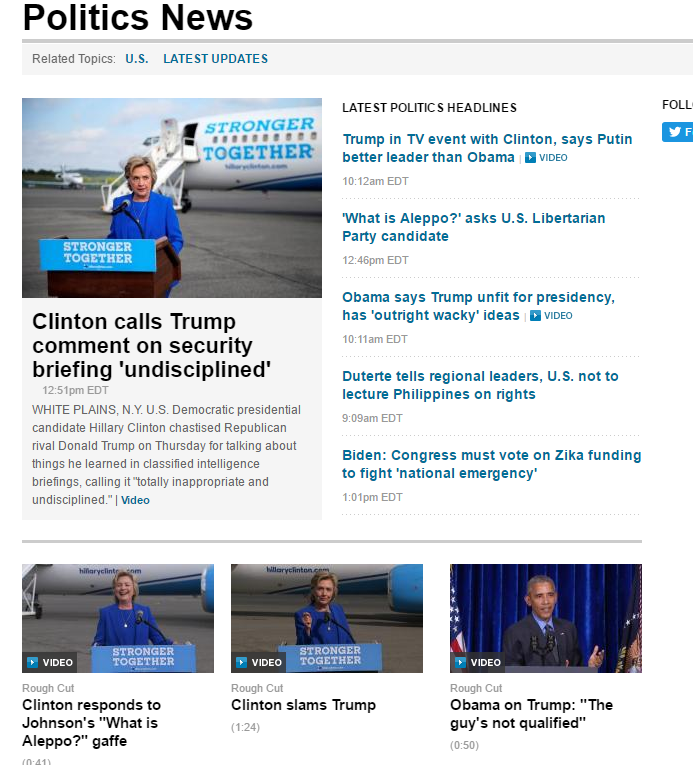
Yet when I go to AP right now here are the headlines I see:
CLINTON BLASTS TRUMP'S COMMENTS ON MILITARY GENERALS, PUTIN
OBAMA: AMERICANS WILL REJECT TRUMP'S 'WACKY' IDEAS
ELECTION OFFICIALS PUSH BACK ON TRUMP'S "RIGGED" ALLEGATIONS
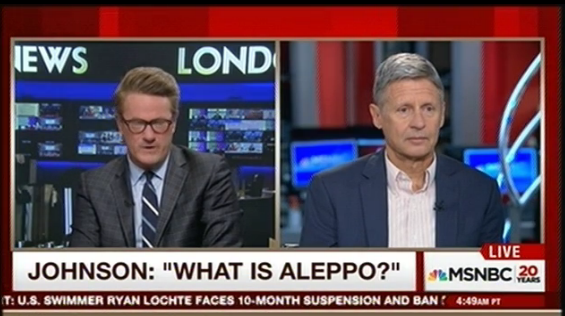
CNN currently:
Spoiler: show
Reuters:
Spoiler: show
I see bias but not in the direction you guys are claiming, please advise.
-
2016-09-08 12:12 #1189I'll change yer fuckin rate you derivative piece of shit
- Join Date
- Sep 2006
- Posts
- 58,937
- BG Level
- 10
I'm just waiting for Krandor to tell me which gulag Colin Powell should be in. Originally Posted by Melena
-
2016-09-08 12:16 #1190I'll change yer fuckin rate you derivative piece of shit
- Join Date
- Sep 2006
- Posts
- 58,937
- BG Level
- 10
The problem is that there's nothing to investigate with Trump and Bondi. It's so obviously a payoff to avoid prosecution, which is something Trump already basically told the American public he does on a regular basis as a businessman for decades, that there's almost nothing to discuss. Originally Posted by kisada
The report would be like "Trump buys attorneys general as part of avoiding prosecution, barely even denies it" and that's the end of it. You can't keep cranking up the intrigue or outrage because it's so blantantly out of bounds on the surface.
-
2016-09-08 12:21 #1191
Sweaty Dick Punching Enthusiast
- Join Date
- Sep 2010
- Posts
- 22,006
- BG Level
- 10
surprised we got stuck with anecdotes when fivethirtyeight literally just ran a story on this Originally Posted by archibaldcrane
http://fivethirtyeight.com/features/...ary-vote-have/[there are] 22 million veterans living in the United States, a powerful demographic group that trends Republican. There are also 1.3 million active-duty military members, 1.8 million dependents and nearly 741,000 U.S. civilian direct hires. Active-duty military service members are not allowed to speak on the record to the press about their political affiliations, but a July survey by Military Times (described as unscientific, since respondents opt in) found that they preferred Trump to Clinton 2 to 1, though the majority dislike both candidates (61 percent in Trump’s case and 82 percent in Clinton’s).
An NBC News/Survey Monkey poll in mid-August found that Trump was leading Clinton by 10 points — 51 to 41 percent — in military households, even after he angered many veterans groups by feuding with a Gold Star Muslim family that had lost a son in Iraq. (Blacks and Latinos in military households chose Clinton over Trump, though by lower margins than among the general population.) A Fox News poll in early August found Trump ahead of Clinton by 14 points in early August among veterans. But that lead is smaller than those of previous Republican candidates, possibly because of Trump’s remarks about the Gold Star family and his criticism of military interventions. At this point in the cycle, John McCain had a 22-point lead among veterans in 2008, and Mitt Romney was up 24 points in 2012.
-
2016-09-08 12:34 #1192
Sweaty Dick Punching Enthusiast
- Join Date
- Sep 2010
- Posts
- 22,006
- BG Level
- 10
in his defense, he is a profoundly stupid man Originally Posted by thetruepandagod
-
2016-09-08 12:51 #1193Tekki's Bitch
Sweaty Dick Punching Enthusiast
- Join Date
- Mar 2006
- Posts
- 9,052
- BG Level
- 8
This was quite literally Hillary's defense against the FBI inquiry. Originally Posted by Quicklet
There was also a big drop of new emails over labor day weekend, from the FBI themselves. Which showed that Hillary had 13 different blackberries and that she had her aides literally destroy them with a hammer office space style. Originally Posted by Quicklet
Just another show of of incompetence and lies.
-
2016-09-08 13:05 #1194I'll change yer fuckin rate you derivative piece of shit
- Join Date
- Sep 2006
- Posts
- 58,937
- BG Level
- 10
How should you safely dispose of an old device from a top state official when she's moving to a new one?
-
2016-09-08 13:07 #11952600klub
Sweaty Dick Punching Enthusiast
- Join Date
- Dec 2008
- Posts
- 5,467
- BG Level
- 8
- FFXI Server
- Bismarck
Hillarys camp now denying she wore an earpiece last night, despite pretty obvious photo and video evidence that she did.
How stupid can you be.

-
2016-09-08 13:09 #1196Tekki's Bitch
Sweaty Dick Punching Enthusiast
- Join Date
- Mar 2006
- Posts
- 9,052
- BG Level
- 8
Apparently in a more thorough manner.. Originally Posted by archibaldcrane
https://www.wired.com/2016/09/actual...phones-better/
-
2016-09-08 13:10 #1197RNGesus
Sweaty Dick Punching Enthusiast
- Join Date
- Jan 2005
- Posts
- 43,870
- BG Level
- 10
- FFXIV Character
- Lenette Valkyr
- FFXIV Server
- Gilgamesh

It's a hearing aid cuz she old and deaf bruh.
But seriously, she does a lot of this shit to herself.
-
2016-09-08 13:15 #1198I'll change yer fuckin rate you derivative piece of shit
- Join Date
- Sep 2006
- Posts
- 58,937
- BG Level
- 10
They're saying it's just a weird reflection of light - there's got to be other shots of her ear over that hour that would make this clear, right?
-
2016-09-08 13:25 #1199My Little Ixion
- Join Date
- Aug 2007
- Posts
- 8,016
- BG Level
- 8
- FFXIV Character
- Olorin Bustyoas
- FFXIV Server
- Sargatanas
- FFXI Server
- Ramuh
 It's pretty obvious that it's a hearing aid too. Earpieces have a cord or antenna because they have to send/receive a audio signal from another source rather than just amplify sound. Originally Posted by Tyrath
-
2016-09-08 13:37 #1200Brown Recluse
Sweaty Dick Punching Enthusiast
- Join Date
- May 2006
- Posts
- 28,458
- BG Level
- 10
- FFXI Server
- Unicorn
She got one of them new iPhones. Originally Posted by Gryffes



Similar Threads
-
Do We Have A 'Silly Shit Politicians Say' Thread? If Not, Here We Are
By Callisto in forum Politics: Advanced ShitpostingReplies: 2380Last Post: 2026-03-31, 10:47 -
2016 USA Presidential election thread I: The warm-up
By quannum in forum Politics: Advanced ShitpostingReplies: 15067Last Post: 2016-08-03, 01:11 -
Internet Regulations/ ITU meetings - Here we go again
By Tyrath in forum Politics: Advanced ShitpostingReplies: 9Last Post: 2012-12-14, 16:32