 XI Wiki


FUCK. It never even came West I'm salty AF that game was fun when I first played it and that was despite the fact I could read exactly 0 JapaneseOriginally Posted by Fiye


- Navigation
Results 241 to 260 of 428
-
2019-05-09 21:20 #241Absolute Messenger of Promathia

- Join Date
- Jan 2008
- Posts
- 13,215
- BG Level
- 9
- FFXIV Character
- Blaise Destin
- FFXIV Server
- Sargatanas
- FFXI Server
- Asura

-
2019-05-10 11:21 #242Ridill
- Join Date
- Apr 2011
- Posts
- 23,594
- BG Level
- 10
- FFXI Server
- Bahamut
Tbf this has less to do with microtransactions and more to do with "esports". Not even actual games that have real esports themselves but just the idea that people want to spend a ton of time watching streamers play games live. So even at games with no real professional level are being designed more and more to cater to viewability than actual playability. Originally Posted by Gredival
-
2019-05-10 15:41 #243Kevin Chang
- Join Date
- Oct 2007
- Posts
- 10,632
- BG Level
- 9
- FFXI Server
- Sylph


Again, it's all fruit from the same poisoned tree. Whenever TI season rolls around, a lot of players come back and also buy the battle pass. Valve is quite transparently consciously trying their best not to alienate these players during that brief window to sell them hats. Which is also why there is a "fresh" patch and new hero to shake things up right after TI to keep people interested in trying out the new patch. Those patches get reverted when the player base craters after the TI boon.
Happened 3 years straight now.
-
2019-05-10 15:44 #244Kevin Chang
- Join Date
- Oct 2007
- Posts
- 10,632
- BG Level
- 9
- FFXI Server
- Sylph
Oh also QOL improvements that should be standard are being rolled out as experimental "features" of the battle pass that you have to pay for the pass to access before they integrate them after TI. Originally Posted by Andalusian girls
Region locked teams in matchmaking, avoiding team stacks in matchmaking, ranked roles in matchmaking, player blacklists for matchmaking. All of these are QOL features the game should have by default (that others in the genre did) that Valve only rolls out as a "bonus" for engaging in micro transactions.
So yes I'll take my $10-20 subscription fee and a playerbase of tryhard neckbeards rather than having the filthy masses in the game.
-
2019-05-10 15:46 #245Kevin Chang
- Join Date
- Oct 2007
- Posts
- 10,632
- BG Level
- 9
- FFXI Server
- Sylph
The same excuse was given for why they never integrated any of these: "It will extend search duration for matchmaking queue."
Yet one by one they trickle in as Battle Pass bonuses
-
2019-06-21 12:49 #246King Bitcher of Bitchington
- Join Date
- Jul 2006
- Posts
- 3,493
- BG Level
- 7
- FFXIV Character
- Chuggs M'koul
- FFXIV Server
- Cactuar
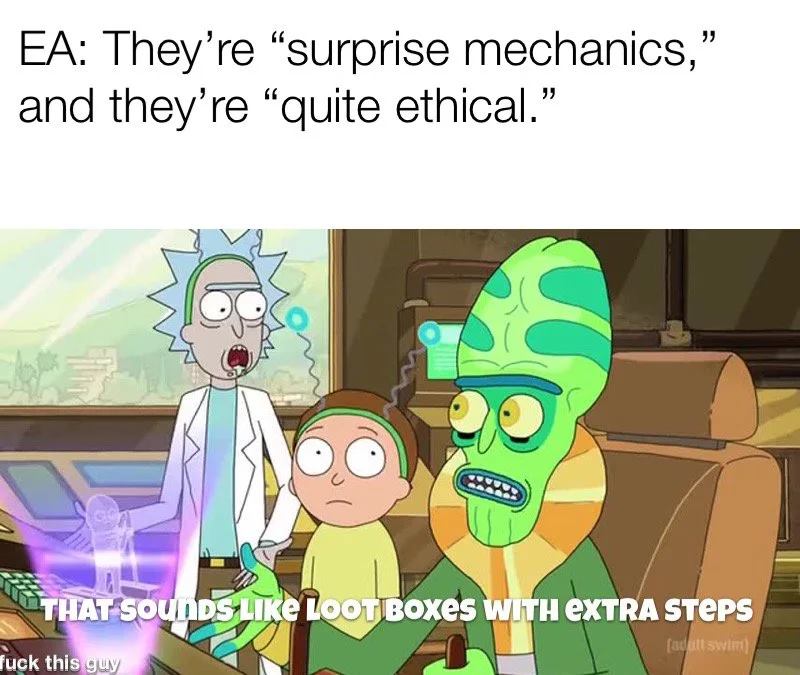
EA: "Loots boxes are surprise mechanics, not loot boxes"
-
2019-06-21 15:50 #247BG Content
- Join Date
- Oct 2005
- Posts
- 69,776
- BG Level
- 10
- FFXIV Character
- Six Souls
- FFXIV Server
- Gilgamesh
- FFXI Server
- Quetzalcoatl
- WoW Realm
- Malorne
- Blog Entries
- 9
https://www.gamesindustry.biz/articl...om-british-mps Originally Posted by Koul
https://parliamentlive.tv/Event/Inde...e-c43c4a0879d4
Attending the hearing were Epic Games' director of marketing Matt Weissinger and general counsel Canon Pence, who were joined by Electronic Arts' UK country manager Shaun Campbell and vice president of legal and government affairs Kerry Hopkins.
Epic Games in particular attracted ire from MPs, driven by evasive or baffling answers that seemed to only raise further concerns.
At one point, Canon Pence claimed it was inaccurate to define Epic as a company which makes money from people playing its games, to which Collins responded: "You're not a charity."
"We don't call them loot boxes... We call then 'surprise mechanics'," said EA's Kerry Hopkins, who said she had no qualms with the publishers' implementation of loot boxes, and justified any problematic consequences as "bad guys find ways to do bad things.
Both companies had little to offer on questions around playtime, either claiming they did not track that data specifically, or providing strawman arguments around what constitutes "too much."
After several minutes of attempting to pin Epic's Matt Weissinger on the definition of a regular player, the committee was met with the response that it was "commercially sensitive" information.
"What I struggle with here, [Fortnite] is a game which makes money out of people playing it," replied Collins in dismay. "It's a hugely successful game played by millions of people around the world. And this sort of basic information -- we know from other game companies we've spoken to -- is something that would be gathered and analysed all of the time. So I don't believe you don't know this information.
"So for me, this arouses suspicion that this is not something we can discuss... this is basic information. We don't need to know your corporate secrets... but I'm sure you've got an idea what the answers to these questions are."
-
2019-06-21 17:48 #248Chram
- Join Date
- Jul 2005
- Posts
- 2,581
- BG Level
- 7
- FFXIV Character
- Deejay Zombie
- FFXIV Server
- Excalibur
-
2019-06-25 16:13 #249BG Content
- Join Date
- Oct 2005
- Posts
- 69,776
- BG Level
- 10
- FFXIV Character
- Six Souls
- FFXIV Server
- Gilgamesh
- FFXI Server
- Quetzalcoatl
- WoW Realm
- Malorne
- Blog Entries
- 9
-
2019-06-25 16:39 #250Ridill
- Join Date
- Feb 2007
- Posts
- 15,591
- BG Level
- 9
Get fucked EA.
-
2019-06-25 18:45 #251I'll change yer fuckin rate you derivative piece of shit
- Join Date
- Sep 2006
- Posts
- 58,737
- BG Level
- 10
can't you just not buy loot boxes?
-
2019-06-25 18:50 #252Chram
- Join Date
- Jul 2005
- Posts
- 2,581
- BG Level
- 7
- FFXIV Character
- Deejay Zombie
- FFXIV Server
- Excalibur
Sure, unless you're addicted to gambling, and you play video games as an alternative to that behavior, and then your favorite games start to implement them. Originally Posted by archibaldcrane
In that case it might not be so easy.
Also, kids don't really have impulse control or a sense of what things cost in the real world.
I think the primary concern is companies are trying to cement these gambling behaviors in children at a young age.
-
2019-06-25 18:52 #253I'll change yer fuckin rate you derivative piece of shit
- Join Date
- Sep 2006
- Posts
- 58,737
- BG Level
- 10
my advice still stands but that's a good point
It's almost hard to articulate how much I loathe the idea that people spend hard-earned cash on video game costumes that don't affect performance. It like, completely blows my goddamn mind what the fuck is wrong with you people
-
2019-06-25 19:04 #254I'm almost as bad as Mazmaz
Sweaty Dick Punching Enthusiast
- Join Date
- Jul 2008
- Posts
- 26,052
- BG Level
- 10
 sounds like this should be a problem for the parents Originally Posted by djzombie
ive never understood the mentality of actively spending extra money to shorten the amount of time you are spending on your hobby by buying the gear you want instead of playing the game to get it. its a fascinating thing Originally Posted by archibaldcrane
-
2019-06-25 19:12 #255Chram
- Join Date
- Jul 2005
- Posts
- 2,581
- BG Level
- 7
- FFXIV Character
- Deejay Zombie
- FFXIV Server
- Excalibur
The only reason I don't agree with this is because casinos use psychological tricks to keep people spending their money. Many of these tricks casinos use videogames have started to implement as well.sounds like this should be a problem for the parents
When you consider the mind of an adult can be manipulated into spending all their money and gaining no benefit do you think a child has any chance of resisting?
I think the long and the short of it is, how do you define gambling? I think lootboxes are very clearly gambling as you're paying money for the chance of getting what you want.
In some cases (CSGO) there is a real monetary value attached to those items, so getting something rare could net you thousands of dollars.
However the bulk of your experience is going to be receiving an item that is worth only pennies of the money you just spent.
Once you attach a real life monetary value to whatever you receive from a lootbox, it's pretty difficult to claim it isn't gambling, and that is done from the start in most cases by charging users real money to open them.
-
2019-06-25 19:15 #256I'm almost as bad as Mazmaz
Sweaty Dick Punching Enthusiast
- Join Date
- Jul 2008
- Posts
- 26,052
- BG Level
- 10
so do supermarkets and all retail stores in general. they're called impulse buy items and they're placed near the cash register. there's been decades of research on it and it's a thing. Originally Posted by djzombie
is every store you walk into evil? no. it's just marketing. be above it
also the kids shouldn't have access to their parents credit card/debit card/whatever to begin with. this, again, sounds like a parenting problem
-
2019-06-25 19:21 #257Chram
- Join Date
- Jul 2005
- Posts
- 2,581
- BG Level
- 7
- FFXIV Character
- Deejay Zombie
- FFXIV Server
- Excalibur
You're comparing tangible goods that provide a benefit to intangible goods that only exist as pixels in a video game.
You also don't get a random result when you go the grocery store. You don't pick up a bag of randomly selected food and walk to the register with it. (or alternatively pay money and still end up with no food)
These things are not same same.
I agree with you on this.also the kids shouldn't have access to their parents credit card/debit card/whatever to begin with
-
2019-06-25 19:27 #258United States of Smash!
- Join Date
- Jun 2006
- Posts
- 8,813
- BG Level
- 8
Do you not understand the difference between gambling and buying stuff directly? That isn't a good parallel. If I walk into a store and buy a candy bar on an impulse I am guaranteed to get the candy bar I want. It would be more akin to walking into a store and paying for a CHANCE to take home a candy bar. Originally Posted by Rhyis.
-
2019-06-25 19:31 #259Chram
- Join Date
- Jul 2005
- Posts
- 2,581
- BG Level
- 7
- FFXIV Character
- Deejay Zombie
- FFXIV Server
- Excalibur
Sorry bro, no candy bar for you today. You got another two bucks? You could try again! Originally Posted by zoobernut
-
2019-06-25 19:31 #260Member since 2006 and still can't think of a title.
- Join Date
- Oct 2006
- Posts
- 28,282
- BG Level
- 10
- FFXIV Character
- Acanis Lindri
- FFXIV Server
- Midgardsormr
- FFXI Server
- Bismarck
- WoW Realm
- Kil'jaeden

The better comparison honestly would be the machines were you put in 25 cents and get some mystery junk toy in the plastic egg.

