 XI Wiki


that's hardly unreasonable. be nice to see that more often.
- Navigation
Results 781 to 800 of 3053
-
2020-06-15 21:33 #781

Sweaty Dick Punching Enthusiast
- Join Date
- Dec 2006
- Posts
- 4,440
- BG Level
- 7

-
2020-06-15 21:44 #782RNGesus
Sweaty Dick Punching Enthusiast
- Join Date
- Jan 2005
- Posts
- 43,933
- BG Level
- 10
- FFXIV Character
- Lenette Valkyr
- FFXIV Server
- Gilgamesh

Watch the video. He still manages to sound like an idiot.
-
2020-06-16 05:20 #783Sandworm Swallows
- Join Date
- Dec 2007
- Posts
- 7,199
- BG Level
- 8
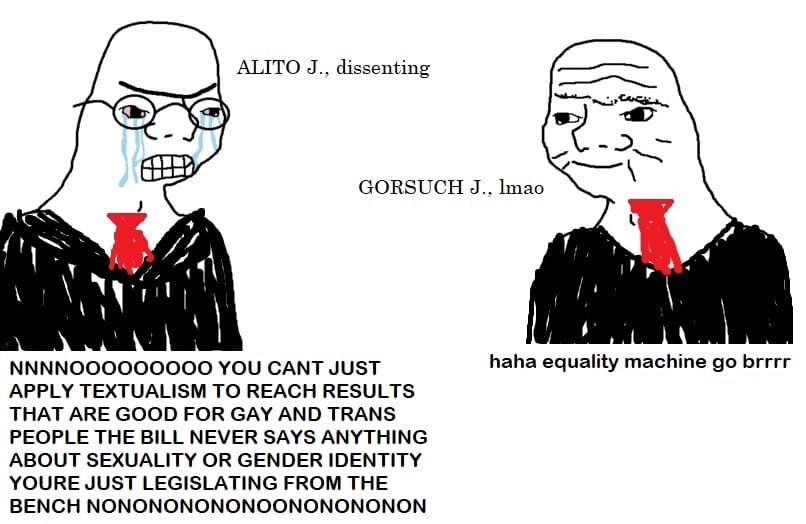
So after reading the dissenting opinions with the wife, we debated a bit about it. She hates that they did a good job of writing it and feels it was reasoned well. The problem I have it with is you know, 100%, that everyone in the dissenting opinion would change their argument on textualism if this was about the second amendment. You could literally take that dissent, and use it to rip the second amendment apart with the limited knowledge the writers had with how powerful guns became. Originally Posted by Gredival

-
2020-06-16 17:25 #784Kevin Chang
- Join Date
- Oct 2007
- Posts
- 10,704
- BG Level
- 9
- FFXI Server
- Sylph
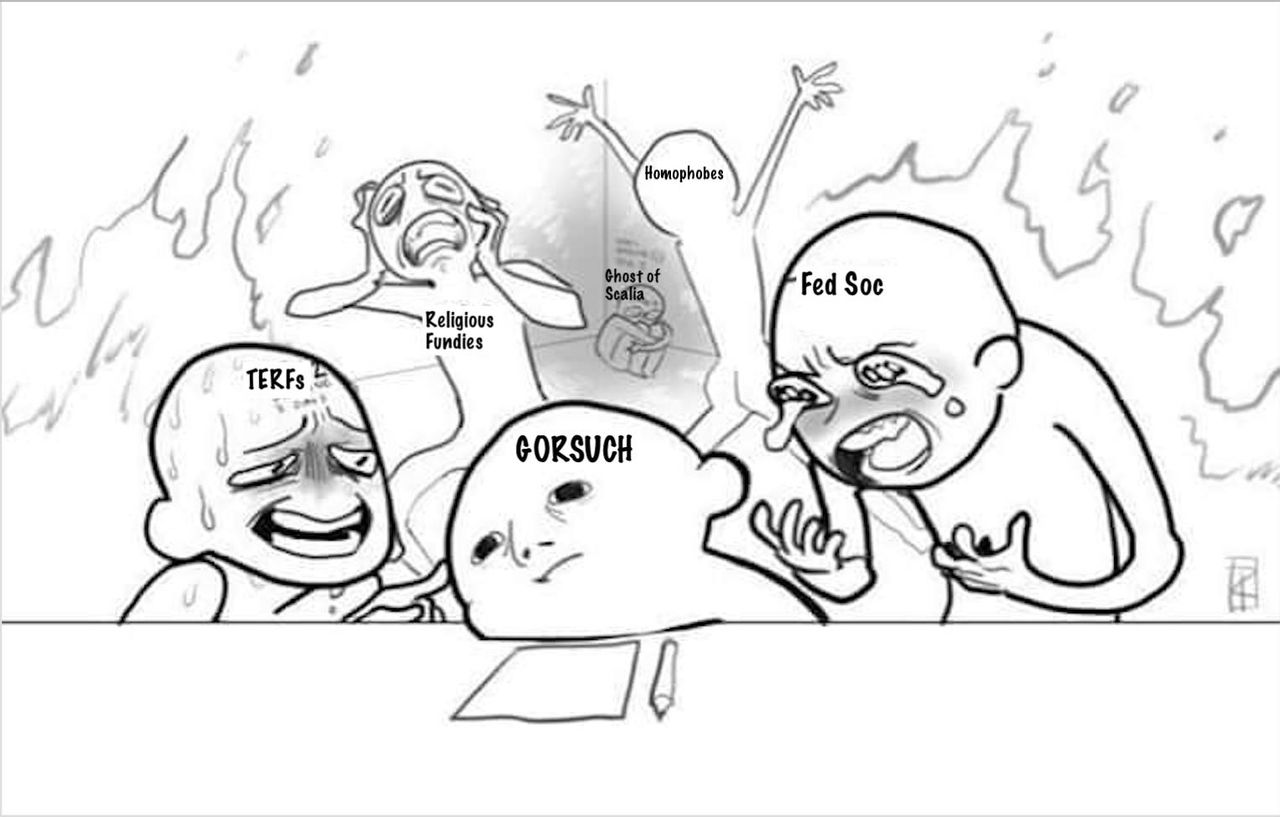
 Gorsuch's opinion could be considered textualist because it takes the stance "orientation and gender identification aren't clearly enunciated and they may not have been intended, but they are clearly covered by the plain language of the statute" whereas Alito's is non-textualist because it is looking for the intent behind the word sex. Originally Posted by Yabby
Textualism becomes whatever the conservative Justice wants it to mean.
-
2020-06-18 04:16 #785Kevin Chang
- Join Date
- Oct 2007
- Posts
- 10,704
- BG Level
- 9
- FFXI Server
- Sylph
-
2020-06-18 09:09 #786I trusted Zet and this is what happened
Eleven owes me $40 bucks
- Join Date
- Jun 2007
- Posts
- 21,276
- BG Level
- 10
- FFXIV Character
- Kaslo Essyx
- FFXIV Server
- Famfrit
- FFXI Server
- Carbuncle
https://twitter.com/SCOTUSblog/statu...443387392?s=20#SCOTUS rules against Trump administration in challenge to decision to end #DACA program, which allowed noncitizens brought to this country illegally as children to apply for protection from deportation, holding decision was arbitrary and capricious
-
2020-06-18 09:22 #787I'll change yer fuckin rate you derivative piece of shit
- Join Date
- Sep 2006
- Posts
- 59,015
- BG Level
- 10
5-4 with Roberts joining the libs
-
2020-06-18 09:24 #788I'll change yer fuckin rate you derivative piece of shit
- Join Date
- Sep 2006
- Posts
- 59,015
- BG Level
- 10
Pretty incredible that Trump, the guy who won the white house on an anti-immigrant, anti-Obama platform, was unable in 4 years as president to undo an Obama pro-immigrant executive order.
-
2020-06-18 09:25 #789I'll change yer fuckin rate you derivative piece of shit
- Join Date
- Sep 2006
- Posts
- 59,015
- BG Level
- 10
Extremely true:
https://twitter.com/matthewamiller/s...834801669?s=19
-
2020-06-18 09:36 #790I trusted Zet and this is what happened
Eleven owes me $40 bucks
- Join Date
- Jun 2007
- Posts
- 21,276
- BG Level
- 10
- FFXIV Character
- Kaslo Essyx
- FFXIV Server
- Famfrit
- FFXI Server
- Carbuncle
Yup Originally Posted by archibaldcrane
-
2020-06-18 09:54 #791Relic Horn
- Join Date
- Jul 2005
- Posts
- 3,017
- BG Level
- 7
 Pretty much. NPR just had a thing about Robert's comments on it which was summed up as "you could have easily had a case for this but you didn't do your freaking homework and based on the arguments given I'm going to side with the libs." Originally Posted by archibaldcrane
-
2020-06-18 10:01 #792Certified Man-Child
- Join Date
- Jun 2007
- Posts
- 3,470
- BG Level
- 7
- FFXIV Character
- Uzuki Ashtear
- FFXIV Server
- Famfrit
- FFXI Server
- Shiva
- WoW Realm
- The Scryers
They keep dabbing on Trump lmao. Shit is beautiful.
Sent from my Pixel 3a using Tapatalk
-
2020-06-18 11:06 #793Ridill
- Join Date
- Oct 2006
- Posts
- 10,411
- BG Level
- 9
- FFXI Server
- Gilgamesh
I'm kind of scratching my head at what homework is needed for the executive branch to un-do an executive memo. Why is anything even required for something like that that was not passed by congress?
-
2020-06-18 11:15 #794I trusted Zet and this is what happened
Eleven owes me $40 bucks
- Join Date
- Jun 2007
- Posts
- 21,276
- BG Level
- 10
- FFXIV Character
- Kaslo Essyx
- FFXIV Server
- Famfrit
- FFXI Server
- Carbuncle
*sigh* okay this is a long one. Originally Posted by Kirin
The transfer of legislative (regulations) or judicial (administrative judges) authority to an executive agency requires a certain level of oversight for checks and balances purposes. That comes in the form of the Administrative Procedures Act. This lays out the procedures an agency has to follow to enact/repeal/amend a regulation (called rulemaking), or procedures the agency must follow in enforcing said regulation (administrative judicial proceedings). Generally for regulations, rulemaking procedures require the agency to propose a rule then publish the rule for comment. The agency then has to consider those comment and address serious concerns raised in its decision to accept or reject the proposed rule.
-
2020-06-18 11:35 #795Brokage
- Join Date
- Oct 2006
- Posts
- 20,331
- BG Level
- 10
- FFXIV Character
- Vasp Anemos
- FFXIV Server
- Faerie
- FFXI Server
- Valefor

So in this case, Trumpito and his croonies made either no effort or really shitty efforts at their comments towards the rule and thus SCOTUS dunked on their attempt to reverse it?
-
2020-06-18 11:39 #796I'll change yer fuckin rate you derivative piece of shit
- Join Date
- Sep 2006
- Posts
- 59,015
- BG Level
- 10
The arguments they were making in court to change the rule were so obviously in contradiction with their (Trump's) public statements outside the court that the court was unwilling to take their fig leaf argument at face value.
-
2020-06-18 11:48 #797Ridill
- Join Date
- Oct 2006
- Posts
- 10,411
- BG Level
- 9
- FFXI Server
- Gilgamesh
Gotcha. Originally Posted by Kaslo
Is there anything in place to allow said agency to not be beholden to a strong social push such as prohibition or 9/11 aftermath that would have these decisions being made on feeling vs law? Or is the intended purpose to have this oversight work more off public opinion than a judgement?
-
2020-06-18 11:54 #798I trusted Zet and this is what happened
Eleven owes me $40 bucks
- Join Date
- Jun 2007
- Posts
- 21,276
- BG Level
- 10
- FFXIV Character
- Kaslo Essyx
- FFXIV Server
- Famfrit
- FFXI Server
- Carbuncle
Generally speaking agency decisions can be reversed and remanded to the agency in the following circumstances: Originally Posted by Kirin
(A) arbitrary, capricious, an abuse of discretion, or otherwise not in accordance with law;
(B) contrary to constitutional right, power, privilege, or immunity;
(C) in excess of statutory jurisdiction, authority, or limitations, or short of statutory right;
(D) without observance of procedure required by law;
(E) unsupported by substantial evidence; or
(F) unwarranted by the facts.
So basically, your rule cannot be unlawful and it has to be supported by substantive evidence. It also has to follow all procedures. The big catch all is arbitrary and capricious. The most common definition I've seen for A&C is:
(A) entirely failed to consider an important aspect of the problem,
(B) offered an explanation for its decision that runs counter to the evidence before the agency, or is so implausible that it could not be ascribed to a difference in view or the product of agency expertise,
(C) failed to base its decision on consideration of the relevant factors, or
(D) made a clear error of judgment.
-
2020-06-18 13:19 #799Ridill
- Join Date
- Oct 2006
- Posts
- 10,411
- BG Level
- 9
- FFXI Server
- Gilgamesh
Okay, thanks. Originally Posted by Kaslo
So B was really the big reason this was torpedoed then.
-
2020-06-18 18:05 #800RNGesus
Sweaty Dick Punching Enthusiast
- Join Date
- Jan 2005
- Posts
- 43,933
- BG Level
- 10
- FFXIV Character
- Lenette Valkyr
- FFXIV Server
- Gilgamesh
Nvm. Spoilered for large Originally Posted by Tyrath
Spoiler: show



Similar Threads
-
SCOTUS Thread (News and Discussion): Eight Becomes Nine
By Cail in forum Politics: Advanced ShitpostingReplies: 3009Last Post: 2018-10-03, 16:28 -
The who will you be voting for Poll and Discussion Thread
By Koyangi in forum Politics: Advanced ShitpostingReplies: 348Last Post: 2012-11-08, 19:49