 XI Wiki


There's no other way to interpret what you just said. You asked how you can convince someone to buy a console over using Stadia, and the answer is obvious: if they can't use Stadia, they won't use Stadia. As myself and others have already tried to drill into your skull, internet is not the same around the world as it is for you. I absolutely fucking despise the word "privilege" and how often it's thrown around these days, but I'm using it here because it's relevant: You're fucking privileged. Most of us on BG are privileged. Our ability to source good, fast, stable internet is a privilege, it is not a given. In many, many, MANY areas you can't simply upgrade yourself to a stable connection that can seamlessly stream games in the way that Google intends for you to stream games. You're living in an absolute fantasy land if you think that consoles are going the way of the dodo within 20 years time, so I sorely hope that you do not think that's the case.Originally Posted by Salodin

- Navigation
Results 161 to 180 of 419
-
2019-03-21 17:41 #161Impossiblu

- Join Date
- Mar 2010
- Posts
- 10,445
- BG Level
- 9
- FFXIV Character
- Prothescar Centursa
- FFXIV Server
- Balmung
- FFXI Server
- Valefor

-
2019-03-21 17:44 #162Caesar Salad
- Join Date
- Nov 2009
- Posts
- 32,175
- BG Level
- 10
Or maybe one of the biggest complaints about current console tech is its expensive for the type of hardware you get, but you put up with it cause the box lasts around a decade and it's cheaper than building a PC. If that barrier to entry, namely the price, was removed, then why would you continue to buy consoles?
If the ultimate gaming PC was available for the price of Netflix (just assuming), why wouldn't you do that instead of dropping hundreds on a console that could never keep up?
The only answer I can think of is first party exclusives, but there arent many of those left.
Sent from my SM-G975U using Tapatalk
-
2019-03-21 17:46 #163Caesar Salad
- Join Date
- Nov 2009
- Posts
- 32,175
- BG Level
- 10
Man, why didn't I think of this. Why is google making a product targetting the underprivileged when they could target us instead? Makes no sense man you're right. Originally Posted by Prothescar
Sent from my SM-G975U using Tapatalk
-
2019-03-21 17:49 #164Impossiblu
- Join Date
- Mar 2010
- Posts
- 10,445
- BG Level
- 9
- FFXIV Character
- Prothescar Centursa
- FFXIV Server
- Balmung
- FFXI Server
- Valefor
My dude, once again, not everyone is going to be capable of using Stadia. It isn't as simple as saying "y would someone buy X over Y" because not everyone can use Y. This is not a difficult concept to comprehend. IF it works as well as Google says it will, will there be a shift from consoles and PCs to Stadia capable devices? Yes. But that's only for people who can actually use the Stadia service, which once again, will not be everybody and probably never will be everybody. At this stage in human development I fully expect a worldwide disaster to wipe us off the face of the Earth before everyone on the planet gets access to reliable internet. These people will continue as they are now: playing on consoles and PCs. Period. End of. We don't live in a sci-fi movie.
And don't even try to pretend like just because someone has bad internet they wouldn't be able to use a console. Being underprivileged when it comes to internet access != being underprivileged when it comes to wealth.
-
2019-03-21 17:53 #165Relic Weapons
- Join Date
- Jan 2012
- Posts
- 343
- BG Level
- 4
no way will it be the price of Netflix lol
-
2019-03-21 17:57 #166Caesar Salad
- Join Date
- Nov 2009
- Posts
- 32,175
- BG Level
- 10
I look forward to reading the reactions in this thread at the next stadia press event
Sent from my SM-G975U using Tapatalk
-
2019-03-21 17:58 #167BG Content
- Join Date
- Oct 2005
- Posts
- 70,801
- BG Level
- 10
- FFXIV Character
- Six Souls
- FFXIV Server
- Gilgamesh
- FFXI Server
- Quetzalcoatl
- WoW Realm
- Malorne
- Blog Entries
- 9


https://www.gamesindustry.biz/articl...-from-consoles
Interview with former Playstation & Microsoft exec and current Google VP Phil Harrison on the platform.
"We are absolutely firm that we are not, will not, and will never release a console," he tells GamesIndustry.biz.
The company positions it as "a new generation platform, rather than a next generation platform," one that can evolve as technology improves and its data centres evolve without the need for the end user to invest in new hardware.
"We're not breaking from the past or trying to distance ourselves from the history of the industry, because without that rich history that I've been intertwined with all my life, we wouldn't be stood here today," he says.
"But for the last 40 years of games, the industry has been device-centric. As a developer, I build for a device. It's been package-centric -- I either ship the game on a disc or a cassette tape or a cartridge or increasingly now I download that package. But it's still that mental model of a package for a thing. As of 10am yesterday, we just broke through that glass ceiling and said to developers, 'The internet is your store and the network and the data centre is your platform.'
"I think that's a really exciting moment for the industry. The whole world isn't going to shift to that new model overnight, and it will take time for us to realise every aspect of the promise. But it's a fundamental and, I passionately believe, an inevitable and one-way direction that the industry is moving."
"As I said, [the industry is] not going to change overnight. I don't believe we're going to shift every gamer from the platforms they love today to our platform tomorrow, but we think this is a very significant change of direction for games."
"For the Project Stream test we did at the backend of 2018, the recommended bandwidth that we asked gamers to have was 25mbps in order to have 1080p, 60fps," he says. "In actual fact, we used a lot less than that -- it was actually closer to 20mbps. For our launch this year, we have made some very significant improvements in our streamer, our codecs, our hardware and software services, which means we can get to 4K 60fps at around 30mbps. 30mbps doesn't exclude a huge segment of the population. We think we can reach a very significant part of the world with that kind of performance. It's not a gigabyte downstream."
"[Internet Service Providers] historically have a proven track record of adjusting to consumer demand," he says. "When music streaming started, bandwidth caps lifted. When video and TV streaming started, bandwidth caps lifted. We expect that to continue.
"ISPs are in a competitive market. There are new entrants all the time that are looking at 5G and other technologies without any bandwidth cap. So I think that, while I completely understand the concern, I think the reality will be very different."
-
2019-03-21 18:04 #168Impossiblu
- Join Date
- Mar 2010
- Posts
- 10,445
- BG Level
- 9
- FFXIV Character
- Prothescar Centursa
- FFXIV Server
- Balmung
- FFXI Server
- Valefor
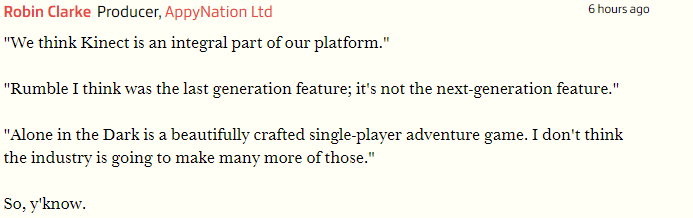
I like this guy
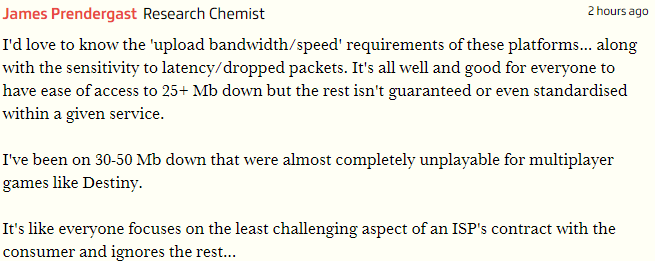
this guy too
-
2019-03-21 23:39 #169Ridill
- Join Date
- Feb 2007
- Posts
- 15,669
- BG Level
- 9
I have no problem with the industry eventually moving this way if done properly, but the hype is much like 3D being pushed after Avatar released and here we are with it largely being a flop due to the impracticality of passing it on to the consumer outside the theater. The interview 6 posted above also ignores things like how stubborn ISPs were about data caps or further upping the cost of access to compensate and all the lobbying they've done to corrupt Pai and the FCC to yank even more power from the consumer. When's the last time we've really seen a marked decrease in internet costs? How many areas actually have noteworthy competition of 3 or more providers of the same quality? This is why not giving a fuck about the proverbial Iowa boy is a bad thing, as he's not alone in this conundrum, just as you're probably have a hard time coaxing gamers used to 1080/4k to go back to 720 because that's just the way the industry went. Gaming isn't and shouldn't be treated as just a rich man's hobby for the select few.
Simply saying this isn't an overnight process isn't enough, and this is just one facet of the accessibility argument we've broached concerns over.
-
2019-03-22 01:08 #170Graduate of the BG School of FFXI
- Join Date
- Apr 2010
- Posts
- 5,016
- BG Level
- 8
- FFXIV Character
- Misses Beansman
- FFXIV Server
- Adamantoise
- FFXI Server
- Quetzalcoatl
Dude fuck off playing offline fighting games is probably the best experience I've ever had with gaming. Originally Posted by Salodin
I'm open to the latency issues being fixed but being reliant on an internet connection is still shit with the current state of ISPs. Like I'm running Google fiber and have no fear of being throttled for this but guess what my internet connection still drops inexplicably from time to time. Maybe offline options will be available now but I just dont see it staying that way forever but ISPs being shit that's probably not changing for the foreseeable future.
-
2019-03-22 23:42 #171Banned.

- Join Date
- Jan 2009
- Posts
- 3,872
- BG Level
- 7
- FFXI Server
- Shiva
- WoW Realm
- Kil'jaeden
you think all MS has is bing? oh boy Originally Posted by Salodin
-
2019-03-23 10:14 #172BG Content
- Join Date
- Oct 2005
- Posts
- 70,801
- BG Level
- 10
- FFXIV Character
- Six Souls
- FFXIV Server
- Gilgamesh
- FFXI Server
- Quetzalcoatl
- WoW Realm
- Malorne
- Blog Entries
- 9
https://www.windowscentral.com/googl...ive-controller
Xbox Adaptive Controller support announced.
-
2019-03-27 19:05 #173Bard-turned-Miner
- Join Date
- Aug 2005
- Posts
- 2,652
- BG Level
- 7
There are rumors Google is considering two-tiered subscription pricing. One would be a lower price for older games and a the other a higher price for day-and-date access. This was actually something I'd been thinking about and IMO is a very smart way to structure it. There's no word on how long until a game would drop into the lower tier. In my head I was thinking something around 6-9 months, with the higher cost being $10 more makes sense.
-
2019-06-03 15:40 #174BG Content
- Join Date
- Oct 2005
- Posts
- 70,801
- BG Level
- 10
- FFXIV Character
- Six Souls
- FFXIV Server
- Gilgamesh
- FFXI Server
- Quetzalcoatl
- WoW Realm
- Malorne
- Blog Entries
- 9
-
2019-06-06 07:24 #175BG Content
- Join Date
- Oct 2005
- Posts
- 70,801
- BG Level
- 10
- FFXIV Character
- Six Souls
- FFXIV Server
- Gilgamesh
- FFXI Server
- Quetzalcoatl
- WoW Realm
- Malorne
- Blog Entries
- 9
https://kotaku.com/sources-destiny-2...ing-1835270126
Destiny 2 and Ghost Recon: Breakpoint support are expected to be announced today.
-
2019-06-06 10:11 #176BG Content
- Join Date
- Oct 2005
- Posts
- 70,801
- BG Level
- 10
- FFXIV Character
- Six Souls
- FFXIV Server
- Gilgamesh
- FFXI Server
- Quetzalcoatl
- WoW Realm
- Malorne
- Blog Entries
- 9
Google doesn't have an official stream link up, yet.
Official;
-
2019-06-06 12:05 #177Caesar Salad
- Join Date
- Nov 2009
- Posts
- 32,175
- BG Level
- 10
I'm on mobile, but basically:
Pro access available November, Base access in 2020.
$9.99/month for pro access, which is basically game pass for stadia. Works on all platforms discussed before. It seems mobile support is limited to the pixel 3/3a for now, they didn't mention others during the video.
They have a bundle with a midnight blue version of the controller, a chromecast ultra ($70 value), 3 months of Pro access and 3 months to gift a friend. All for $129.
Base access is for people who buy a game straight, without subscription. Base access is capped at 1080p/60fps/stereo, Pro access offers 4k/60fps/hdr/5.1surround.
They're officially advertising a 35mb connection needed to hit 4k/60fps, but the service will work with up to a 10mb connection, coming in at 720/stereo. I dont recall if the 10mb connection was 30fps or 60fps. Another random note I heard, if you're playing this on a chrome browser on say a tablet, the controller is required. It seems you dont need the controller if playing on PC (you can use your own), but all other avenues for streaming require the controller. I do not recall if they mentioned the base price for the controller without the bundle.
All in all, unless some terrible press comes out before November, I'll probably get the founders bundle and be BGs test subject on this one. I'm super interested in how it turns out, and getting a chromecast ultra out of it is very useful for all my 4k TVs.
Sent from my SM-G975U using Tapatalk
-
2019-06-06 12:29 #178Caesar Salad
- Join Date
- Nov 2009
- Posts
- 32,175
- BG Level
- 10
Oh, Stadia Founders bundle also comes with the full Destiny 2 experience. All expansions and passes.
Sent from my SM-G975U using Tapatalk
-
2019-06-06 16:10 #179Impossiblu
- Join Date
- Mar 2010
- Posts
- 10,445
- BG Level
- 9
- FFXIV Character
- Prothescar Centursa
- FFXIV Server
- Balmung
- FFXI Server
- Valefor
I'm interested to see your experiences with it. As I said in the past I won't mind being wrong about Stadia, but I will remain skeptical until people actually try it.
This is alarming
Initial reception is poor due to lack of ownership over games as expectedGoogle says it can provide a steady 60fps 4K stream with a bitrate of 35Mbps. That's the high end of the streaming requirements, while 1080p at 60fps drops the bandwidth to 20Mbps, and 720p 60fps requires just 10Mbps. That works out to around 15.75GB per hour of 4K streaming, 9GB per hour of 1080p, or 4.5GB per hour at 720p.
-
2019-06-06 17:23 #180Caesar Salad
- Join Date
- Nov 2009
- Posts
- 32,175
- BG Level
- 10
I'm not concerned about the ownership aspect; I've been buying from steam for a long time and I dont own those either. I just want to know what they get the final latency to. Honestly I'm excited to just have an excuse to shell out the money for a chromecast ultra lol. This bundle came at the right time.
Sent from my SM-G975U using Tapatalk

