 XI Wiki


https://twitter.com/justinbaragona/s...53993034911744Originally Posted by 6souls

- Navigation
Results 661 to 680 of 3129
-
2021-11-04 11:40 #661BG Content

- Join Date
- Oct 2005
- Posts
- 69,835
- BG Level
- 10
- FFXIV Character
- Six Souls
- FFXIV Server
- Gilgamesh
- FFXI Server
- Quetzalcoatl
- WoW Realm
- Malorne
- Blog Entries
- 9


-
2021-11-04 11:42 #662IMPERIAL CONCUBINE OF ME

Coolest Monkey In The Jungle
- Join Date
- Sep 2007
- Posts
- 21,547
- BG Level
- 10
I do fat free half and half for coffee and 1% milk Originally Posted by Yabby
 the sacrifices i make i swear
-
2021-11-04 11:43 #663IMPERIAL CONCUBINE OF ME
Coolest Monkey In The Jungle
- Join Date
- Sep 2007
- Posts
- 21,547
- BG Level
- 10
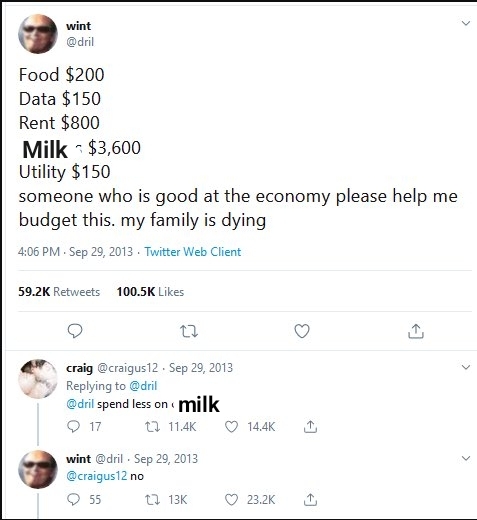
genuinely cant tell if this is an argument for or against the child credit Originally Posted by 6souls
-
2021-11-04 11:49 #664BG Content
- Join Date
- Oct 2005
- Posts
- 69,835
- BG Level
- 10
- FFXIV Character
- Six Souls
- FFXIV Server
- Gilgamesh
- FFXI Server
- Quetzalcoatl
- WoW Realm
- Malorne
- Blog Entries
- 9
More fat equals more flavor. Originally Posted by Day
-
2021-11-04 11:49 #665IMPERIAL CONCUBINE OF ME
Coolest Monkey In The Jungle
- Join Date
- Sep 2007
- Posts
- 21,547
- BG Level
- 10
-
2021-11-04 11:59 #666I trusted Zet and this is what happened
Eleven owes me $40 bucks
- Join Date
- Jun 2007
- Posts
- 21,236
- BG Level
- 10
- FFXIV Character
- Kaslo Essyx
- FFXIV Server
- Famfrit
- FFXI Server
- Carbuncle
Damnit day, stop making good memes, it's fucking with my mind. Originally Posted by Day
-
2021-11-04 12:00 #667I'll change yer fuckin rate you derivative piece of shit
- Join Date
- Sep 2006
- Posts
- 58,762
- BG Level
- 10
My family drank a ton of milk growing up, my mom grew up on a literal dairy farm, but as soon as I went to college my milk consumption cratered and I immediately developed mild lactose intolerance lol.
-
2021-11-04 12:02 #668HABS SUCK!!!!!
Sepukku is my Hero
Therrien's Cum Dumpster
- Join Date
- Mar 2005
- Posts
- 37,884
- BG Level
- 10
- FFXI Server
- Gilgamesh
 I ate at his resto in Miami. Food was good, but guy is charging ridiculous absurd prices because of his meme status...but the whales are willing to foot the bill. Originally Posted by 6souls
-
2021-11-04 13:16 #669United States of Smash!
- Join Date
- Jun 2006
- Posts
- 8,818
- BG Level
- 8
Buy a milk goat and it will solve the milk problem. My wife is getting 1-2 gallons of milk per day right now and that is slowed down from what it was. Even with her and the kids drinking all they want we still have an entire fridge full of milk. Plus all the freezers are full of goat cheese. /s
-
2021-11-04 13:34 #670Caesar Salad
- Join Date
- Nov 2009
- Posts
- 31,838
- BG Level
- 10
If it wasn't for the /s I would have absolutely believed you haha Originally Posted by zoobernut
Sent from my SM-G996U using Tapatalk
-
2021-11-04 13:58 #671United States of Smash!
- Join Date
- Jun 2006
- Posts
- 8,818
- BG Level
- 8
I mean we do own dairy goats and do get gallons of milk every day and our fridge and freezers are full of milk and cheese. I just know it is a lot of work and not possible unless you have land. The /s is just for the suggestion that it would solve the issue of milk costing too much. Originally Posted by Salodin
-
2021-11-04 14:21 #672IMPERIAL CONCUBINE OF ME
Coolest Monkey In The Jungle
- Join Date
- Sep 2007
- Posts
- 21,547
- BG Level
- 10
This guy is an actual goat f***er
-
2021-11-04 15:22 #673
Sweaty Dick Punching Enthusiast
- Join Date
- Sep 2010
- Posts
- 21,894
- BG Level
- 10
you can just say Welsh
-
2021-11-04 17:04 #674United States of Smash!
- Join Date
- Jun 2006
- Posts
- 8,818
- BG Level
- 8
Well that escalated quickly. Would you like to share with the rest of us how I hurt you? Originally Posted by Day
-
2021-11-04 19:51 #675IMPERIAL CONCUBINE OF ME
Coolest Monkey In The Jungle
- Join Date
- Sep 2007
- Posts
- 21,547
- BG Level
- 10
i was saying farmer what were you thinking smh
-
2021-11-05 10:37 #676United States of Smash!
- Join Date
- Jun 2006
- Posts
- 8,818
- BG Level
- 8
Lol you southparked me. Good one. Originally Posted by Day
-
2021-11-05 10:45 #677BG Content
- Join Date
- Oct 2005
- Posts
- 69,835
- BG Level
- 10
- FFXIV Character
- Six Souls
- FFXIV Server
- Gilgamesh
- FFXI Server
- Quetzalcoatl
- WoW Realm
- Malorne
- Blog Entries
- 9
https://finance.yahoo.com/news/octob...180531280.html
https://www.bls.gov/news.release/empsit.nr0.htm
October jobs report.
Here were the main metrics from the report, compared to consensus estimates compiled by Bloomberg:
- Change in non-farm payrolls, October: +531,000 vs. +450,000 expected, +194,000 in September
- Unemployment rate: 4.6% vs. 4.7% expected, 4.8% in September
- Average hourly earnings, month-over-month: 0.4% vs. 0.4% expected, 0.6% in September
- Average hourly earnings, year-over-year: 4.9%. vs. 4.9% expected, 4.6% in September
Non-farm payrolls posted their biggest jump in a single month since July. Job growth for the past two months was also upwardly revised. The Labor Department said Friday that September payrolls increased by 312,000, up from the disappointing 194,000 previously reported. And employers in August brought back 483,000 jobs, versus the 366,000 posted in the prior print.
Though payrolls have grown in every month so far in 2021, the economy remains more than 4 million jobs short of its pre-pandemic levels following plunges in employment between March and April of 2020. And the civilian labor force was still down by nearly 3 million individuals compared to February 2020 as of October.
Hiring was expected to pick up in a broad range of industries for October, but leisure and hospitality employers saw an especially pronounced boost as concerns over the Delta variant receded and enabled more service employees to return to work. These industries added back 164,000 jobs in October, or nearly double the 88,000 brought back in September. Professional and business services payrolls also jumped by 100,000, and education and health services roles rose by 64,000 in the private sector.
In the goods-producing sector, manufacturing jobs rose by 60,000 to come in double the consensus estimate. This also accelerated from the 31,000 payrolls brought back in this industry in September. Durable goods payrolls specifically rose by 41,000 durable goods payrolls while jobs in motor vehicles and parts increased by nearly 28,000, after this industry group shed jobs on net a month earlier.
Job openings came in at a near-all-time high in August — the latest month for which data is available — while the quits rate soared by a record. And companies have been widely citing labor shortages in third-quarter earnings reports. Mentions of "labor" on earnings calls have skyrocketed by 320% over last year, according to data from Bank of America.
-
2021-11-10 13:01 #678BG Content
- Join Date
- Oct 2005
- Posts
- 69,835
- BG Level
- 10
- FFXIV Character
- Six Souls
- FFXIV Server
- Gilgamesh
- FFXI Server
- Quetzalcoatl
- WoW Realm
- Malorne
- Blog Entries
- 9
Unemployment figures released a day early
https://twitter.com/USDOL/status/1458426732361523209
-
2021-11-10 13:07 #679BG Content
- Join Date
- Oct 2005
- Posts
- 69,835
- BG Level
- 10
- FFXIV Character
- Six Souls
- FFXIV Server
- Gilgamesh
- FFXI Server
- Quetzalcoatl
- WoW Realm
- Malorne
- Blog Entries
- 9
https://apnews.com/article/business-...ced724f2ea2e45
https://www.bls.gov/news.release/pdf/cpi.pdf
October saw it's highest inflation increase since 1990.
Prices for U.S. consumers jumped 6.2% in October compared with a year earlier, leaving families facing their highest inflation rate since 1990, the Labor Department said Wednesday. From September to October, prices jumped 0.9%.
Inflation is eroding the strong gains in wages and salaries that have flowed to America’s workers in recent months, creating a political threat to the Biden administration and congressional Democrats and intensifying pressure on the Federal Reserve as it considers how fast to withdraw its efforts to boost the economy.
Fueling the spike in prices has been robust consumer demand, which has run into persistent supply shortages from COVID-related factory shutdowns in China, Vietnam and other overseas manufacturers. America’s employers, facing worker shortages, have also been handing out sizable pay raises, and many of them have raised prices to offset those higher labor costs.
The jump in inflation is hardly confined to the U.S. Prices have been accelerating in Europe and elsewhere, too, with annual inflation in the 19 countries that use the euro currency exceeding 4% in October, the most in 13 years, and energy prices spiking 23%. In Brazil, inflation soared more than 10% in the 12 months through October, according to data released this week. Higher prices for electricity, cooking gas, meat and other staples have plunged many Brazilians further into financial instability.
Americans are now spending 15% more on goods than before the pandemic. Ports, trucking companies and railroads can’t keep up, and the resulting bottlenecks are swelling prices. Surging inflation has broadened beyond pandemic-disrupted industries into the many services that Americans spend money on, notably for restaurant meals, rental apartments and medical services, which jumped 0.5% in October.
-
2021-11-10 13:09 #680Duplicitous Jew with Political Aspirations
- Join Date
- Dec 2015
- Posts
- 18,691
- BG Level
- 9
If you didn't get a 6.2% raise, you got a paycut.

