 XI Wiki

NDT back in the day:
Dem chopz.
- Navigation
Results 5201 to 5220 of 5661
Thread: Large Hardon Collider


-
2011-12-17 13:23 #5201E. Body

- Join Date
- Jan 2007
- Posts
- 2,103
- BG Level
- 7

-
2011-12-17 13:41 #5202I'm not safe on my island
Nikkei will still get me.
- Join Date
- Oct 2006
- Posts
- 20,043
- BG Level
- 10

Dem arms!
-
2012-01-11 17:23 #5203Bagel
- Join Date
- Jan 2009
- Posts
- 1,412
- BG Level
- 6
Bit of an oddity. Can't say I know too much about this technology honestly. In before FMA magic jokes.
First for accelerator-driven nuclear reactor
A first-of-a-kind reactor system has been set up in Belgium by coupling a subcritical assembly with a particle accelerator. The work is a major step in a program to research advanced waste management.
http://world-nuclear-news.org/upload...%20cutaway.jpg
A cutaway of Myrrha.
The equipment, known as Guinevere, is a demonstration model that supports the project for a larger version that will be called Myrrha (Multipurpose Hybrid Research Reactor for High-tech Applications). It was assembled by France's National Centre for Scientific Research and is managed by the Belgian Nuclear Research Centre (SCK-CEN) at Mol, about 50 kilometres east of Antwerp. The overall project is supported by 12 other European laboratories and the European Commission.
Nuclear terminology classifies an item of equipment as in a critical state if the chain fission reaction is self-sustaining and each reaction leads on average to one more. The term supercritical means the number of fissions is increasing, while subcritical means it is decreasing and will therefore dwindle to nothing.
Guinevere is designed to be subcritical if it were not for an accelerator system that sends a constant stream of protons to a target that emits neutrons to trigger fission. SCK-CEN said, "This type of reactor is very safe because the reactor section relies on a particle accelerator: when it is turned off, the reactor will stop immediately."
As well as this kind of accelerator-driven operation, Guinevere is also capable of 'classic' criticality triggered by a neutron source in the reactor core and maintained by the reactor geometry and operation of its lead cooling system. This mode of operation was 'inaugurated' in February 2011.
Guinevere has "very limited power" and is being used to learn more about the operation and control of this kind of reactor arrangement. The knowledge will be put to use at Guinevere's larger relation, Myhrra, which should begin operation in 2023.
Myrrha will be able to produce radioisotopes and doped silicon, but its research functions would be particularly well suited to investigating transmutation. This is when certain radioactive isotopes with long half lives are made to 'catch' a neutron and thereby change into a different isotope that will decay more quickly to a stable form with no radioactivity. If achievable on an industrial scale, transmutation could greatly simplify the permanent geologic disposal of radioactive waste. Myrrha can also be used to test the feasibility of lead fast reactor technology and is seen as complimentary to the Jules Horowitz Reactor, a thermal spectrum reactor under construction in Cadarache, France.
The total cost of Myrrha has been put at €960 million ($1.2 billion), with 40% of this coming from the Belgian government. SCK-CEN is looking to set up an international consortium to ensure additional financing and has completed a memorandum of understanding with the Chinese Academy of Sciences focusing on Myrrha.
-
2012-01-27 06:13 #5204Bagel
- Join Date
- Jan 2009
- Posts
- 1,412
- BG Level
- 6
Not that I'm sure anyone cares, but approaching the end of NNSW, or National Nuclear Science Week.
Been doing a few things associated with it, a few news issues but nothing major released. Still just talk about ITER / NIF / AP1000. The first pictures taken from inside Fukushima Dai-ichi were taken recently, they're a bit grainy and don't reveal much due to radiation degrading the signal but they are there. Taken from Unit 2, IIRC. Japan continues with a 'support for nuclear power approach', but as of this time only 5 of 54 units located in Japan are operating. Lots of political talks about the viability of nuclear and who is using what, etc. Most exciting bit was talks about NRC thinking about going for 'small modular reactor design units'; something I would very much like to see happen. Germany's released their figures for what shutting down nuclear is costing / will cost them... which is about the yearly GDP of Brazil, IIRC. That was the comparison point, anyway, from what I recall.
Overall though, still kind of stagnant, not a lot happening besides hopes and dreams and generic information on cleanup and future concerns.
-
2012-02-03 06:24 #5205Bagel
- Join Date
- Jan 2009
- Posts
- 1,412
- BG Level
- 6
SOARCA has been released. I haven't found a copy online yet, just references to it; but I imagine it should be available soon.
News article:
Link to SOARCAA severe accident at a US nuclear power plant would not be likely to cause any immediate deaths, while the risks of fatal cancers caused by such an accident would be millions of times lower than the general risks of dying of cancer, a long-running research study has found.
"The analyzed accidents would cause essentially zero immediate deaths and only a very, very small increase in the risk of long-term cancer deaths."
Nuclear Regulatory Commission
The US Nuclear Regulatory Commission (NRC) launched the State-of-the-Art Reactor Consequence Analyses (SOARCA) research project in 2007, and a draft report has now been completed and opened to public comment. Focusing on the Surry and Peach Bottom nuclear power plants as representative of pressurised water reactors (PWRs) and boiling water reactors (BWRs) operational in the USA, the in-depth study combines up-to-date information on plant layout and operations, local population data and emergency preparedness plans with state-of-the-art computational analysis tools and best modelling practices. These have been used to provide an evaluation of accident progression and offsite consequences for a selection of severe accident scenarios which the authors say are more realistic than previous analyses.
Scenarios considered for both plants included short- and long-term station blackouts, involving the loss of all alternating current power. Scenarios including a containment bypass involving the rupture of steam generator pipes were also considered for the Surry PWR plant. Such scenarios would not be relevant in a BWR plant, which does not utilise steam generators.
SOARCA's main conclusions fall into three areas: how a reactor accident progresses; how existing systems and emergency measures can affect an accident's outcome; and how an accident would affect the public's health.
According to the report, the studies have shown that existing resources and procedures can stop an accident, slow it down or reduce its impact before it can affect the public, but even if accidents proceed without such mitigation they take much longer to happen and release much less radioactive material than earlier analyses suggested. Moreover, the analysed accidents would cause "essentially zero immediate deaths and only a very, very small increase in the risk of long-term cancer deaths".
Latent cancer fatality risk from the selected specific scenarios was found to be thousands of times lower than the NRC's own so-called Safety Goal and millions of times lower than the general cancer fatality risk in the United States from all causes, even when employing the linear no-threshold (LNT) dose-response model, which assumes that health risk is directly proportional to radiation exposure and that even the smallest radiation exposure carries some risk.
The US study was already nearing completion when the severe accident at Japan's Fukushima Daiichi nuclear power plant took place in March 2011. The Fukushima accident had both similarities and differences with the SOARCA severe accident scenarios for Peach Bottom, and these are considered in an appendix to the report based on the current extent of knowledge on events at Fukushima.
The SOARCA results, while specific to Peach Bottom and Surry, may be generally applicable to plants with similar designs, the report notes, although cautioning that additional work would be needed to confirm this because of differences in plant-specific designs, procedures, and emergency response.
Seismic updates
The Electric Power Research Institute, US Department of Energy and US Nuclear Regulatory Commission have released a new seismic study to help nuclear facilities in the central and eastern USA to reassess seismic hazards. The report is the culmination of a four-year exercise and replaces previous seismic source models in use by industry and government since the 1980s.
The model can be used to calculate the likelihood of various levels of ground motions caused by earthquakes, based on a data set covering over 400 years of historical and geological data for the entire region.
Researched and written
by World Nuclear News
Related Stories
WNA Links
Related Links
-
2012-02-08 22:30 #5206If I screw up again Im gone forever.
Secret Admin
- Join Date
- Jul 2008
- Posts
- 8,540
- BG Level
- 8
- FFXI Server
- Bismarck
http://gizmodo.com/5882725/the-mirac...ions-of-lives/
It's shit like this that makes me want to get into nanotechnology.The Miraculous NASA Breakthrough That Could Save Millions of Lives
There are no hospitals in space. The closest E.R. is back on Earth, and astronauts can't exactly jump in a cab to get there. So what happens if the sun burps out a massive blast of radiation while an astronaut is space-amblin' by?
The NASA Biocapsule—made of carbon nanotubes—will be able to "diagnose" and instantly treat an astronaut without him or her even knowing there's something amiss. It would be like having your own personal Dr. McCoy—implanted under your skin. It represents one of the most significant breakthroughs in the history of medicine, and yes, it'll work on Earth, too.
Out of all the amazing things we saw during our NASA visits, nothing blew our minds as much as this tiny little bundle of carbon. The Space Biosciences Division at NASA Ames creates medical technology for astronauts. They essentially provide healthcare for outer space. Dr. David Loftus is the man who invented the NASA Biocapsule and has been awarded a patent for it.
Picture this: An astronaut is going to Mars. The round-trip journey will take between two and three years. During that time, the astronaut will not have access to a doctor, and there's a lot that can go wrong with the human body in space. So, prior to launch, the astronaut is implanted with a number of NASA Biocapsules. A very small incision is made in the astronaut's skin for each Biocapsule (probably in the thigh), which is implanted subcutaneously. It's outpatient surgery that requires only local anesthetic and a stitch or two to close the wound. But after it's complete, the astronaut's body is equipped to deal with a whole host of problems on its own.
One of the primary threats in space is exposure to high levels of radiation. When astronauts travel beyond Low Earth Orbit (i.e., to the Moon or Mars), they are at risk of acute radiation exposure from "solar particle events," sudden releases of intense radiation from the sun, which can damage bone marrow and wipe out someone's immune system. That's where the NASA Biocapsule kicks in: It could be filled with cells that sense the increased levels of radiation and automatically disperse medicine to help the body compensate.
This isn't science fiction. We already use a hormone called G-CSF (Granulocyte colony-stimulating factor) to treat cancer patients who are receiving radiation treatment. So it was a very small jump to put these cells in a capsule. Without G-CSF, an astronaut's immune system might not recover; he or she could die of a massive infection.
The Biocapsules aren't one-shot deals. Each capsule could be capable of delivering many metred doses over a period of years. There is no "shelf-life" to the Biocapsules. They are extremely resilient, and there is currently no known enzyme that can break down their nanostructures. And because the nanostructures are inert, they are extremely well-tolerated by the body. The capsules' porous natures allow medication to pass through their walls, but the nanostructures are strong enough to keep the cells in one place. Once all of the cells are expended, the Biocapsule stays in the body, stable and unnoticed, until it is eventually removed by a doctor back on Earth.
While the treatment of radiation-effects in space is NASA's no. 1 application for the Biocapsule, different capsules will be created to combat different threats. Heat, exhaustion, and sleep-deprivation are serious risks on an EVA (a "spacewalk"), and astronauts are usually on a very tight schedule. Different capsules can be created that contain unique triggers and treatments for different stress-factors. Naturally, DARPA has expressed a huge interest in the Biocapsules for potential military applications. But there are far loftier things planned for us Earthlings.
On our home planet, the NASA Biocapsule's primary target is diabetes—specifically, patients who need insulin. Says Dr. Loftus:
The capsule would contain pancreatic islet cells (from animals) or would contain engineered cells designed to behave like pancreatic islet cells, with both glucose-sensing and insulin secretion function. Patients with low-insulin requirement might benefit from implantation of a single capsule (containing perhaps a million to 10 million cells); patients with higher insulin requirement might require implantation of more than one capsule.
In other words, diabetes patients might never need to give themselves another shot. They wouldn't have to worry about remembering to bring medicine everywhere, and they might even be free of having to constantly monitor their blood-sugar levels. Plus, many diabetes patients lapse into comas or die during sleep because that's eight hours every day when they can't monitor their levels. The NASA Biocapsules would work automatically, regardless of whether you're awake or not. As of 2010 there were an estimated 285 million people living with diabetes, so saying that this invention could potentially save millions of lives is not an exaggeration.
Secondary "terrestrial" applications include cancer treatment (especially brain cancer). A Biocapsule implanted directly into a tumor bed could deliver very high doses of chemotherapy right to the area where it is needed—and it would greatly reduce side effects by minimizing the amount of medication that gets to other sites in the body. There are also important applications in gene therapy.
Some children are born missing a gene, or are born with a defective gene. As a result, they can't make a needed protein. Hemophilia is a classic example. These patients are missing an important blood coagulation protein. The biocapsule could be used to implant cells that are engineered to release the missing protein. Successful therapy would mean that the patients are spared the need to receive periodic injections. Patients would be safely protected by the protein released from the capsule, and they would be able to lead more normal lives.
During our visit, we asked Dr. Loftus if there could be applications for severe allergy sufferers. Many people have potentially deadly allergies (to bees, to nuts, etc.) that could send them into anaphylactic shock, and they have to carry a shot of epinephrine (an "EpiPen") in case of exposure. He said that was very much a possibility, and implementing that technology into the biocapsule would be relatively very simple. He even credited us with coming up with the idea, so in the future when you get stung by a bee and don't die, you're welcome, from Gizmodo.
Given all of these applications (and there are many more), it's not a stretch to say that the NASA Biocapsule could change the face of medicine forever. They are inexpensive and (as you can see in the video) extremely easy to create. The vacuum sucks carbon nanotubes into the mold, you slide the capsule off the mold, you fill it with cells, and then you cap it off either using more nanotubes or a protein glue. Easy as pie. They are scheduled to begin animal trials this year and next, and human trials would begin shortly after that. If all goes well we would likely see these implanted in International Space Station astronauts sometime this decade, and while it's always a wild guess, Dr. Loftus thinks we could realistically see wildspread usage on Earth within 10 to 15 years.
The NASA Biocapsule I made now sits proudly on a shelf above my desk. It is almost certainly the coolest physical thing I have ever made. An artifact from the future. Every time I look at it I feel like I'm looking through a window into another time. Twenty years from now these capsules may be commonplace. We may all have them under our skin, keeping us safe on Earth—or maybe on Mars.
Huge thanks to Dr. Loftus for being so generous with his time. On tomorrow's Space Camp, we'll take you inside "The Center of the Universe."
-
2012-02-09 18:07 #5207Banned.

- Join Date
- May 2011
- Posts
- 88
- BG Level
- 2
Holy shit! Put me on the human trials, i want this stuff now. Maybe this will stop my chronic migraines.
-
2012-02-10 06:34 #5208

- Join Date
- Feb 2006
- Posts
- 22,049
- BG Level
- 10
- FFXI Server
- Bismarck

Interesting. First time seeing/hearing about using it in that capacity.
-
2012-02-21 06:24 #5209Chram

- Join Date
- Nov 2007
- Posts
- 2,622
- BG Level
- 7
To the math wizards, i need help with a stubborn problem.
Basically, i have to calculate the formula for f '(x), when f(x) is 1/(x+1)^1/2 (aka 1 divided by the square root of x+1). I've tried multiplying by the conjugate, turning the square roots into negative fractional exponents, but i cannot seem to make heads or tails of getting it so i can plug in 0 for h without winding up with 0 in the denominator. (we're doing the whole difference in y/difference in x thing where x1,y1 is x, f(x) and x2, y2 is x+h, f(x+h).) We are NOT allowed to use chain rule for this. ;_;
I've always found square roots to be the bane of my existence, compound fractions nearly as much so, and calculus just doesn't make any sense to me. the second part was we were supposed to find out the equation of the tangent line to f when x = 3, but i think i could figure that out if i could just figure out how to do the first part. ><
and wolfram alpha is no use at all, because it uses the chain rule, without showing how to do it without.
-
2012-02-21 07:08 #5210SiralinGuest
If you turned them into negative exponents you should know how to do the rest. The chain rule isn't necessary in this particular problem. Either bring the denom to the top with a negative exponent or do it the long way with the quotient rule. (Hint: Don't use the quotient rule.
1/(x+1)^1/2
(x+1)^-1/2
Derive rule
1/2(x+1)^-3/2
1/2(x+1)^3/2
From here I could have the numbers mixed up, but I believe its:
1/2cbrt((x+1)^2)
The chain rule would be necessary if the (x+1) was something else. Like 2x+1. Then when you take the derivative you would also multiply by two. Because this problem was x+1...the derivative of (x+1) is just 1, so it's unnecessary.
For the other part I'll spoiler it if you want to try before having it shown to you.
Spoiler: show
-
2012-02-21 07:19 #5211Chram
- Join Date
- Nov 2007
- Posts
- 2,622
- BG Level
- 7
Not sure where that -3/2 came from. wouldnt that mean its the same as 3/squareroot (x+1)?
And I'm not trying to solve for f(x) either, but f ' (x), the derivative... which means the beginning of the equation is an unholy horror of:
[(1/(x+h+1)^1/2)-(1/(x+1)^1/2)]/h
And the whole problem is i turned them into negative exponents, and i DIDN'T know how to do the rest. ><; i'm just terrible with the whole exponents and square roots thing, i always get lost. i feel like math stopped making logical sense ever since the end of trig, and i've decended into a world of madness where you can turn a formula into other formulas via witchery, to the point where i'd see lead being turned into gold as more logical and sane.
-
2012-02-21 07:56 #5212SiralinGuest
The -3/2 came from f'(x^n)= nx^n-1. So yours was x^(-1/2). Use the rule: 1/2(x^(-3/2)). Where did the h come from?
Edit, just saw the rest of the explanation in the original post. I'm familiar with using d(x)/d(y) etc...but it's unnecessary in this problem as you can just solve for a single variable. Also, i havent seen the x+h thing you said.
-
2012-02-21 08:23 #5213Chram
- Join Date
- Nov 2007
- Posts
- 2,622
- BG Level
- 7
yeah, i can't use the chain rule or any shortcuts, which is why i'm having so much issues.
As for the h thing, it's basically you select 1 point, which is x, f(x), or in this case, x, 1/(x+1)^1/2. you then select a second point, which you name x+h, f(x+h), and draw a secant line connecting the two. h is basically the extra distance between x and the second variable, and your calculating the limit as h approaches 0, so you can get "arbitrarily" close to 0, aka the tangent line. in this case when you do the change in y/change in x, the denominators wind up canceling since it was x - x +h, and your just left with h as the denominator. Then you basically have to rework the formula so that when you plug in 0 for h, you get something that ISN'T 0 in the denominator, or any other invalid formula, and it will poop out the formula for the derivative of x.
A simple example would be 2x^2. in this case, you have x, 2x^2, and x+h, 2(x+h)^2 for your two points, and when you plug them in, you get:
lim
h -> 0 2(x+h)^2 - 2x^2/h
so distribute, and you get
lim
h -> o of 2(x^2 + 2hx + h^2)-2x^2/h
then distribute the 2
lim
h -> 0 of 2x^2 +4hx +2h^2 -2x^2/h
combine like terms, the x^2s cancel
lim
h ->0 of 4hx +2h^2/h
take out the 2h as a factor of both terms
lim
h -> 0 of 2h(2x +h)/h
divide
lim
h -> 0 of 2(2x +h)
plug in 0 for h, because now you don't have to worry about dividing by 0:
2(2x + (0))
2(2x)
f'(x) = 4x.
So yeah, there you have it. that's where the x+h thing came from. you can use other forms, but our teacher wants us to use this type >: she's a real demon.
-
2012-02-21 08:40 #5214SiralinGuest
Ohhh the limit definition of the derivative. In class right now so i'll reply after.
Edit: apparently i can't upload a picture to get a url to pos here from my phone so you'll have to wait until i get home. i would type it out, but it gets extremely messy. Fuck your teacher for having you use the limit def. on this equation.
-
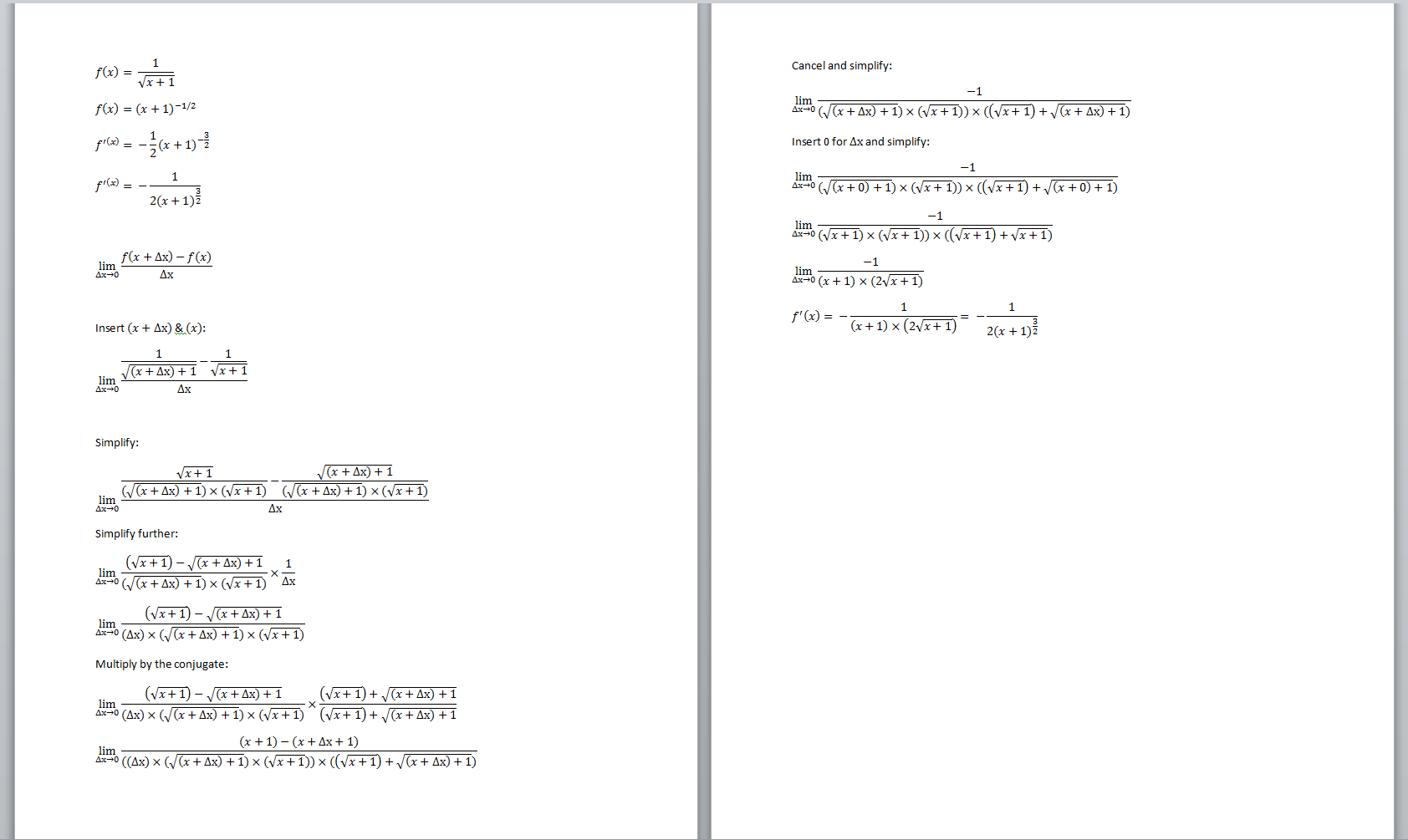
2012-02-21 13:25 #5215SiralinGuest
Sorry for the large image. I'm not really sure how I could make it a viewable size and not have a massive image though. lol
Spoiler: show
-
2012-02-21 18:53 #5216Chram
- Join Date
- Nov 2007
- Posts
- 2,622
- BG Level
- 7
blargh, i knew it. i had to simplify the top first, and THEN multiply by the conjugate. >: thanks for the help siralin, i couldn't figure out where to start. Still, fuck that problem. lol
sorry for the late response, was staying up late and had to sleep heh.
-
2012-02-21 19:07 #5217SiralinGuest
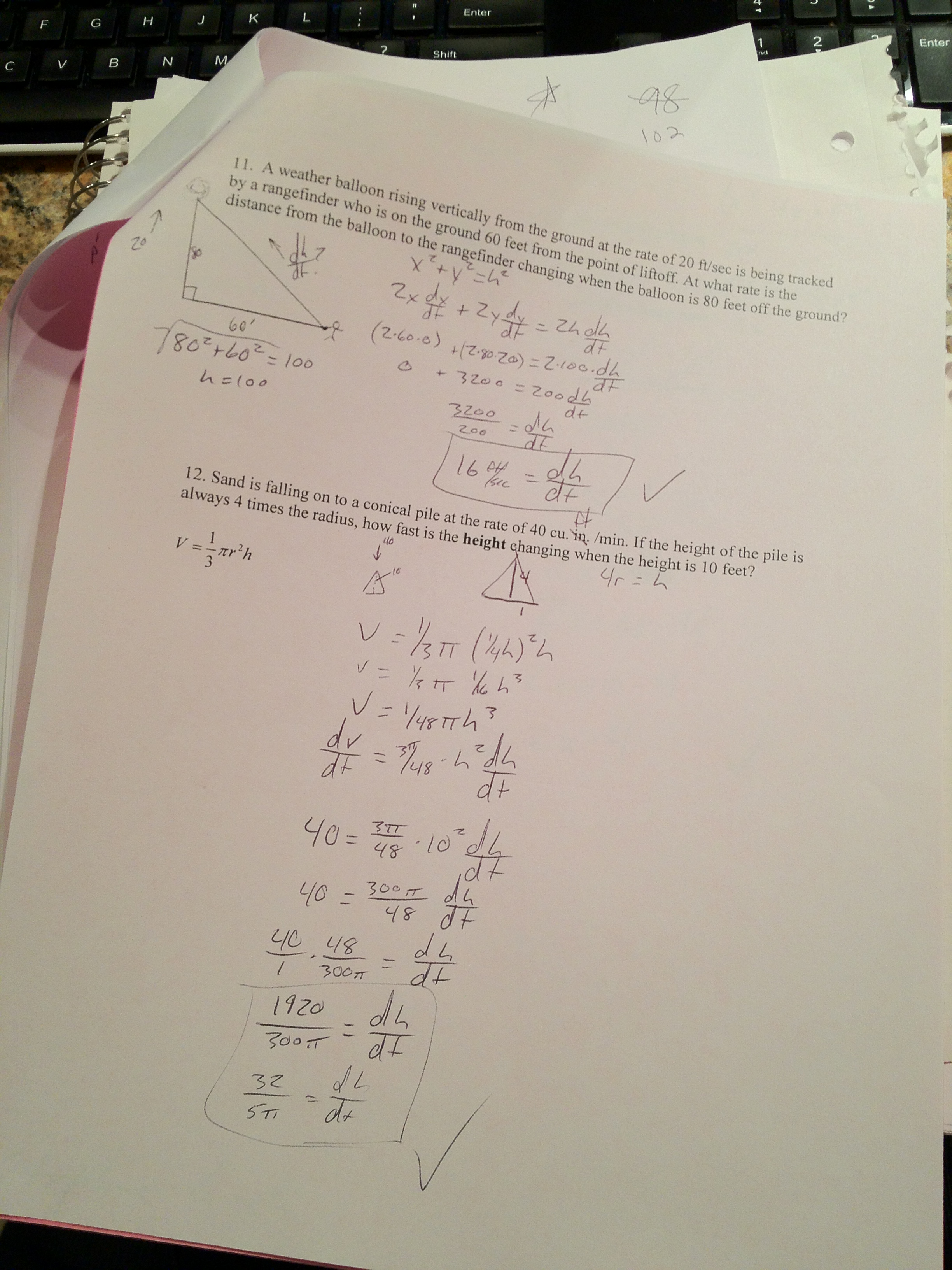
It's a fucking nasty way to have to do that. I'm probably in the same class as you at the moment. We just got the test over derivatives, implicit differentiation, and related rates back today. (102% fuck yeah) Helping with that just helps my understanding of the material.
All we had to do with the limit definition of the derivative was find the derivative of 1/x.
Are you guys going over this kind of stuff as well?
Spoiler: show
-
2012-02-21 22:36 #5218Chram
- Join Date
- Nov 2007
- Posts
- 2,622
- BG Level
- 7
Nope. we're just getting into the chain rule ourselves now.
And i got a 55 on my first test ; ; i just cannot seem to grasp any concepts of calculus, it's just a ridiculous ton of memorization and none of the things you got to memorize is named anything that's easy to remember, or is a horrid formula, or is trig, which is it's own version of hell.
Every time i take a post algebra class i feel my math self esteem falling lower and lower than the graph of f(x) = -x^2, x > 0.
-
2012-02-22 21:34 #5219Melee Summoner
- Join Date
- Jan 2012
- Posts
- 25
- BG Level
- 1

A bad fiber optic cable was responsible for neutrinos going faster than light, more testing on the way.
tp://gizmodo.com/5887398/a-loose-cable-caused-the-faster+than+light-particles-test
Can't post link to the story.
-
2012-02-23 16:54 #5220Banned.

- Join Date
- Jul 2005
- Posts
- 17,471
- BG Level
- 9
- FFXI Server
- Ifrit
- WoW Realm
- Area 52
Why is phdcomics always so accurate lol
http://www.phdcomics.com/comics/archive/phd022012s.gif
http://www.phdcomics.com/comics/archive/phd022212s.gif



Similar Threads
-
Two Nuclear Submarines Collide in Atlantic Ocean
By Firedemon in forum General DiscussionReplies: 33Last Post: 2009-02-18, 06:38 -
The Large Hadron Collider goes online tonight...
By alt in forum General DiscussionReplies: 8Last Post: 2008-09-10, 00:50 -
Large Hadron Collider...
By Jotaru in forum General DiscussionReplies: 71Last Post: 2007-11-05, 22:42