 XI Wiki

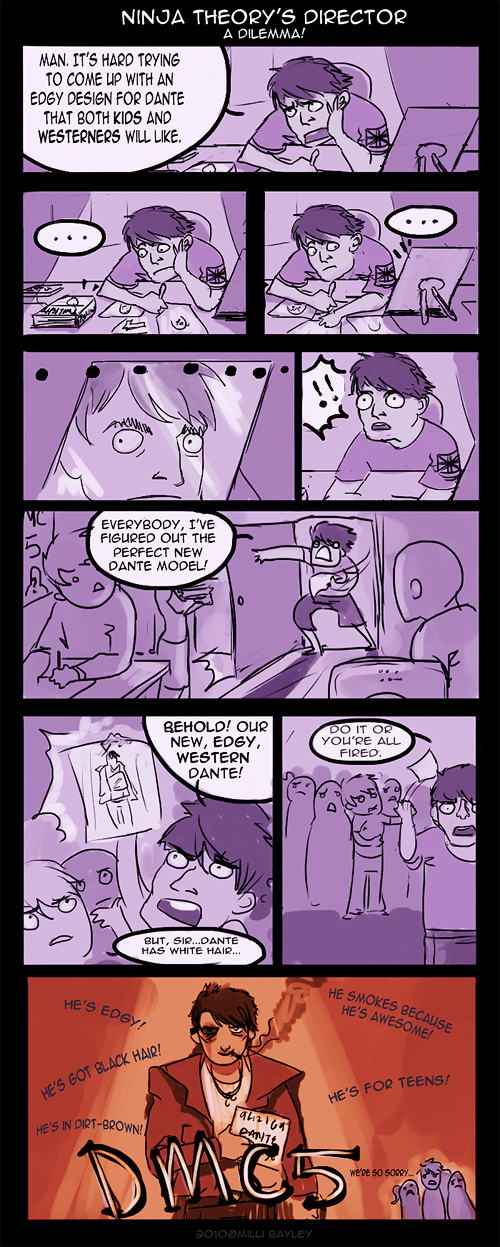
CAPCOM1: they still hate it!!!
CAPCOM2: WHY!?!?!
CAPCOM1: he doesn't look like old Dante.
CAPCOM2: THEN MAKE DLC COSTUMES DAY ONE!!!
- Navigation
Results 181 to 200 of 933
Thread: DMC (Devil May Cry Reboot)


-
2011-11-02 20:27 #181TrigunGuest
-
2011-11-02 20:41 #182

Sweaty Dick Punching Enthusiast
- Join Date
- Nov 2007
- Posts
- 51,351
- BG Level
- 10

I think people still hate it because it's looking more and more like a bastardized DMC2. The looks are just fueling the rage.
-
2011-11-03 06:27 #183Ridill

- Join Date
- Jan 2005
- Posts
- 19,023
- BG Level
- 9
 Yep.
Yep. Originally Posted by Hirokei Kiaza

Add in the fact that Capcom is just fucking around with DMC fans with this bullshit. I just want to see some proper game play/combat. Actually, I just want to play it and see if it's as stiff as all NTs other games.
-
2011-11-09 09:42 #184BG Staff
- Join Date
- Feb 2006
- Posts
- 27,188
- BG Level
- 10
- FFXI Server
- Sylph

http://www.destructoid.com/ninja-the...y-215493.phtml
Ninja Theory invites fanboys to play DmC: Devil May Cry
Ninja Theory is a graduate of the "Kill with Kindness" school and is putting its education to good use. With hardcore fans still butthurt over the new look for Dante in DmC: Devil May Cry, the studio has invited some of the squeakiest wheels to come to their studio and play the game.
Invites went out to "top end DMC players," especially in the United Kingdom where Ninja Theory is based.
This is a smart move on the part of Ninja Theory. Treating a detractor to a free lunch and a trip to your studio is usually a good way of getting them on side (as Valve can tell you) and causing a rift among the dissenters. Also, it's a public display of confidence, which always looks good.
I am quite curious to see how this game turns out, so I look forward to checking out the fan feedback.
[Via NeoGAF]
-
2011-11-09 09:56 #185Ridill
- Join Date
- Jan 2005
- Posts
- 19,023
- BG Level
- 9
Interesting and ballsy move. If top players say it handles like DMC4, then I guess the only thing to bitch about is Dante's stupid looks.
I'm oddly optimistic, because Capcom have to have faith in their combat system to put it on display so early. And dammit, I know exactly where NT studios are but I can't crash that party any more.
-
2011-11-09 10:21 #186Spiders are Awesome
- Join Date
- Sep 2006
- Posts
- 7,073
- BG Level
- 8
You realize they'll just get NT fangirls and/or make everyone sign NDAs, right?
Remember when Uwe Boll announced he'd box his critics, then chose a couple of the wimpiest fucks who applied?
-
2011-11-09 10:44 #187
Sweaty Dick Punching Enthusiast
- Join Date
- Nov 2007
- Posts
- 51,351
- BG Level
- 10
How do you determine who top end DMC players are anyways? Legit question.
-
2011-11-09 11:46 #188Ridill
- Join Date
- Jun 2006
- Posts
- 12,821
- BG Level
- 9
- FFXI Server
- Bahamut
Lots of youtubing? or maybe they took scores off the scoreboard.
-
2011-11-09 11:59 #189Spiders are Awesome
- Join Date
- Sep 2006
- Posts
- 7,073
- BG Level
- 8
Easy. You pick your interns and pretend they're "expert" players.
I like how they went from "not caring" about criticism straight to PR stunts to beg those "uncool" fans for a chance.
-
2011-11-09 13:28 #190Ridill
- Join Date
- Jan 2005
- Posts
- 19,023
- BG Level
- 9
Find the best combo videos I guess. Dunno about any top end players in the UK, but anyone who can rock DMD mode without issues is skilled enough to judge whether the game is good enough or not. Pretty easy to tell if you like the combat in a game within the first 5 minutes of fighting. Originally Posted by Hirokei Kiaza
Perhaps, but NT has more of a reputation to uphold. They gain nothing from doing what you say they would and everything from doing it properly. They'd be stupid to fuck this up by botching it with idiots who don't know what they're doing. Originally Posted by Kerberoz
-
2011-11-10 00:07 #191The Defense is ready, Your Honor
- Join Date
- Sep 2007
- Posts
- 20,636
- BG Level
- 10
- FFXIV Character
- Lord Longhaft
- FFXIV Server
- Gilgamesh
- FFXI Server
- Cerberus
- WoW Realm
- Mug'thol

Has this ever happened before in a widely publicized game? The whole "I'm in charge of the game, so we'll use MY face for the protag" thing?
-
2011-11-10 00:16 #192I'm not safe on my island
Nikkei will still get me.
- Join Date
- Oct 2006
- Posts
- 20,043
- BG Level
- 10

I don't know, but i think game producers/developers should do it more often. It trolls great.
-
2011-11-10 01:31 #193CustomTitle
Banned for Duping
- Join Date
- Feb 2007
- Posts
- 7,994
- BG Level
- 8
- FFXIV Character
- Jam Valesti
- FFXIV Server
- Leviathan
Sounds stupid but there was actually a pretty decent sized "competitive" scene for DMC3, if you wanna put it that way. People ran style tournaments and there was usually a decent number of entries. They'd use certain themes/styles/stages and people would record their best stuff and a group of people would judge them. Kinda shrunk a bit with DMC4 but they still do it I believe. Either way I doubt they're really gonna go out of their way to fly out Japanese and US players for it, probably just a few notable or vocal UK/EU players since they're close by. Originally Posted by Hirokei Kiaza
-
2011-11-10 07:08 #194Ridill
- Join Date
- Jan 2005
- Posts
- 19,023
- BG Level
- 9
I'd think so too. Getting people like Brea or Heretic (two of the best I've ever seen) would be awesome but unnecessarily expensive. Originally Posted by Kiarax
-
2011-11-10 12:31 #195Ridill
- Join Date
- Jun 2006
- Posts
- 12,821
- BG Level
- 9
- FFXI Server
- Bahamut
didn't the article say they were only inviting europen players? edit: it says they were mostly from the UK.
-
2011-11-18 09:20 #196BG Staff
- Join Date
- Feb 2006
- Posts
- 27,188
- BG Level
- 10
- FFXI Server
- Sylph
http://www.capcom-unity.com/gregaman...itsu_interview
November DmC Famitsu Interview
Hey, guys. Last week Japanese publication Famitsu released a new DmC interview with Tameem, Alex, and Eshiro. I saw people circulating around a Google translation, but it was complete gibberish. Here's a better translation provided by me--the GregaMan. Who loves ya?!
Anyway, enjoy.
=================
Design, story, and gameplay elements are all closely intertwined.
Q: This game is a collaborative effort on part of three separate nations: Capcom of Japan, Capcom of America, and Ninja Theory of England. To start, could you tell about how you ended up recruiting Ninja Theory to be the game’s developer?
Alex: It started when someone in Capcom [Japan] approached us saying, “We’re looking to make an all new Devil May Cry. Know any good developers?” We had someone who used to work for Microsoft, and who had once worked with NT’s core members including Tameem, and he was the one who first suggested them to us. NT is quite knowledgeable when it comes to storytelling, so we felt that if we coupled that with Capcom’s action game know-how, we could really make an incredible game.
Eshiro: With DmC, we wanted to incorporate a theme of “rebirth,” making use of the franchise’s existing world view to create a brand new Devil May Cry. To do that, we felt that it would be best if we passed the torch to a team whose values/views were different from those of a Japanese team, but who still understood what makes the Devil May Cry series interesting. As Alex said, it occurred to us that if we combined the respective strengths of Ninja Theory and Capcom, we could make an all new sort of game, which is why we ultimately decided to go to them.
On the Japan side, I’m overseeing things as Producer, and Itsuno (Hideaki Itsuno, director of Dragon’s Dogma [also of DMC 2-4]) is Supervising Director. Banding very closely together like this with overseas teams is another new challenge for Capcom.
Q: So that’s how this project came to encompass staff from three separate nations. Specifically, what roles do you each carry?
Alex: I mainly take care of scheduling, contracts, budget management and so forth. You know--the “work” work (laughs). I also act as an intermediary between Capcom [Japan] and Ninja Theory to ensure that we’re making a great game.
Eshiro: My role is as a sort of “Creative Producer.” I, along with Itsuno, oversee the content of the game. Additionally, I look at it from a Producer’s perspective, keeping an eye open for things that might be salable highlights in the game, making sure schedules are in order, and so forth. Alex deals with nailing down the more specific details of scheduling, communicating what assets will be needed for certain promotions, and things of that nature. This is actually a rather unusual way of divvying up roles for Capcom.
Tameem: I am the Director, so I supervise the game’s overall production at Ninja Theory. My aim is to make a great game that takes everybody’s opinion into account and that everybody will be satisfied with.
Alex: Devil May Cry really is the perfect fit for a project like this that’s a combined effort of Japan and the West. The series boasts high popularity both in and out of Japan, so I think it’s well suited to this style of game development.
Q: So between Producers and Directors there are three different cooks in the kitchen. Doesn’t that cause some trouble with creative opinions?
Eshiro: If we tried to incorporate every single opinion or idea, it would probably create some trouble. But as long as people are clear in declaring their intentions and aims, it doesn’t cause a problem. I think that a necessary part of being a Producer is knowing when to yield and when not to. Creators like Tameem and Itsuno are very self-assertive, so it’s up to Alex and me to know where to draw the line and say, “This here is fine,” “This we can’t go with.”
Alex: Also helps if we can get them to respect the budget. ::laughs::
Q: I see. ::laughs:: So with DmC, you’ve changed Dante’s look, which has brought forth a lot of feedback. Why exactly have you altered his design?
Eshiro: It’s a single facet of the “rebirth” theme. We asked Ninja Theory to imagine a Dante that would fit a Western image of “cool.” Of course, the design needed to be something that would also appeal to Japanese people, so various adjustments were made to get the design to what you see now.
Tameem: We’ve changed the color of his hair and some other things from their previous look in the series, but those sorts of details are interconnected with the story. We intend to explain in the story why Dante looks the way he does. The Western audience tends to wonder about how given characters got to look the way they do.
Q: It was a surprise to see that Dante had changed from half-human, half-demon to half-angel, half-demon.
Tameem: This also relates to the game’s story, so unfortunately I can’t discuss it here. But there is a concrete reason for this as well.
Alex: The angel-devil thing also factors into the gameplay in the form of Angel Power and Demon Power.
Eshiro: It’s been interesting to see how Japan and the West interpret the concept of “demons” differently. In Japan, people tend to think that demons are just “evil,” pure and simple, while that isn’t quite the case in the West. There’s a notion in the West that demons have their own demon lives that they lead, their own culture. They act out of rational thought when they approach humans. This is another idea that will manifest itself in the game’s scenario and and design.
Tameem: Not only has Dante’s design changed dramatically for this game, but the setting has as well. With DmC, we want to depict a more realistic world than before. Parallel to this “real” world is the world of Limbo, where demons manipulating mankind become visible.
Eshiro: The previous games in the series had sort of a gothic horror vibe. For this one we’re focusing on a more realistic environment where you’ll be battling in a variety of places and buildings. I feel like this is another one of the highlights of DmC’s new style.
Q: Could you talk in a little more detail about “Limbo”?
Eshiro: Well, in the beginning, Dante is living in the “real” world. In this world, there are demons lying in hiding. Dante is hunted down by these demons, who find him, drag him into Limbo, and try to kill him. On top of that, the world of Limbo is itself alive, and also wants Dante dead. As for why they want him dead, that will gradually become clear over time.
Q: Was it Capcom or Ninja Theory who thought up that concept?
Eshiro: It was proposed by Ninja Theory. We had them show us their scenario, then gave our feedback from a Japanese perspective. Of course, we didn’t just say, “You absolutely have to chance this and that.” If were to make too many demands, we would effectively be squashing what makes Ninja Theory great in the first place. So it’s more like we go, “Here’s our opinion, please consider that and see what you can do to make the game even more interesting.”
Q: I see. Incidentally, where exactly does DmC lie in the grand scheme of the series?
Eshiro: You can think of it as a separate work. That’s why we’ve given it the title “DmC.” It’s not exactly a gaiden (side story), it’s really a completely new work.
Q: Will the game have appearances from any of the series‘ recurring characters like Vergil or Trish?
Eshiro: Who could say? ::laughs:: I will say that the game has a lot of characters aside from Dante, brand new characters included. Stay tuned and look forward to more on that.
-Switch Between Dual Powers in Real Time
Q: I’d like to ask about the game’s action elements. It seems like Angel Power and Demon Power play a big role here.
Eshiro: You’re right. Angel Power emphasizes speed, with lots of multi-striking moves. It also allows for speedy mobility. Demon Power, on the other hand, focuses on heavy, powerful moves with few strikes. The key point is that you can switch between these two powers in real time. In past titles in the series, you could go into a submenu to re-equip guns and swords and stuff and keep a combo going, but here you’ll be able to switch between 4 weapons, on top of your default sword and guns, on the fly in real time.
Tameem: You could whip out your angel weapon, fire off your guns, switch to Demon Power, then back to your angel weapon. . . . The player will be able to play in the style of his or her liking. We’re aiming for a very free gameplay experience, where you can do just about anything, anywhere at any time.
Eshiro: You don’t just walk up to an enemy and cut him down; there’s a combo system in place where that rates you based on how well you utilize switching between Angel and Demon Power and link together midair combos. Up until now in the series, on-ground combos have really been in the spotlight, but we’ve made mid-air combos easier to pull off, allowing for even more stylish action. There will also be a wide variety of battle situations, like fighting in spaces with no ground to stand on, fighting while traveling through the air, and so forth.
Tameem: You’ll gradually gain new Angel and Demon Power. Once you’ve gained all the moves, you’ll be able to play very intuitively. Meanwhile, the better your performance, the faster the tempo of the music gets, so you get this sort of “runner’s high.” It’s a feeling you don’t get from other games.
Q: It looks like Angel and Demon Power aren’t just for fighting, but also play a part in movement and exploration.
Tameem: Yeah, you can use Angel Power to get close to objects and enemies, and conversely you can use Demon Power to pull objects and enemies toward you. As a result, mobility and exploration play a more interesting role in the gameplay than they have in the series’ previous titles.
Eshiro: We want to use the world of Limbo not just as a narrative element, but as a concrete gameplay element. Since the city itself is out to get Dante, even the stages are enemies. Thus, we’ve added a lot of new things that you can do with the stages, and we hope that players will get a real sense of freedom in their mobility and combat.
Tameem: The stages are bigger than they’ve been in the past. It’s not an open-world game, but you’ll have an element of exploration, where you’ll be able to reach new areas by learning new skills and such.
Q: Interesting. Regarding battle, could you talk a little more about the firearms?
Eshiro: Generally speaking, the game hasn’t changed in the sense that it’s still an action game and you still wield both swords and guns, but we’re thinking of introducing a system wherein skillful use of the firearms will yield players an even greater advantage. There will be a variety of firearms in addition to the traditional dual pistols. The “skill shop” from past games will also be returning.
-To all fans awaiting DmC
Q: Okay, so this is my last question--Do you have anything to say to all the fans eagerly awaiting this game’s release?
Tameem: I hope that you’ll all look at this game as a brand new work, rather than as a part of the existing series. That said, the fun aspects from the series are carrying over here, so it will definitely be fun for series fans.
Alex: This game shows a dramatic visual difference from the DMC series, but we’re very conscious of what aspects of the series need to be preserved. Our aim is to preserve those elements while adding a new “spice” made possible by this collaboration, and creating a kind of game people have never experienced before. Hope you look forward to it.
Eshiro: I see this game as a big challenge. It’s being developed by different people than the past games so it will inevitably be a different end product, but all of us are working hard to ensure that the series’ established game feel will carry over. DmC is a rebirth, but with the same DNA. Expect it to be great.
-
2011-12-02 02:54 #197E. Body
- Join Date
- Feb 2010
- Posts
- 2,459
- BG Level
- 7
New gameplay video.
Not gonna lie, I'm a bit more excited for this game after seeing this. Gameplay wise, it seems like a mix of Dante and Nero which is fine with me. A bit slower like people mentioned before, but whatever. Platforming wise, it seems like DMC4 with those spots you can grab.
Also, is it just me or does Dante look a little less retarded? Still not cool, but not THAT bad anymore.
-
2011-12-02 04:34 #198Ridill
- Join Date
- Jun 2007
- Posts
- 12,838
- BG Level
- 9
- FFXIV Character
- Teisha Linne
- FFXIV Server
- Moogle
- FFXI Server
- Bahamut

Yeah, they've changed the design a bit since the first version.
-
2011-12-02 08:04 #199Relic Shield
- Join Date
- Oct 2007
- Posts
- 1,552
- BG Level
- 6
The environments are the only tolerable bit of this game, but my are they beautiful.
-
2011-12-02 09:52 #200Ridill
- Join Date
- Jan 2005
- Posts
- 19,023
- BG Level
- 9
Game play looks better, the only thing that worries me is lack of hard lock (or at least one that I can see). Also, dodge roll distance is fucking huge (bad for combos if you're out of range all the time), but at least it looks invincible. Here's to hoping you can dodge during attacks, otherwise the game will be shitty.
Story/Graphics/Animation will all be fine, because NT can do everything but game play well.


Similar Threads
-
Devil May Cry 4
By Arelian in forum Gaming DiscussionReplies: 413Last Post: 2012-12-13, 14:08 -
Devil May Cry(1-3) HD Collection PS3/360
By Tobi in forum Gaming DiscussionReplies: 103Last Post: 2012-04-08, 20:25 -
Devil May Cry 5
By Kyo in forum Gaming DiscussionReplies: 23Last Post: 2010-04-14, 05:03