XI Wiki


(This guide is the culmination of several months of answering questions about why XIV won't run on this or that laptop, and what to look for when buying a laptop for gaming purposes. Great thanks to notebookcheck.com for their fantastic and thorough comparison charts, and to tomshardware.com for providing at least a "road map" chart for translating desktop GPUs to laptop ones)
Introduction: (spoilered for tl;dr)
Spoiler: show
Mobile Processors: (spoilered for tl;dr)
Spoiler: show
For FFXIV's purposes, the minimum specifications are about the same. A mobile Core 2 Duo or Athlon X2 will run the game, but you'll want to go for one with a slightly higher clock (2.4GHz) to offset the power-sipping design.
Mobile Graphics: (spoilered for tl;dr)
Spoiler: show
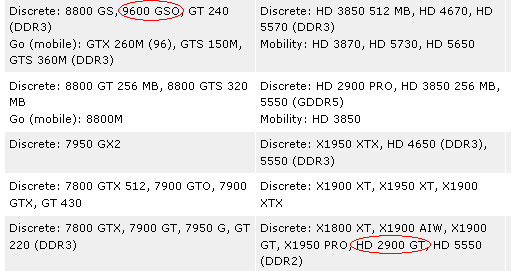
So the real question is what is the line where laptop GPUs become good enough to handle the demands of FFXIV? Let's go to the chart..
The two red circles are the first time our baseline cards appear in the list, and those two are fairly old GPUs. So it's pretty safe to assume we can work up the chart from here and extend out to include older models:
For NVidia: GeForce "Go" 8800M GTX or equivalent (9800M GTS, GTS 150M, GTX 260M-96core, GTS 360M w/ GDDR3)
For ATI/AMD: Mobility Radeon HD 3850 or better (4830, 5750)
- Navigation
Results 1 to 1 of 1
-
2010-12-28 14:44 #1My Little Ixion

- Join Date
- Aug 2007
- Posts
- 8,016
- BG Level
- 8
- FFXIV Character
- Olorin Bustyoas
- FFXIV Server
- Sargatanas
- FFXI Server
- Ramuh


Laptop Gaming Tech Guide (with Minimum Spec Guide for XIV!)